November 1, 2026
DeepSeek SuperAgent Explained: A Coding Agent That Works Beyond a Single Chat
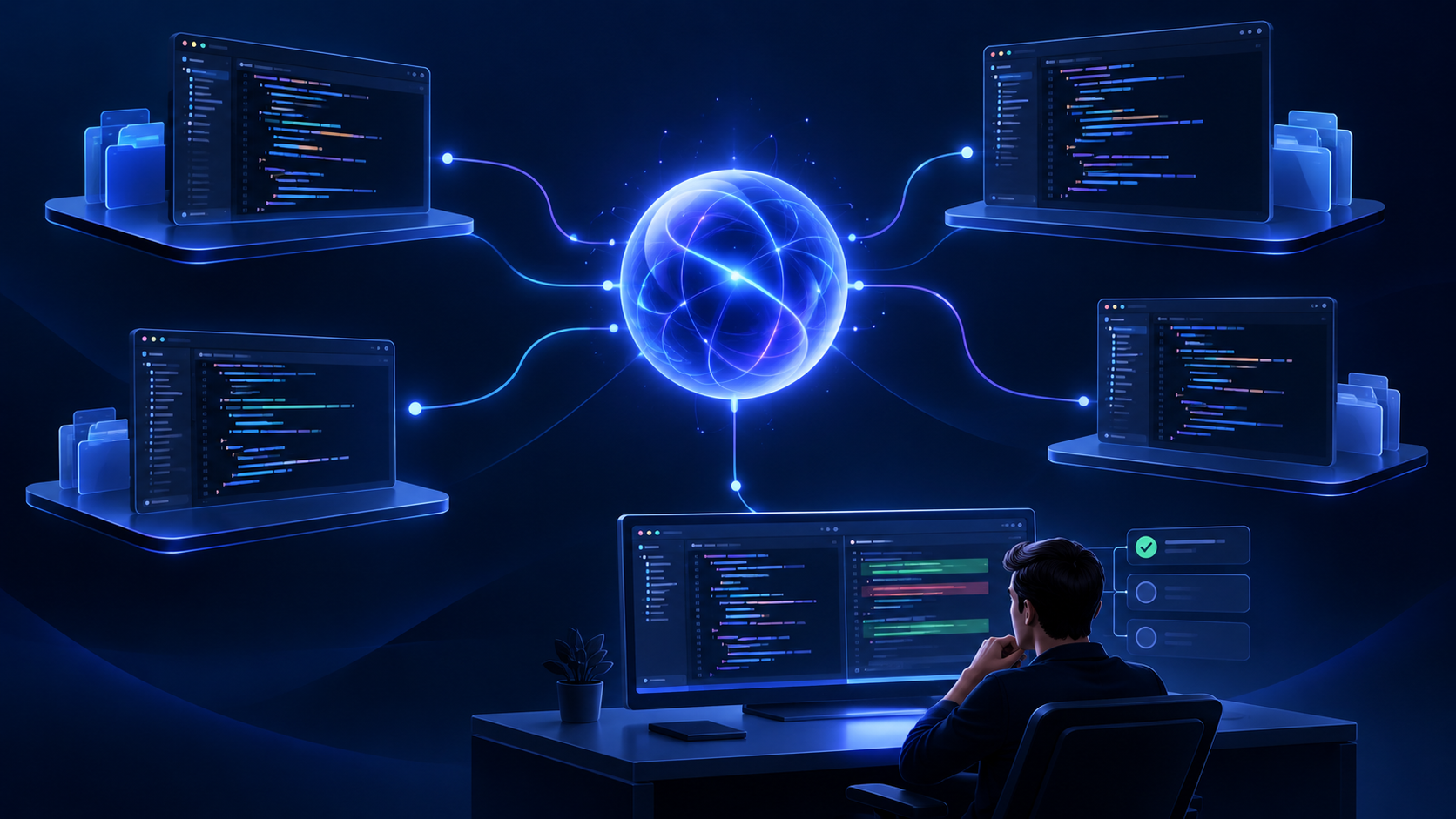
DeepSeek SuperAgent is an experimental coding-agent system designed to follow work across a GitHub repository. It can receive authorized requests, create separate work items, carry out tasks in their own sessions, and return results to the original conversation. Its bigger idea is continuity: the agent participates in a team's workflow instead of ending its involvement when one chat reply is finished.
Why the SuperAgent idea matters
Most coding agents are good at a bounded interaction: give them a task, let them inspect a project, and review the answer or patch. Real software work is less tidy. A bug report may start in a conversation, move to an issue, produce a pull request, and return days later when a test fails or a reviewer asks for a change.
SuperAgent explores what it takes to keep that thread of work moving. Its design treats incoming activity, authorization, task ownership, execution, and communication as parts of one system. The model is still important, but the surrounding workflow determines when it should act, what context it receives, and when a person needs to step in.
This is an architectural direction, not evidence that an agent can safely run an entire engineering organization on its own.
How does DeepSeek SuperAgent work?
The public prototype focuses on one GitHub repository. GitHub is a source of work; Feishu can optionally provide another entry point. The project describes a flow in which eligible requests become work items, each handled by an agent session in its own directory. A web panel surfaces work that needs human attention.
The separation matters when several things happen at once. A routing session can handle incoming activity while workers focus on individual tasks. The execution documentation also describes concurrency limits and gives a person's follow-up or status request priority access to an additional slot. This is a practical way to keep new work from crowding out a human trying to continue an existing task.
A concrete example
Imagine an authorized teammate asks the agent in a GitHub issue to investigate a failing test. The system can open a work item, prepare a separate working directory, inspect the failure, and propose a fix in a pull request. A later review comment can provide context for continuing the work. Whether it succeeds depends on the environment, permissions, task and implementation; this is an illustrative workflow, not a demonstrated guarantee.
How is it different from a typical coding assistant?
| Question | Single-task assistant | SuperAgent prototype |
|---|---|---|
| Where does work begin? | Usually an interactive prompt or task. | Connected repository activity and eligible requests. |
| How is work organized? | Often around one session. | Work items with separate execution sessions and directories. |
| What happens afterward? | A person typically starts the next interaction. | The system is designed to route follow-ups and report in the originating conversation. |
| What keeps activity useful? | Instructions and review within the task. | Authorization, written rules, routing, a human-attention panel, and operator oversight. |
These are broad workflow differences, not a ranking. Other coding agents can also run asynchronously, handle pull requests, or use multiple sessions. What is distinctive here is the particular combination and the explicit goal of reducing the attention a team spends managing the agent.
Autonomy starts with authorization
The project’s philosophy is direct: the agent should act when an allowed person asks it to, or when a team-written rule authorizes the work. For work that nobody explicitly requested, the documentation says to start in a mode that records what the agent would have done. That makes proposed behavior visible before an operator broadens its authority.
There are two different questions here: should this event become work? and what can the worker do once it starts? A legitimate request does not make every command or external action appropriate. Teams still need to review credentials, repository access, execution boundaries, and the consequences of the tools they enable.
Separate working directories help organize concurrent changes, but a directory or Git worktree alone is not a security sandbox. Treat issue text, comments, logs, and repository content as untrusted input, and keep a human review step for changes with real-world impact.
Where could it be useful?
- Issue investigation: reproduce a reported failure and prepare a concise diagnosis or proposed patch.
- Pull request follow-up: respond to relevant review feedback and investigate failing checks.
- Maintenance tasks: handle clearly scoped updates where a team can define acceptance criteria and verify the output.
- Research into agent operations: examine routing, permissions, state, and the cost of interruptions across a longer workflow.
These are possible applications of the design, not a claim that every workflow is implemented or reliable out of the box. The prototype’s own documentation should be the starting point for evaluating a specific integration.
What are the limitations?
It is research code. The maintainers warn about bugs and inconsistent engineering practices and ask users to review and adapt it. Features described in the broader research should not be assumed to exist in the public prototype.
It has a defined scope. The README describes a proactive coding agent for one GitHub repository, with optional Feishu input. It should not be presented as a general-purpose agent that can manage any business process.
More autonomy creates operational costs. A poorly scoped agent can produce noisy messages, unnecessary pull requests, unsafe changes, or unexpected model and infrastructure costs. Tests can catch some failures, but they cannot establish that an agent understood a team's intent.
Performance is context-dependent. The architecture is interesting, but a team's actual results depend on its codebase, tasks, model, configuration, and review process. Do not treat a small experiment or a demo as a guaranteed productivity gain.
How to evaluate it responsibly
- Read the repository and setup guide. Understand what the public code implements and which services and credentials it requires before installing anything.
- Choose a low-risk test repository. Start with a small allowlist and limited permissions, using non-sensitive data and a spending limit appropriate to the experiment.
- Define a narrow task. For example, ask for a diagnosis of one test failure, with a clear definition of done and no automatic merge or deployment.
- Review its decisions and output. Inspect the proposed diff, test results, external messages, and resource use. Measure whether it saves attention as well as time.
- Expand only after evidence. Add permissions, event sources, or proactive rules gradually, based on observed behavior and the team’s tolerance for mistakes.
The project offers an agent-assisted setup path in its setup guide. Because it is a research prototype, review the instructions and environment before allowing an agent to execute them.
Inside the architecture: from event to reviewable work
A persistent agent has to do more than generate code. It must distinguish a new task from a follow-up, decide who owns it, preserve enough context to continue, and make progress without blocking other requests. The public prototype organizes this around sources, work items and execution sessions.
Sources turn activity into context
A source connects the system to a place where work happens. GitHub provides repository activity; Feishu is optional. An incoming event is not automatically a command. The system must interpret the message in context, determine whether it is eligible, and decide whether it belongs to an existing work item or warrants a new one. This distinction matters when a discussion contains ordinary conversation alongside a direct request to the agent.
Routing keeps coordination separate from implementation
The main session handles routing decisions, while an executor works on an individual ticket. This separation gives the system a way to receive new events while a worker is busy with code. A worker can carry out a longer investigation without requiring the routing session to hold the entire implementation in its own active context.
That does not make task boundaries self-evident. Two reports may describe the same defect, and a review comment can change the scope of a task. A useful system must attach related context carefully and avoid turning every message into a separate job. The quality of that routing deserves its own evaluation, alongside the quality of the resulting code.
Execution needs state as well as tools
The project prepares a directory for a ticket before work starts; its documentation gives a Git worktree as a typical preparation method. A separate directory helps prevent simultaneous tasks from stepping on each other's uncommitted changes. It also gives each task a place to run checks and prepare a branch. Preparation can fail, and the failure itself must be visible rather than silently treated as completed work.
The executor can report progress or an outcome and associate a pull request with the work item under the project's rules. The pull request is a useful handoff because it gives reviewers a concrete diff, test results, and a place to discuss changes. The important output is not merely that the agent was active; it is whether the team can understand and verify what it produced.
Decision: Was the event eligible and routed to the right task?
Execution: Did the worker make an appropriate, tested change within its permissions?
Handoff: Can a person review the result and understand any uncertainty or remaining work?
What “proactive” should mean in practice
Proactivity is often confused with unrestricted initiative. In this design, an agent can be ready to respond to new information over time, but the decision to act remains bounded by requests and team-written rules. For example, a rule might permit the agent to examine a failed check on an existing agent-authored pull request. The rule should specify the trigger, allowed actions, and when the agent must stop and ask a person.
Start by recording prospective actions before enabling autonomous execution. Review whether the proposed actions are relevant, correctly scoped, and worth their cost. A rule that catches too many events may create noise even if every individual action looks reasonable. Conversely, a rule that is too narrow can miss useful follow-ups. Adjust it using actual examples rather than a vague instruction to “be proactive.”
Good escalation is part of the system
An agent should not guess when the choice changes product behavior, access, spending, or data. A useful escalation states the decision, explains the practical consequence of each option, and includes the evidence already gathered. For routine implementation details, the worker can often proceed to a reviewable result. The aim is to reserve interruptions for decisions that need an owner.
A worked example: a failing pull request check
- Event: A check fails on a pull request associated with an existing task. The event enters through the repository source.
- Context: The system associates the failure with the relevant work item and gives the worker the check output and surrounding task context.
- Investigation: The worker inspects the failure and decides whether it stems from its changes, an unrelated flaky test, or missing information. Logs and comments are data, not authority to change the task.
- Action: If the correction is within the team's rules, the worker prepares a focused change and runs relevant checks. If the required change alters the product contract, it pauses for a decision.
- Handoff: The worker reports the change, the checks it actually ran, and unresolved issues in the relevant conversation. A reviewer remains responsible for accepting the pull request.
This example illustrates a sensible operating policy; it is not a claim that every deployment will handle each step automatically. Configuration, permissions, and the prototype's implementation determine the actual behavior.
How should a team measure an experiment?
Measure the entire workflow, not just how quickly a patch appears. Start with a small set of representative tasks and compare them with your team's normal process. Keep the tasks and acceptance criteria comparable, and record cases where the agent needed a retry or a human intervention.
| Measure | What it reveals | Question to ask |
|---|---|---|
| Time to reviewable result | How long it takes to produce a useful handoff. | Did the result include enough context and verification? |
| Human attention | Review, clarification and cleanup effort. | Did the team save time after correcting mistakes? |
| Correctness and rework | Whether changes satisfy the task and survive review. | How often did people need to substantially revise the work? |
| Noise and routing | Unnecessary messages, duplicate tasks and missed follow-ups. | Did the agent act on the right events? |
| Cost and boundaries | Model usage, infrastructure expense and permission behavior. | Was the outcome worth the cost, and did actions stay within policy? |
Track failed and abandoned tasks as well as successful ones. A fast result that requires extensive review may be less valuable than a slower result a reviewer can trust. Record the sample size and task mix before drawing conclusions.
DeepSeek Harness, the model, and SuperAgent
These names describe different layers. The model generates and reasons over information; DeepSeek Harness supplies an agent environment with tools and sessions; dsh-superagent adds a workflow for receiving and coordinating repository work. Replacing or improving one layer does not automatically solve problems in the others. A stronger model can still be routed the wrong task, receive excessive permissions, or produce a change that needs review.
For developers exploring DeepSeek-powered coding workflows, access and usage limits should be assessed separately from this research prototype. Available Coding Plans are inventory-backed and their terms are shown on the pricing page.
Review available options and their current terms before choosing a plan.
View pricing →Frequently asked questions
Is DeepSeek SuperAgent a new AI model?
No. The public project is a coding-agent system packaged for DeepSeek Harness. A model supplies reasoning and generation, while the surrounding system handles tasks, tools, permissions, and communication.
Is it open source?
Yes. The public repository is available under the MIT license. Check the repository for the license terms and any changes to the project.
Is it ready for production?
The repository says it is not production-ready. Teams should treat it as research code, inspect it, and evaluate it in a controlled environment before considering broader use.
Can it work without human supervision?
The design aims to reduce routine interruptions, but it still depends on explicit authorization, operator configuration, and human judgment. Reduced interruption is not the same as eliminating accountability.