Kimi K3.1 Pro launches: one-third cheaper than K3, with weights due by November 4
TL;DRKimi K3.1 Pro is live, with a 1-million-token context window and API prices of $2 for input and $10 for output per million tokens. Highspeed doubles those input and output prices. Kimi promises model weights by November 4; its performance claims still need independent testing.
By AI Fan
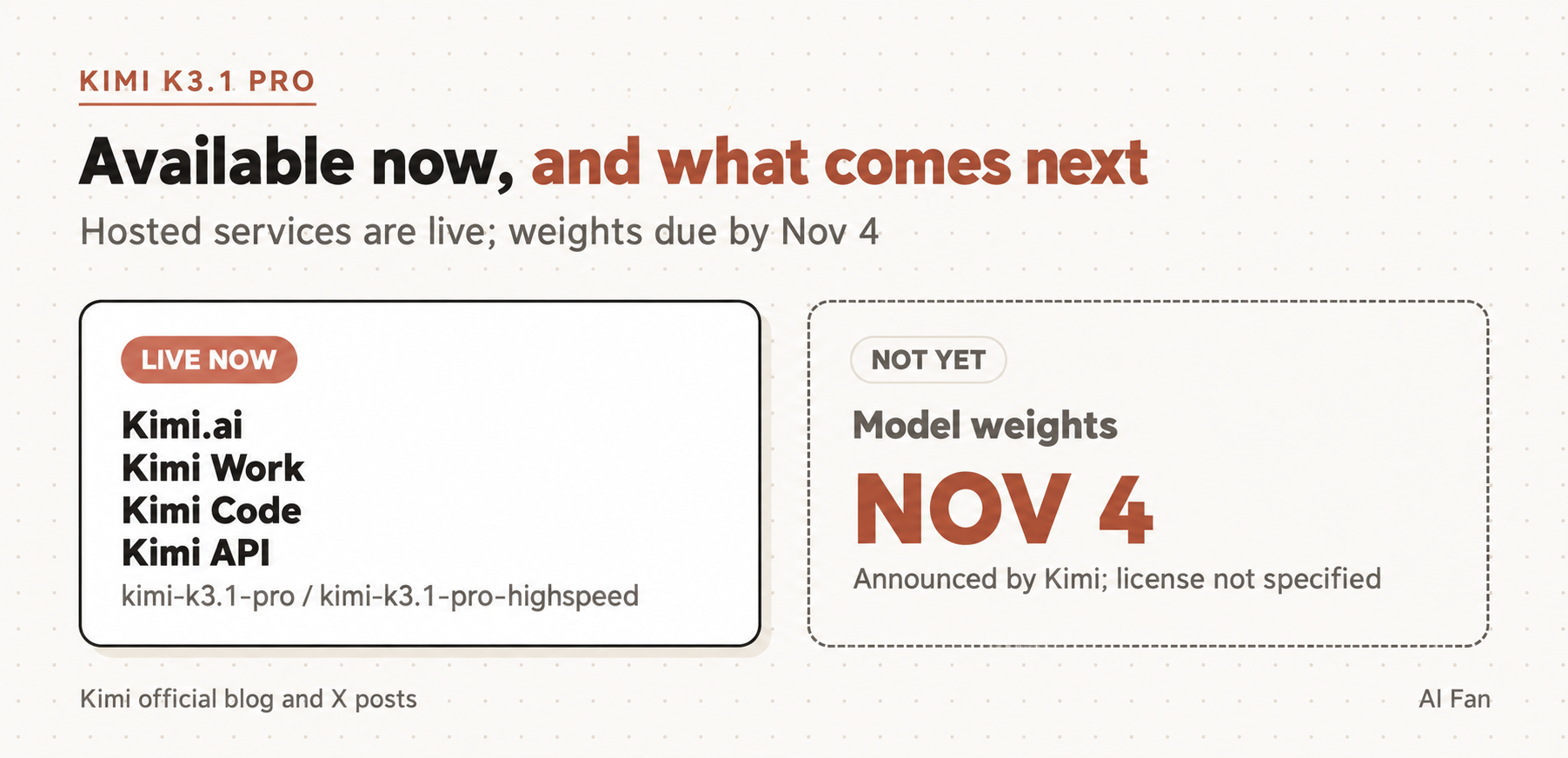
Kimi K3.1 Pro launched early on October 23. You can use it through hosted services now, but anyone hoping to deploy it themselves will have to wait. Kimi says it will release the weights by November 4.
The company says the model matches the strongest proprietary models on coding and agent tasks. For now, that claim rests on its own results. Independent evaluations have yet to establish how well it holds up.
Who can use Kimi K3.1 Pro now?
There are four launch entry points: Kimi.ai, Kimi Work, Kimi Code and the Kimi API. The API model ID is kimi-k3.1-pro.
There is also a Highspeed version, kimi-k3.1-pro-highspeed, which Kimi says runs two to three times faster. The official pricing page lists the same capabilities and context length as the standard version.
Enterprise users have an extra step. Kimi says administrators can enable the model for their organizations in Kimi Enterprise; it is switched off by default at launch.
The weights are the part you cannot use yet. Kimi's launch post names November 4 as the release date, while its blog says they will arrive by November 4. The announcement does not specify a license.
Kimi lists a 1-million-token context window, multimodal input and a mixture-of-experts architecture with 2.8 trillion total parameters, of which 104 billion are active per token. The company calls it a “3T-class” model; the stated total is 2.8T.
What do Kimi's own benchmarks show?
The results below come from Kimi's own tests. They have not been independently reproduced.
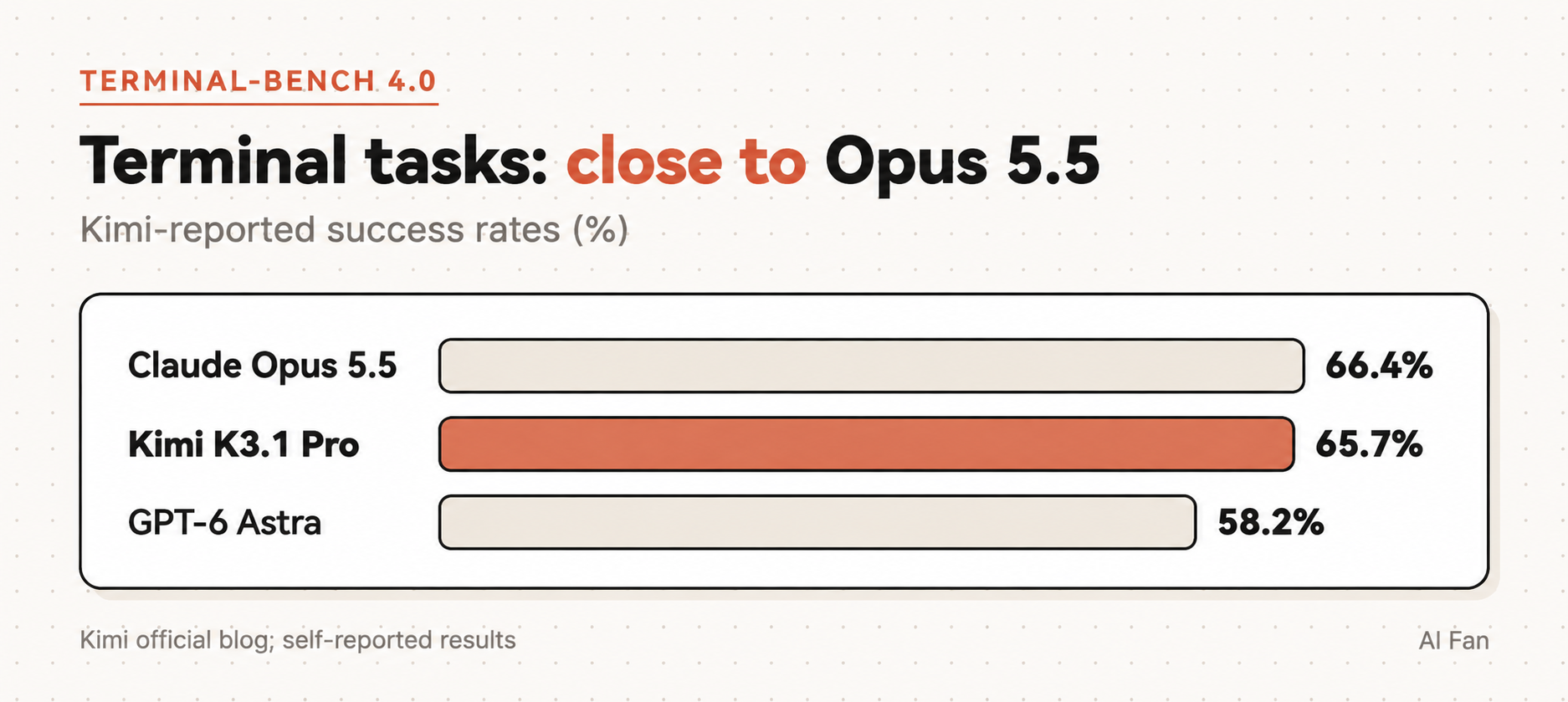
Terminal-Bench 4.0 measures a model's ability to carry out tasks in a terminal. K3.1 Pro scores 65.7%, close to Claude Opus 5.5 at 66.4% and ahead of GPT-6 Astra at 58.2%. Kimi also reports an improvement over K3 on long-running coding tasks.
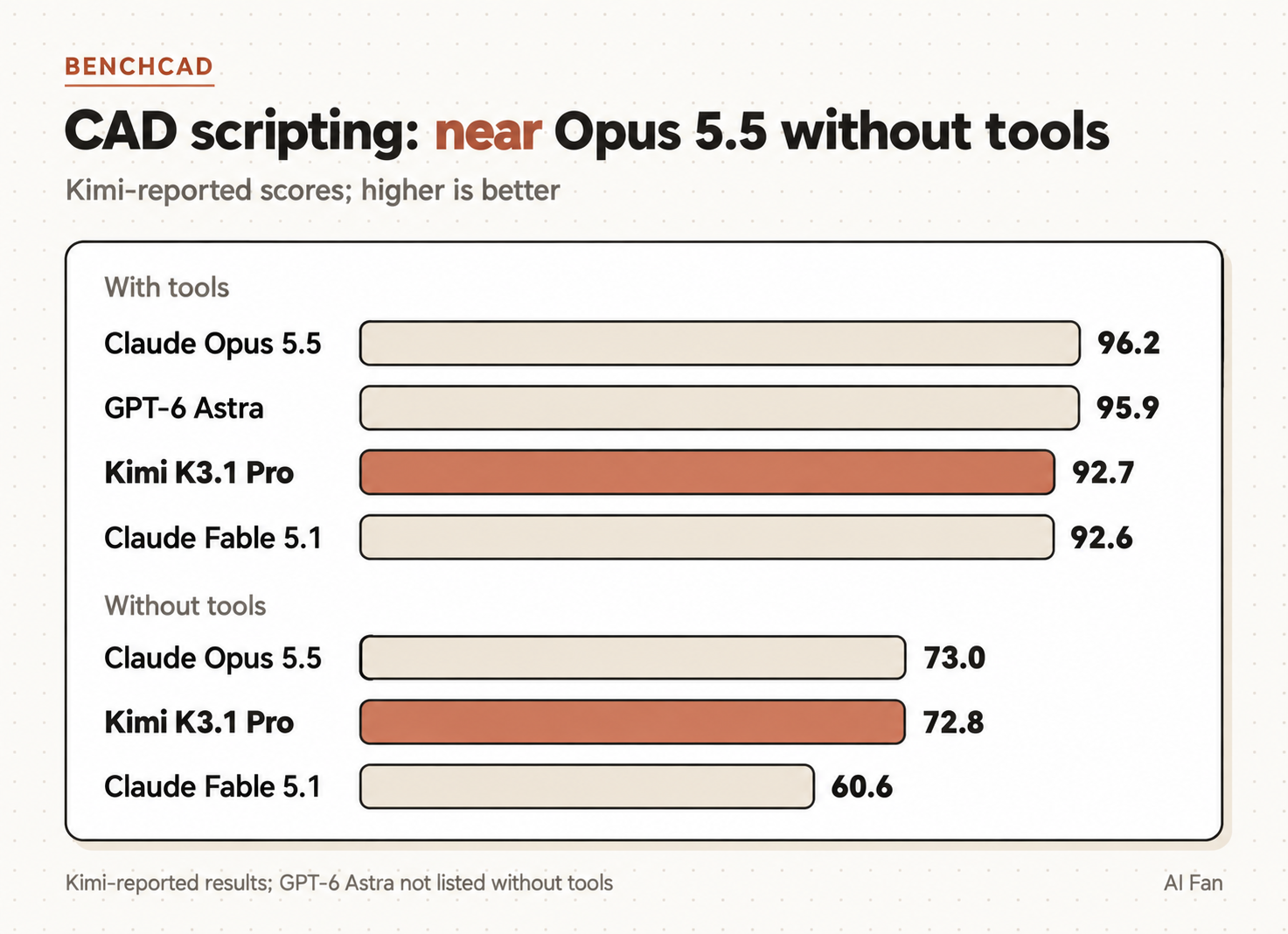
3D and CAD are a major focus of this release. BenchCAD asks a model to reconstruct a 3D shape in CAD code from rendered views taken at different angles. It scores the result by voxel overlap.
With tools, K3.1 Pro trails Opus 5.5 and GPT-6 Astra slightly and scores about the same as Claude Fable 5.1. Without tools, it is effectively level with Opus 5.5 and well ahead of Fable 5.1.
Fewer hallucinations are another selling point. The launch-day chart reproduced below puts K3.1 Pro's claim-level hallucination rate at 8.3%, down from K3's 23.4%, a reduction of about 65%. Opus 5.5 has a higher rate in that comparison; GPT-6 Astra has a lower one.
Kimi describes this as a stress test built around deliberately difficult questions. The figures do not represent the overall error rate in everyday use.
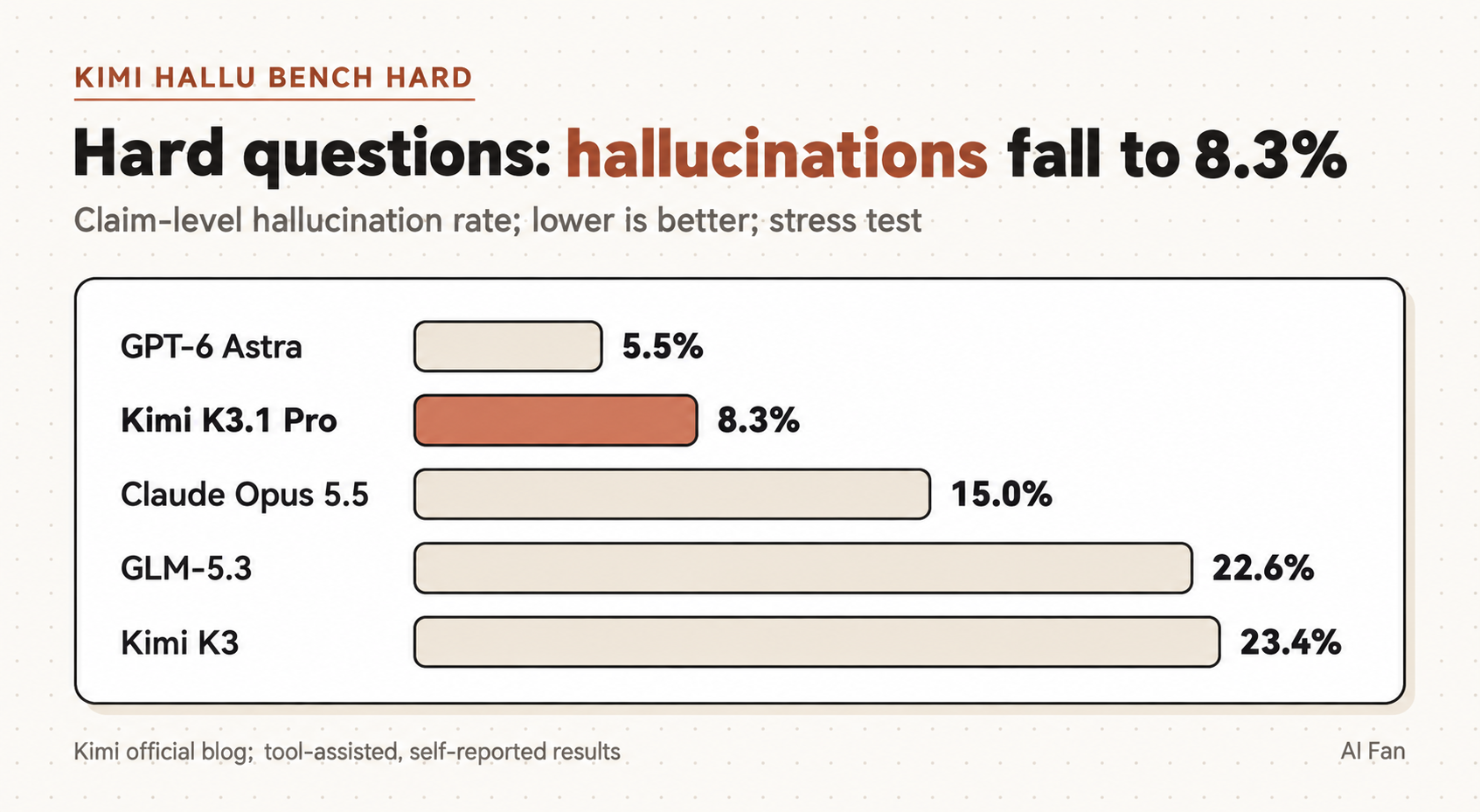
Kimi's API quickstart currently reports a different claim-level figure, 6.85%. The chart above retains the original article's 8.3%; the two published figures should not be treated as interchangeable.
On cybersecurity, Kimi says K3.1 Pro remains behind frontier proprietary models that have been publicly available for at least three months. It also says its goal is to avoid releasing open weights that would push the absolute frontier of cyber capability further.
Independent results are still pending in this launch-day account. Artificial Analysis had not yet listed K3.1 Pro when the original report was written. Under AA's scoring at that point, K3 (max) scored 44, while the leader, Claude Opus 5.5, scored 58. Where the new model lands will depend on AA's own evaluation.
How much does the API cost?
K3.1 Pro costs $2 per million input tokens and $10 per million output tokens, one-third less than K3's $3 and $15. Highspeed charges twice the standard version's input and output rates: $4 and $20.
| Model | Input | Output | Cache hit |
|---|---|---|---|
| Kimi K3 | $3.00 | $15.00 | $0.30 |
| Kimi K3.1 Pro | $2.00 | $10.00 | $0.20 |
| K3.1 Pro Highspeed | $4.00 | $20.00 | $0.20 |
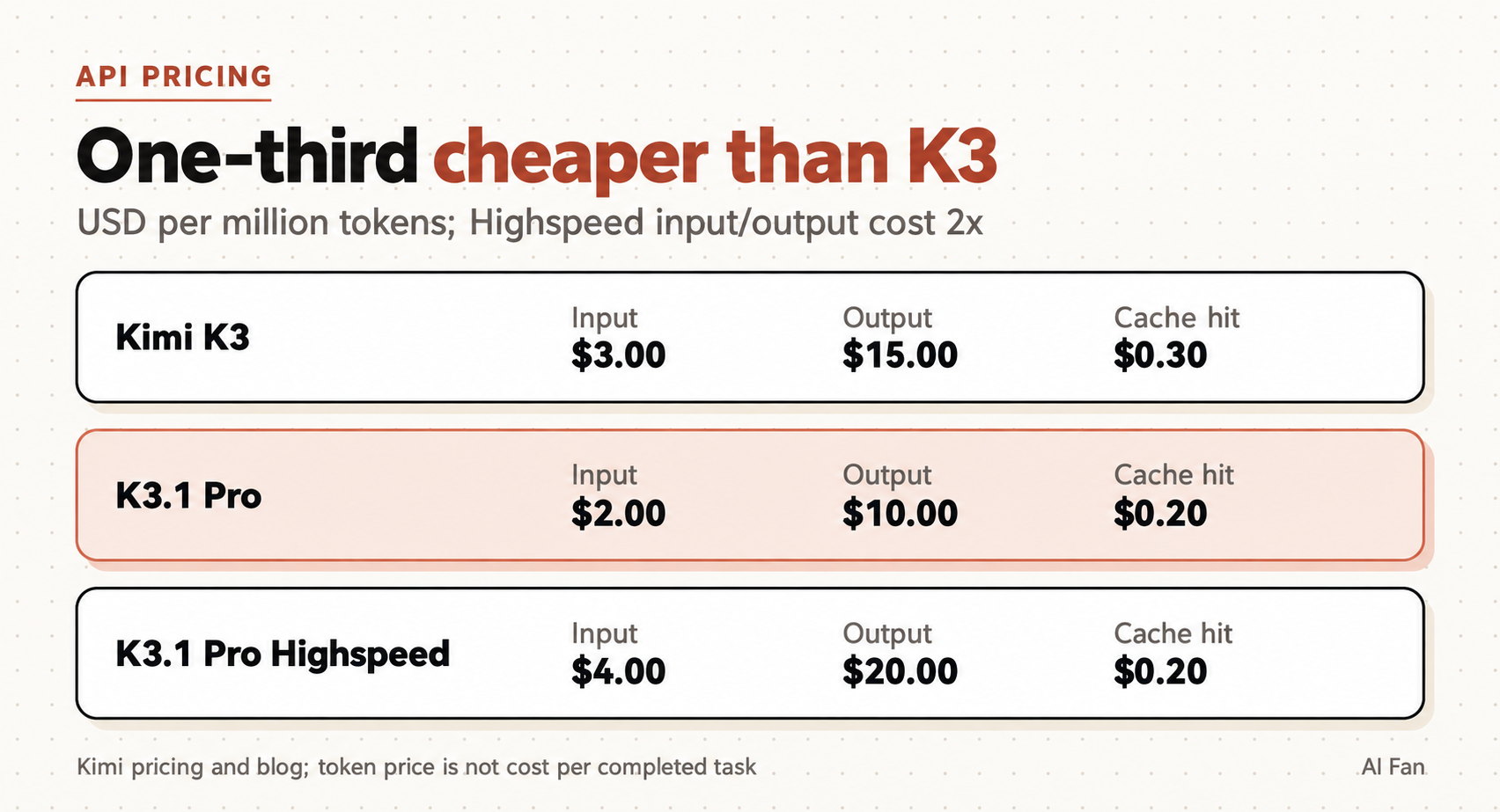
That is as far as the value comparison can go for now: nearly level with Opus 5.5 on Kimi's Terminal-Bench run, at a token price one-third below its own predecessor. A fair score-versus-cost comparison with other providers needs comparable independent results. This launch-day report does not yet have enough to draw that chart.
A price per million tokens is also different from the cost of finishing a task.
The blind tests mostly show things that look good
In the days before launch, an anonymous Arena model called Kibitz drew attention. Many users thought it was K3.1, but Kimi did not confirm the connection. Arena versions are often early checkpoints and can differ from the release. The examples below came from those blind tests.
@k2sbhai used a single prompt to build a BMW M5 configurator in Three.js. It let users change the paint, open the doors and switch camera angles.
@abhinavflac compared Qwen 4 and Kimi using the same “voxel cherry-blossom valley” prompt. Kimi's scene leaned toward realism, with fog, distant mountains and a red bridge across a river. Qwen 4 used more purple and pink, with larger blocks.
@chetaslua put Kimi and Claude Fable 5.5 through the familiar SVG test of a pelican riding a bicycle. His verdict was simply, “we are eating well this week”.
There were less flattering examples, too. @Haleeeemahh compared four models on an animation of a running giraffe. Kimi's giraffe had a short body and thin legs; Gemini was the tester's final pick.
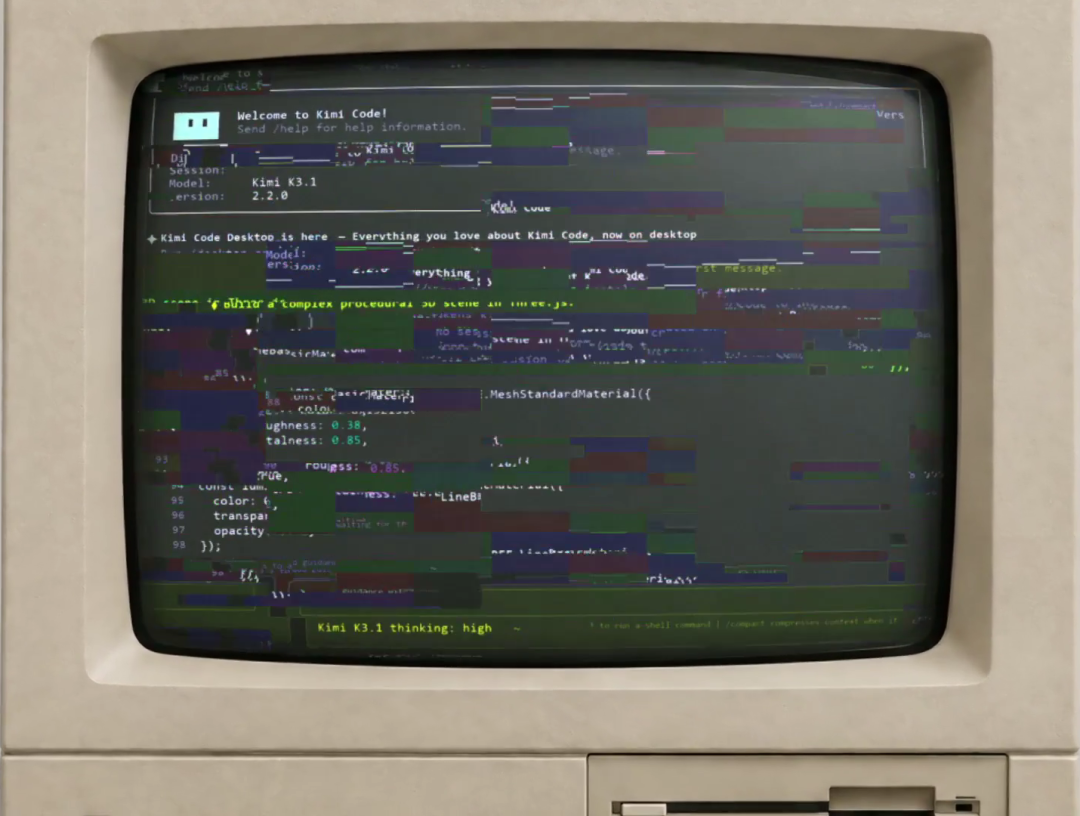
The official teaser followed much the same pattern. A terminal prompt read “Build a complex procedural 3D scene in Three.js”, followed by particles, wireframes and 3D scenes.
What still deserves skepticism?
The biggest issue is that Kimi produced the scorecard itself. It also says some competing models found reference answers online during OfficeQA Pro and received zero for those questions. That scoring decision lowers their results, so the comparison needs to be read with care.
Community feedback is scattered. @Fei2411 reported seeing 117 tokens per second, and @ai_funss reported about 120. Neither personal test identified whether it used the standard or Highspeed version. The original report had no corresponding official measurement.
@akazwz_ said an existing Kimi Code 699 subscription began consuming its five-hour allowance noticeably faster after switching to K3.1 Pro. That observation also lacked an official explanation.
The examples collected in the original report were almost all 3D and SVG generation. They did not include hands-on tests of long-running agents or large-codebase refactoring.
What comes next?
K3 launched on July 16. K3.1 Pro arrived just over three months later, a quick turnaround.
For now, the launch and pricing are the firm parts of the story. The weight-release date is still a promise. Whether K3.1 Pro really approaches Opus 5.5 will take independent evaluations and reproducible tests after the weights arrive.