Updated 2026-11-26 · Cameron Voss
DeepSeek V4.1 Flash Pricing: Cost for 1M Tokens & API Requests
A coding agent can read twelve million input tokens for less than a dollar. How much of the prompt repeats, how long the answers run, and when the requests land determine whether that estimate holds. DeepSeek publishes three numbers for Flash: cache-hit input, cache-miss input, and output. Everything below comes from those three rates, the peak schedule, and token counts you can check yourself.
What are the official DeepSeek V4.1 Flash rates?
The current model ID is deepseek-flash, served by DeepSeek-V4.1-Flash-1017. The same model answers to the legacy IDs deepseek-v4-flash and deepseek-v4-flash-vision-exp at the same price. Context is 1M tokens, max output is 384K, vision works on Flash, thinking is the default mode, and the concurrency limit is 2,500.
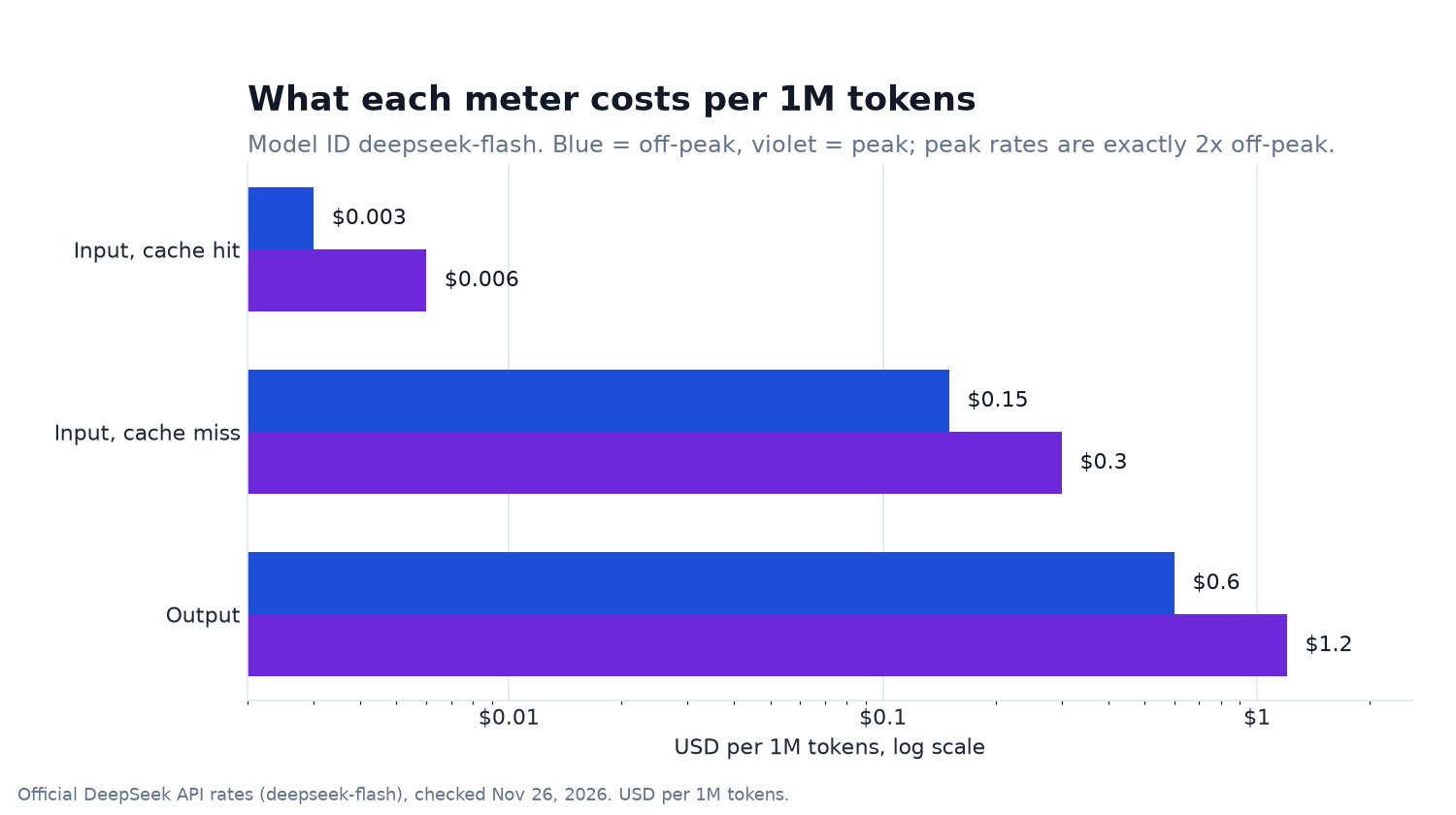
| Meter | Off-peak | Peak |
|---|---|---|
| Input, cache hit | $0.003 | $0.006 |
| Input, cache miss | $0.15 | $0.30 |
| Output | $0.60 | $1.20 |
Peak hours: 01:00-04:00 and 06:00-10:00 UTC, Monday to Friday, excluding Chinese public holidays. All other hours, plus full weekends and holidays, are off-peak. Off-peak is exactly half of peak.
During standard time in the eastern US, peak lands at 20:00-23:00 on the previous calendar day and 01:00-05:00. In Central European standard time it is 02:00-05:00 and 07:00-11:00. A batch job that can move out of those windows pays half.
How much do one million tokens cost?
A token is billed once, at the rate for its direction and cache state. The 1M figure is also the context ceiling, but filling the window is not a flat fee. The table below prices 1M tokens under several assumptions.
| Case | Off-peak | Peak |
|---|---|---|
| 1M input, 0% cache hit | $0.150 | $0.300 |
| 1M input, 50% cache hit | $0.0765 | $0.1530 |
| 1M input, 90% cache hit | $0.0177 | $0.0354 |
| 1M input, 100% cache hit | $0.003 | $0.006 |
| 1M output | $0.600 | $1.200 |
| 1M total: 90% input at 90% hit, 10% output | $0.07593 | $0.15186 |
| 1M total: 75% input at 90% hit, 25% output | $0.163275 | $0.32655 |
The two mixed rows use 1M tokens in total, not 1M input tokens plus output.
A 100% hit rate puts 1M input tokens at $0.003, which is 98% below the $0.15 miss rate. Output has no cache tier. That is why the same token count can produce very different bills.
For a single long call, a full 1M-token prompt with a 1,000-token answer costs $0.1506 off-peak and $0.3012 at peak at zero hits. At a 90% hit rate those totals fall to $0.0183 and $0.0366. A response can run to the 384K output ceiling, which costs $0.2304 off-peak and $0.4608 at peak before any input is counted.
If your coding agent runs every day, use a typical week of requests to compare the two options. Estimate your API spend with the rates above, then check which plan covers your busiest week at a price that fits your budget. You can compare allowances and monthly prices on our DeepSeek subscription page..
What do 1,000 requests cost?
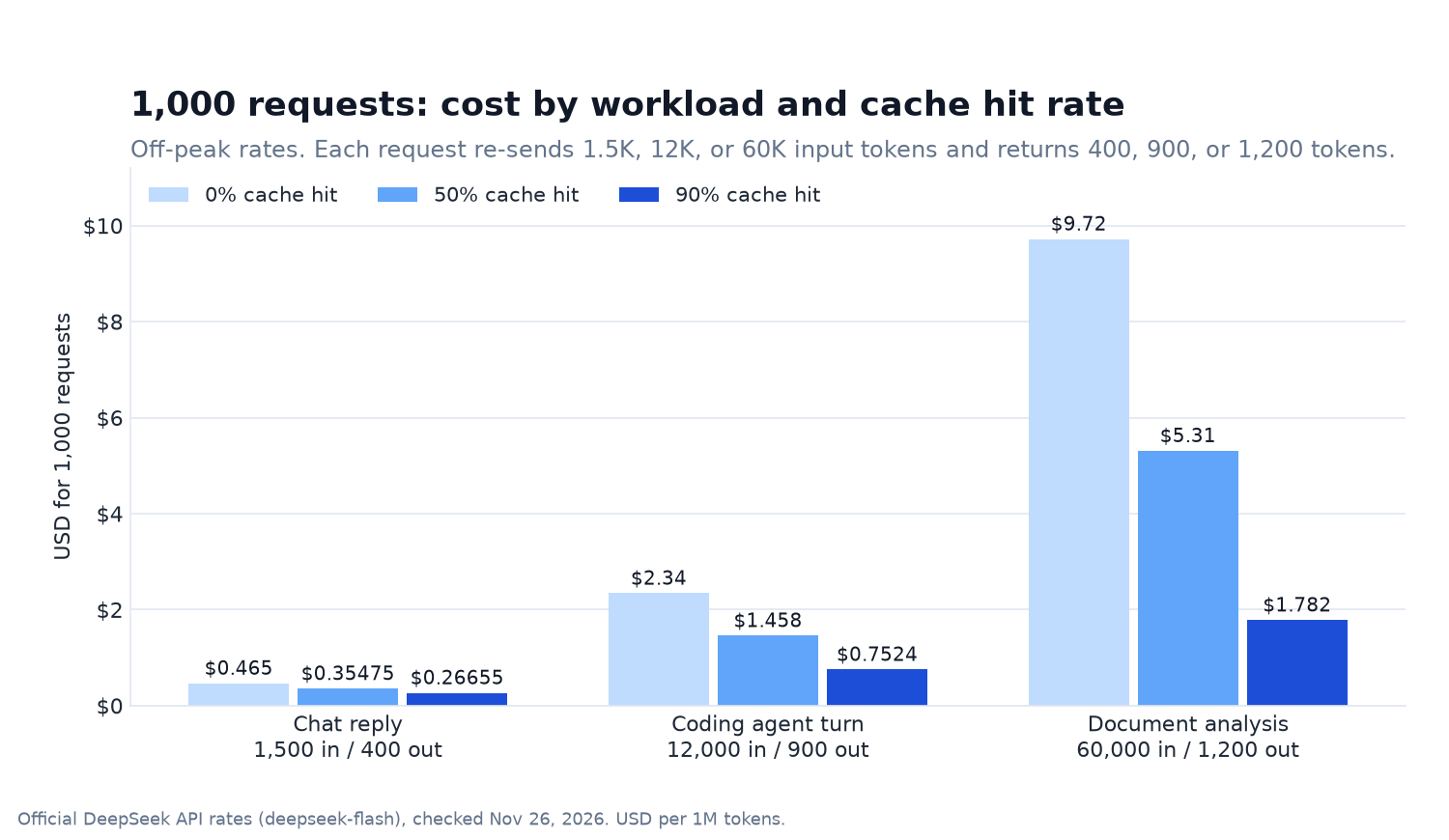
A request count is not a price. The bill depends on tokens per request and the cache hit rate. Three reference profiles below keep the arithmetic checkable. They are assumptions, not measurements.
| Workload | Tokens per requestinput / output | 0% hit | 50% hit | 90% hit | Peak, 90% hit |
|---|---|---|---|---|---|
| Chat reply | 1,500 / 400 | $0.465 | $0.35475 | $0.26655 | $0.5331 |
| Coding agent turn | 12,000 / 900 | $2.34 | $1.458 | $0.7524 | $1.5048 |
| Document analysis | 60,000 / 1,200 | $9.72 | $5.31 | $1.782 | $3.564 |
A coding-agent request costs $0.000752 at a 90% hit rate. Run 1,000 per day for 30 days and the bill is $22.57. At zero hits, the same 30,000 requests cost $70.20. Document analysis costs $53.46 for 30,000 requests at 90% hits, against $291.60 with no hits. Chat stays cheap either way: $8.00 against $13.95.
These totals move with the assumptions. A coding agent that resends 30K tokens per turn instead of 12K multiplies the input side by 2.5. A chat product that returns 1,500 tokens instead of 400 multiplies the output side by 3.75.
Reading a coding agent’s bill
Take the 1,000-request run with 12,000 input and 900 output tokens per call. At a 90% input cache hit rate, the off-peak invoice has three parts.
10.8M cached input tokens × $0.003 per million = $0.0324.
1.2M uncached input tokens × $0.15 per million = $0.18.
0.9M output tokens × $0.60 per million = $0.54.
The total is $0.7524. Raising the hit rate from 90% to 95% saves $0.0882 across the run. Trimming 150 output tokens from each answer saves $0.09. For an agent that needs to return a complete patch, improving prefix reuse buys nearly the same saving while preserving the answer.
How much does the cache hit rate change the bill?
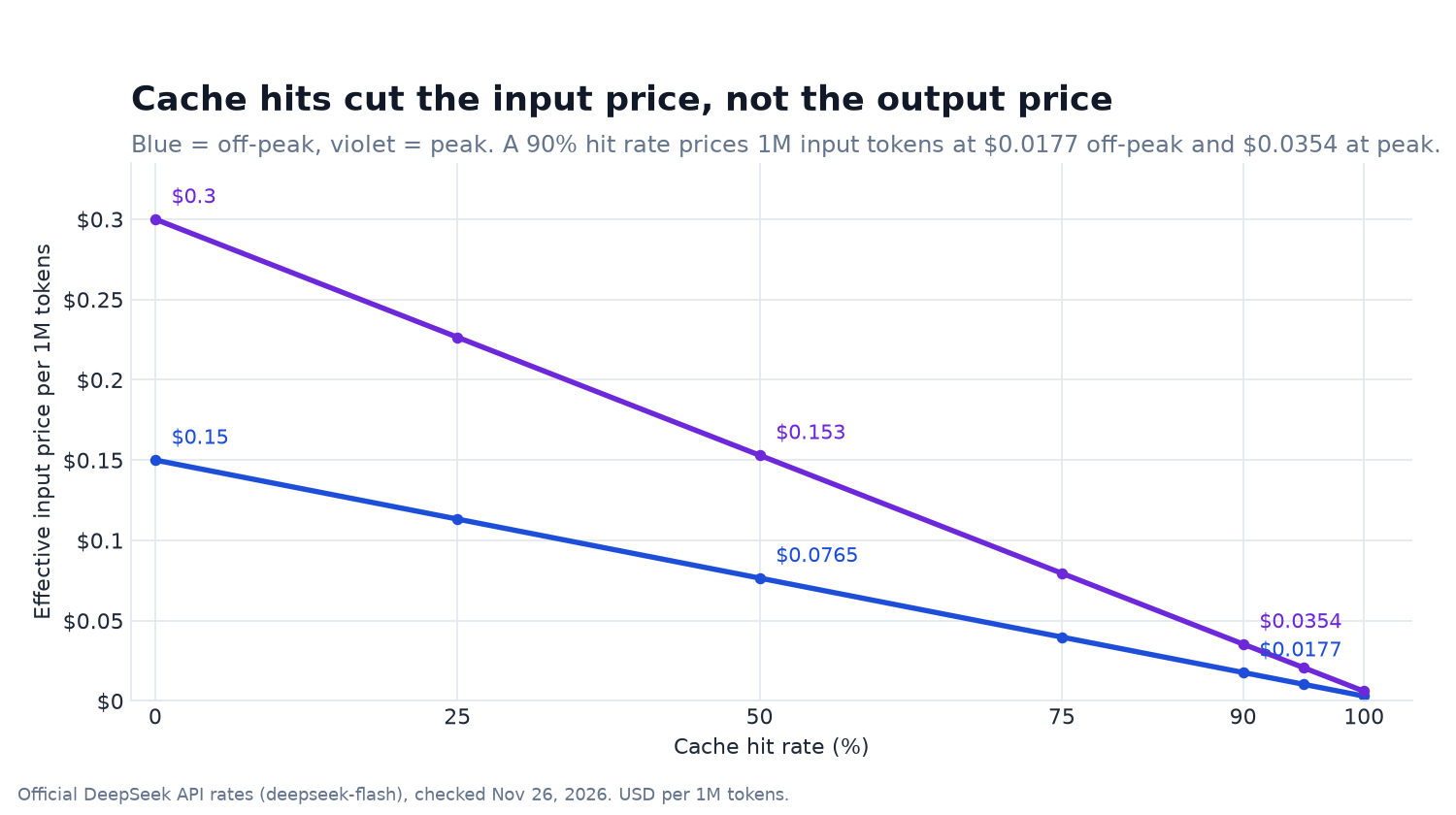
The effective input rate is a weighted average of the hit and miss prices:
Group usage by peak and off-peak hours. Within each group, divide the sum of cached input tokens by total input tokens to get h. Averaging the hit percentages per request gives a short chat turn the same weight as a repository scan. Calculate each group’s cost using its own rates, then add the totals.
| Cache hit rate | Off-peak | Peak | Saving vs 0% |
|---|---|---|---|
| 0% | $0.150 | $0.300 | 0.0% |
| 25% | $0.1133 | $0.2265 | 24.5% |
| 50% | $0.0765 | $0.1530 | 49.0% |
| 75% | $0.0398 | $0.0795 | 73.5% |
| 90% | $0.0177 | $0.0354 | 88.2% |
| 95% | $0.0104 | $0.0207 | 93.1% |
| 100% | $0.003 | $0.006 | 98.0% |
effective input rate = h * 0.003 + (1 - h) * 0.15 # off-peak, USD per 1MHere h is the share of input tokens that hit the cache. At peak, use $0.006 and $0.30. The result is linear in h, so every 10 percentage points of hit rate removes $0.0147 per 1M input tokens off-peak, or $0.0294 at peak.
DeepSeek matches repeated prefixes automatically. The lever you control is request order: system prompt, tool definitions, and reference documents first, the changing user turn last. A timestamp or request ID near the top of the prompt resets the prefix and turns hits into misses. The pricing page lists no separate cache write or storage fee, so matching tokens pay the hit rate and the rest pay the miss rate.
How does the input/output split change the total?
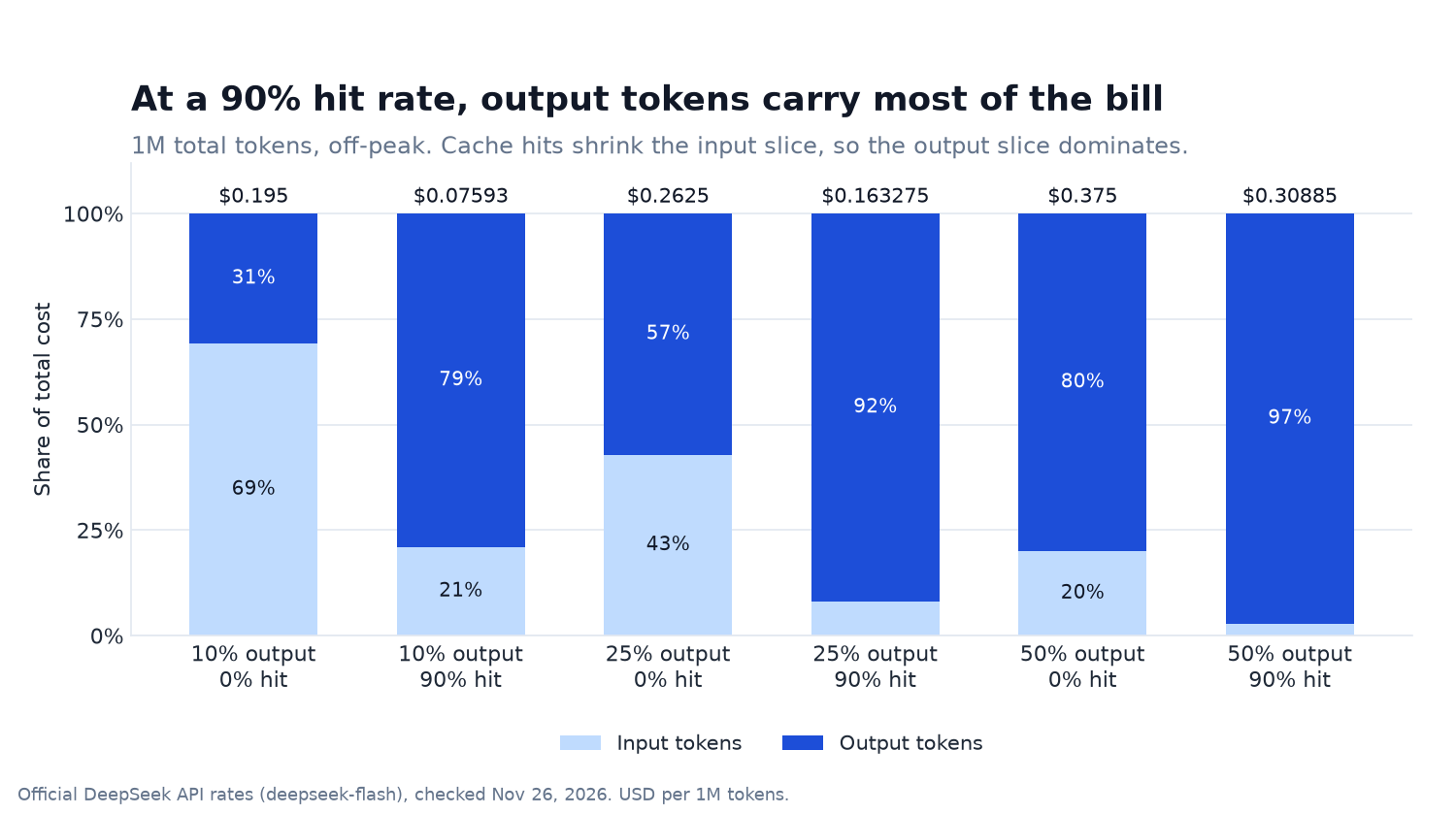
An output token lists at 4x a cache-miss input token and 200x a cache-hit input token. Once caching is in play, the token split matters more than the raw token count.
| Output share of tokens | Bill at 0% hit | Output share of bill | Bill at 90% hit | Output share of bill |
|---|---|---|---|---|
| 10% | $0.195 | 30.8% | $0.07593 | 79.0% |
| 25% | $0.2625 | 57.1% | $0.163275 | 91.9% |
| 50% | $0.375 | 80.0% | $0.30885 | 97.1% |
With no cache hits and a 10% output share, output is 30.8% of the bill. At a 90% hit rate, the same split puts 79.0% of the bill on output. At a 50/50 split and 90% hits, output is 97.1%. At that point, a lower max_tokens and a tighter answer format save more than another caching tweak. For input-heavy work the opposite holds: raising the hit rate is where the savings are.
What changed for search and web fetch on November 18, 2026?
At 12:00 Beijing time on November 18, 2026, server-side search and web fetch calls triggered inside a model request stopped being billed separately. The results are appended to the model context and billed as input tokens. The pricing page still lists $0.75 per 1,000 successful requests for the standalone Search and Fetch APIs.
Token billing depends on how much text each call adds. Using the $0.75 per 1,000 rate as a flat-fee reference, 1,000 searches that each append 2,000 tokens cost $0.30 off-peak or $0.60 at peak with no cache hits. The break-even is 5,000 appended tokens per search off-peak, or 2,500 at peak. Shorter results cost less than the flat fee. Longer results cost more.
| Tokens added per search | $0.75 per 1,000 reference | Token billing, off-peak | Token billing, peak |
|---|---|---|---|
| 2,000 | $0.75 | $0.30 | $0.60 |
| 5,000 | $0.75 | $0.75 | $1.50 |
| 10,000 | $0.75 | $1.50 | $3.00 |
How do you recompute this for your own workload?
Use the official rates and your own token counts. The formula is the same in both periods; peak multiplies all three rates by 2.
input_cost  = input_tokens  / 1e6 * (h * 0.003 + (1 - h) * 0.15)
output_cost = output_tokens / 1e6 * 0.60
total       = input_cost + output_cost          # off-peak, USD
Example: 1,000 requests, 8,000 input and 700 output tokens each, 85% cache hit. That is 8M input and 0.7M output tokens. The effective input rate is 0.85 * 0.003 + 0.15 * 0.15 = $0.02505 per 1M. Input costs $0.2004, output costs $0.42, and the total is $0.6204 off-peak or $1.2408 at peak. Per request, that is $0.0006204 off-peak.
FAQ
Does DeepSeek charge for cache writes or cache storage?
The pricing page lists three meters for deepseek-flash: cache-hit input, cache-miss input, and output. It lists no separate cache write or storage charge. You pay the hit rate for input tokens that match a cached prefix and the miss rate for the rest.
Is off-peak pricing always half of peak pricing?
Yes. DeepSeek states that off-peak rates are half of peak rates, and the three published Flash rates follow that rule exactly: $0.003 against $0.006 for cache-hit input, $0.15 against $0.30 for cache-miss input, and $0.60 against $1.20 for output.
Do the legacy deepseek-v4-flash model IDs cost more?
No. DeepSeek says requests sent to deepseek-v4-flash and deepseek-v4-flash-vision-exp are served by DeepSeek-V4.1-Flash-1017 and billed at the Flash price. Use deepseek-flash as the model name.
What is the largest output token bill for a single request?
Max output is 384K tokens on deepseek-flash. At $0.60 per 1M output tokens that is $0.2304 off-peak, or $0.4608 at peak, before any input tokens are counted.
Do search and web fetch cost extra after November 18, 2026?
For tool calls triggered inside a model request, no. Since 12:00 Beijing time on November 18, 2026, those calls are no longer billed separately. The results are appended to the model context and billed as input tokens. The pricing page still lists $0.75 per 1,000 successful requests for the standalone Search and Fetch APIs.