Updated November 16, 2026 · Cameron Voss and West Mao
Qwen4-Max: Cost, Benchmarks and How to Evaluate It (Nov 2026)
Announced list prices, checked November 16, 2026. Thinking tokens are billed as output.
- Nov 11Qwen 4 announced with a Max preview.
- Nov 11 to 15QoDuck runs anonymously in Qoder.
- Nov 16Qwen4-Max ships with pay-as-you-go API.
- NextSmaller Qwen 4 models promised with open weights.
The preview-to-launch sequence. The last box is a promise, not a date.
What changed since the preview
Five days ago the only Qwen 4 model you could touch was a preview with a stated retirement date. That window closed early: on November 16, 2026, Alibaba released Qwen4-Max as a product, with list pricing, a pay-as-you-go API and a benchmark table. If you built a test plan around a November 25 cutoff, the cutoff is no longer the thing to worry about. What matters now is whether the shipped model does your work.
The shape of the offer also changed. The preview was Token Plan only, and the guide published before this launch said so. Qwen4-Max can now be called with pay-as-you-go billing or through the Token Plan, and it is available in Qwen Studio, QwenWork and Qoder. The model is not open source; Alibaba says smaller Qwen 4 models will follow with open weights trained the same way.
One practical consequence: do not carry a model ID forward from a preview integration. Re-read the live model list on the service you use, because the stable release is a different offer even where the name looks similar.
What it costs, in dollars and in points
List prices are $1.50 per million input tokens, $4.50 per million output tokens and $0.07 per million implicit-cache tokens. The cache rate is about 5% of the fresh input rate, so replayed context is cheap and fresh context is not.
Work through one job: 1M input tokens plus 200K output tokens costs $2.40 when all input is fresh. The same job with the input served from cache costs $0.97. That gap explains why prompt order and session reuse matter more than they did at higher cache prices.
One 1M-input, 200K-output job
Output priced at $4.50 per million. Illustrative, before tools and retries.
Cache hits depend on prompt structure and provider behavior. A read that misses the cache is billed as fresh input.
Our Multi-Model gateway does not bill in dollars. It multiplies tokens by a points rate, and the published rate for qwen4-max is 15×, which is 15 points for each input or output token. The same 1.2M-token job therefore costs 18M points. On the Max tier that is about 6 jobs per 5-hour window and 44 per 7-day window.
Points per 1M tokens
Points = (input tokens + output tokens) × multiplier.
The dollar prices above and the points rate below are different billing systems. Compare them by cost per accepted result, not by headline rate.
Long jobs a Max-tier account can run per window
One job is 1M input plus 200K output: 18M points at 15×.
Whole jobs at the stated size, with every model in the plan drawing on the same balance.
Where the model is strong, and which of your tasks resemble them
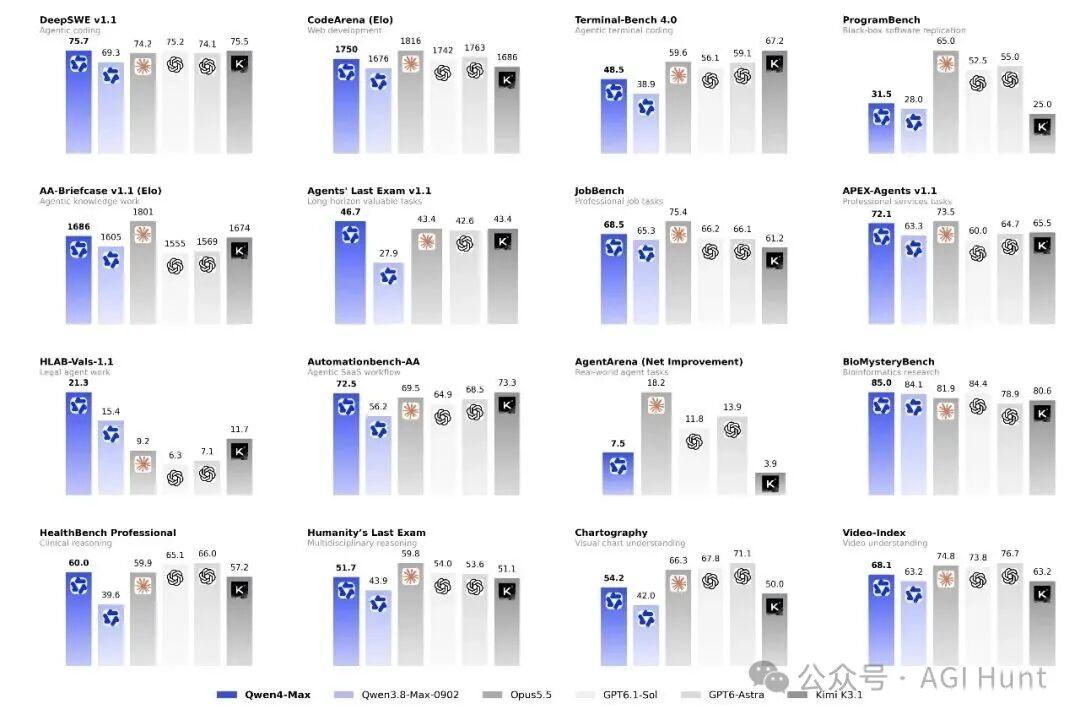
The launch table gives Qwen4-Max first place on DeepSWE v1.1 at 75.7, Agents' Last Exam v1.1 at 46.7, BioMysteryBench at 85.0 and HLAB-Vals-1.1 at 21.3. The last one is a legal-agent benchmark where Opus 5.5 scores 9.2.
Read those four as a shape rather than a ranking. Software engineering, long-horizon agent work, biology research and document-heavy legal work are all tasks where the output is a deliverable that can be checked against sources. That is also where Alibaba's demo material concentrates: mixed-document due diligence, finance workbooks with traceable cells, ICU records with per-line correspondence to orders.
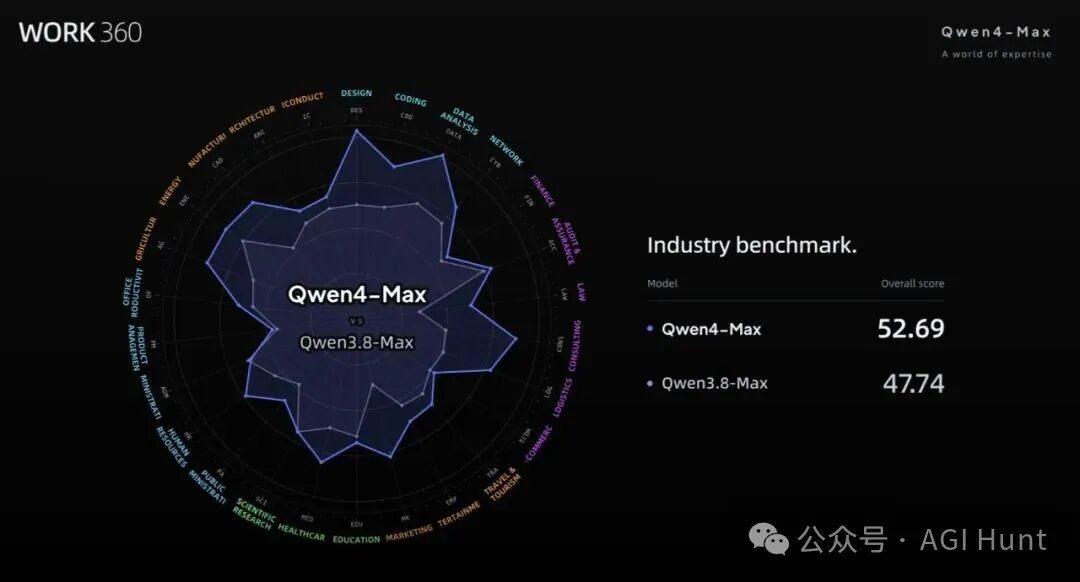
The vendor also built Work360 for this launch, with 26 first-level domains, 182 sub-domains and 721 specialist areas. Qwen4-Max scores 52.69 against 47.74 for the previous generation, about 10%. A benchmark the vendor designed and can revise is weak evidence on its own, but the domain breakdown is useful for choosing which task to test first.
Where it trails, and how to test those axes
Two losses stand out. Terminal-Bench 4.0 scores 48.5 against Kimi K3.1 at 67.2, and ProgramBench, which asks for a working reproduction of existing software, scores 31.5 against Opus 5.5 at 65.0. Chart understanding and AgentArena place it near the back of the same comparison.
Those are the three axes worth a dedicated test before a migration. If your agent lives in a shell, hand it a task that needs a sequence of commands, a failure, and a recovery. If you maintain a legacy service, ask for a behaviour-compatible rewrite against a test suite you already have. If your workflow starts with a chart, a dashboard screenshot or a diagram, check whether the model reads values correctly instead of describing shapes.
The token-efficiency claim and how to verify it
The launch claims that XHigh and High thinking use about 24% and 35% fewer tokens than the previous generation on Work360, and about 48% and 49% fewer on Terminal-Bench 4.0. Together with the lower rates, that moves the average Work360 task from $4.43 to $1.67, a 62% reduction.
Do not translate that into a discount on your bill. A saving of that size comes from reasoning tokens disappearing, so it scales with how much thinking your prompts trigger. Two cheap checks settle it: log input, cached input, output and reasoning tokens for the same task on both models, and count tokens per accepted result rather than per attempt. A model that is 30% cheaper per token and needs two extra attempts is not cheaper.
Do the same at Low and XHigh. If Low closes most of the quality gap on your tasks, the default setting is the expensive one.
Long-horizon work: what Live Delivery changes about testing
The launch adds Live Delivery: instead of working silently until the end, the agent returns a usable first version early and then iterates, so you can correct direction before the expensive part. Alibaba open-sourced the companion Qwen-Live-Delivery-Plugin.
That changes what a good test looks like. Instead of scoring only the final artifact, record when the first deliverable arrived, whether it was usable, and how many interventions you made before the last version. A model that reaches a good final state after four corrections is a worse agent than one that reaches a usable draft in one pass, even when the final outputs look identical.
The launch demos lean on this pattern: a game built and then self-tested, a production line modelled and then corrected against simulation, a molecule designed, synthesised and revised through four loops.
Six demos as task templates
The demo list is more useful as a set of test templates than as proof. Each row below is something you can shrink to a task your team can grade.
On smaller screens, scroll the table sideways.
| Demo | What the vendor reported | Template you can run |
|---|---|---|
| Blender and game builds | Scenes from a white model to a rendered shot; Unreal Engine and Unity 6 games, one packaged for Android | Give the agent a tool it can run, then ask for a playable build and a self-test pass |
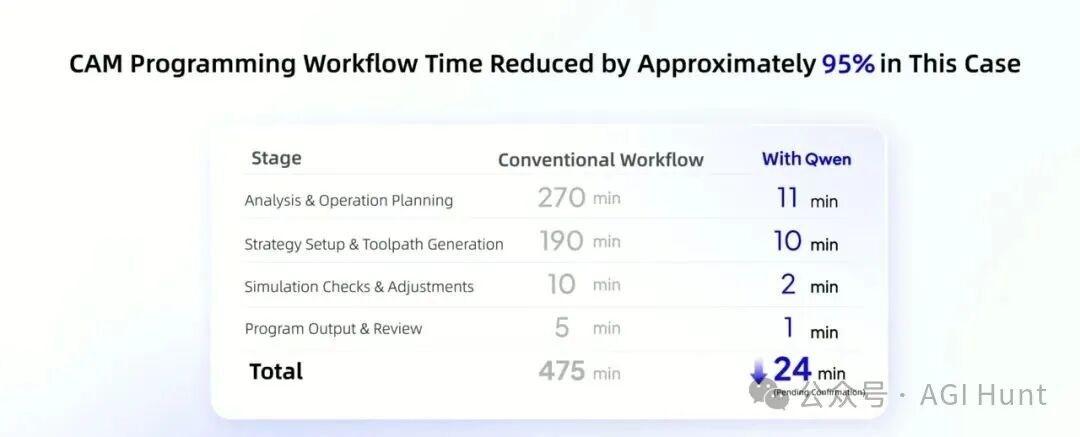
| Manufacturing | 3D line from a 2D layout, PLC virtual commissioning, toolpaths; 475 to 24 minutes per workpiece | A geometry or CAD conversion with a simulation check and a measurable cycle time |
| Materials | New coolant molecule designed and synthesised after four design and test loops | A search loop with a real validation step, not a text answer |
| Drug design | 454 tool calls, 3,239 evaluations, 24 candidates, 3.6x predicted affinity | A long tool-driven run where progress is only real if the scoring function moves |
| Finance | 90 MCP tools, Excel and deck with chart-to-cell traceability | A multi-source data task where every figure must trace back to a cell |
| Legal and medical | 198-document due diligence with citations; six days of ICU records with per-line correspondence | A document pile of your own where each conclusion needs a source |
Vendor-reported outcomes, rewritten as tasks you can grade with your own data.
A one-week evaluation plan
On smaller screens, scroll the table sideways.
| Day | What to run | What to record |
|---|---|---|
| 1 | One repository, one harness, two models, one effort level | Model ID, provider, region, date, effort level, context setting |
| 2 | A failing test, a multi-file feature, a shell sequence with a forced failure | Pass rate against tests written first, retries, tool errors, recovery steps |
| 3 | A behaviour-compatible rewrite against an existing suite | Regressions, hidden failures, review time |
| 4 | A chart or screenshot task, plus one long input with facts at the start, middle and end | Values read correctly, contradictions caught, recall at each position |
| 5 | The same tasks at Low and XHigh | Tokens per accepted result, thinking tokens, dollars or points per accepted result |
| 6 | A long-horizon task with Live Delivery | Time to first usable version, interventions, final quality |
| 7 | Repeat the winner twice, archive traces, name the default | Prompts, settings, outputs, scores, dates, spend |
A starting point. Cut what does not resemble your work and keep the records.
Archive the package when you finish. The next Qwen 4 release, including the smaller open-weight models, can then be measured against the same tasks in a day instead of a week.
If you need open weights or a cheaper baseline
Qwen4-Max is closed. Alibaba promises smaller Qwen 4 models with open weights from the same generation, and gives no date. If open weights are a requirement rather than a preference, this release does not satisfy it, and a decision should wait for the smaller models.
For volume work that does not need frontier quality, DeepSeek Flash at 1× remains the cheap baseline on our plan: the same tier buys far more tokens, and the comparison is easy to run with the same harness. The useful pattern is to keep the cheap model as the default and escalate to Qwen4-Max for the long, high-value tasks.
Whatever you choose, hold the harness constant when you compare models. A model that looks weaker in one agent can look stronger in another, and you will not learn which effect you measured.
Frequently asked
Is Qwen4-Max released?
Yes. Alibaba released Qwen4-Max on November 16, 2026, as the first model in the Qwen 4 family. The API is available on QwenCloud with pay-as-you-go and Token Plan billing, and the model is also available in Qwen Studio, QwenWork and Qoder.
How much does Qwen4-Max cost?
The announced list prices are $1.50 per million input tokens, $4.50 per million output tokens and $0.07 per million implicit-cache tokens. Check the provider's live pricing before budgeting, and remember that thinking tokens are billed as output.
Is Qwen4-Max open source?
No. Alibaba says Qwen4-Max itself is not open source, and that smaller Qwen 4 models trained with the same generation will be released later with open weights.
Is Qwen4-Max the best model on every benchmark?
No. In the vendor's own comparison it leads DeepSWE v1.1, Agents' Last Exam v1.1, BioMysteryBench and HLAB-Vals-1.1, but trails Kimi K3.1 on Terminal-Bench 4.0 (48.5 versus 67.2) and Opus 5.5 on ProgramBench (31.5 versus 65.0), and it places near the back on chart understanding and AgentArena.
Does a 1M context window mean reliable recall at 1M tokens?
No. Context is a capacity limit, not a measure of recall, latency or cost. Test retrieval with facts at the start, middle and end of a long input, and include a newer document that contradicts an older one.
Can I use Qwen4-Max through the Multi-Model Coding Plan?
Use qwen4-max on the Singapore gateway at 15 points per token. Existing qwen4-max-preview configurations also route to Qwen4-Max.
Do the token savings mean a 50% cheaper bill?
Not automatically. The 24% to 49% reductions are the vendor's measurements on specific benchmarks at specific thinking levels. Your saving depends on how much of your usage is reasoning tokens, how much input repeats, and how many attempts a task needs.
The preview window is over. What remains is a model you can call, a price you can calculate and two benchmark rows that tell you where to look first. Run the week, keep the traces, and let your own repository decide.