Step 5 Preview: China's New Open-Weight 600B Sparse MoE with a 1M-Token Context Window
TL;DRStep 5 Preview is a sparse mixture-of-experts model with 600B total parameters, 27B active parameters per token, and up to 1M tokens of context. StepFun made the model weights public on October 15, after launching the preview and API on September 20. In a hands-on test by Chinese independent developer Lin, it turned a UI mockup and a short product brief into a working Agent dashboard, then fixed a preview-panel bug found during manual testing.
By Chinese independent developer Lin
StepFun's new model has an unusually large context window and a small active slice of its 600B parameters. Lin's workbench build is more useful than a leaderboard score for seeing what that combination can do, and where it still needed a human to check the result.
- 600B total parameters
- 27B active parameters per token
- 1M maximum context tokens
- October 15, 2026 open-weight release
What did StepFun release?
StepFun introduced Step 5 Preview as a model for coding, agent tasks, and professional work. Its sparse MoE design routes each token through a portion of the network. The model has 600B parameters in total, while 27B are active for a given token. StepFun lists text and image input and a context window of up to one million tokens. These are model specifications, not evidence that every application can use the entire window at the same speed or cost.
“Open-weight” means the model weights have been published. For reuse or redistribution, check the license in StepFun's official model repository; accessible weights alone do not settle every licensing question. Lin's September review said open weights were still planned. That was accurate for the day it was written, but it is no longer the current status.
What do the three short demos show?
Before Lin's own coding test, the article shows three Step 5 Preview demos: a playable 3D Chinese chess board, a p5.js rendering inspired by Along the River During the Qingming Festival, and an interactive historical atlas built from a 1922 travel guide. They show the range of artifacts featured in the article. The clips do not show the full prompts, development history, or a reproducible test setup.
How did Step 5 Preview handle a longer coding task?
Lin gave the model a desktop Agent workbench mockup and a brief PRD.md. The task was to read the design, turn it into requirements, define the API, build a front end and back end, and test the working interface. He ran the model through Claude Code using the step-5-preview model ID.
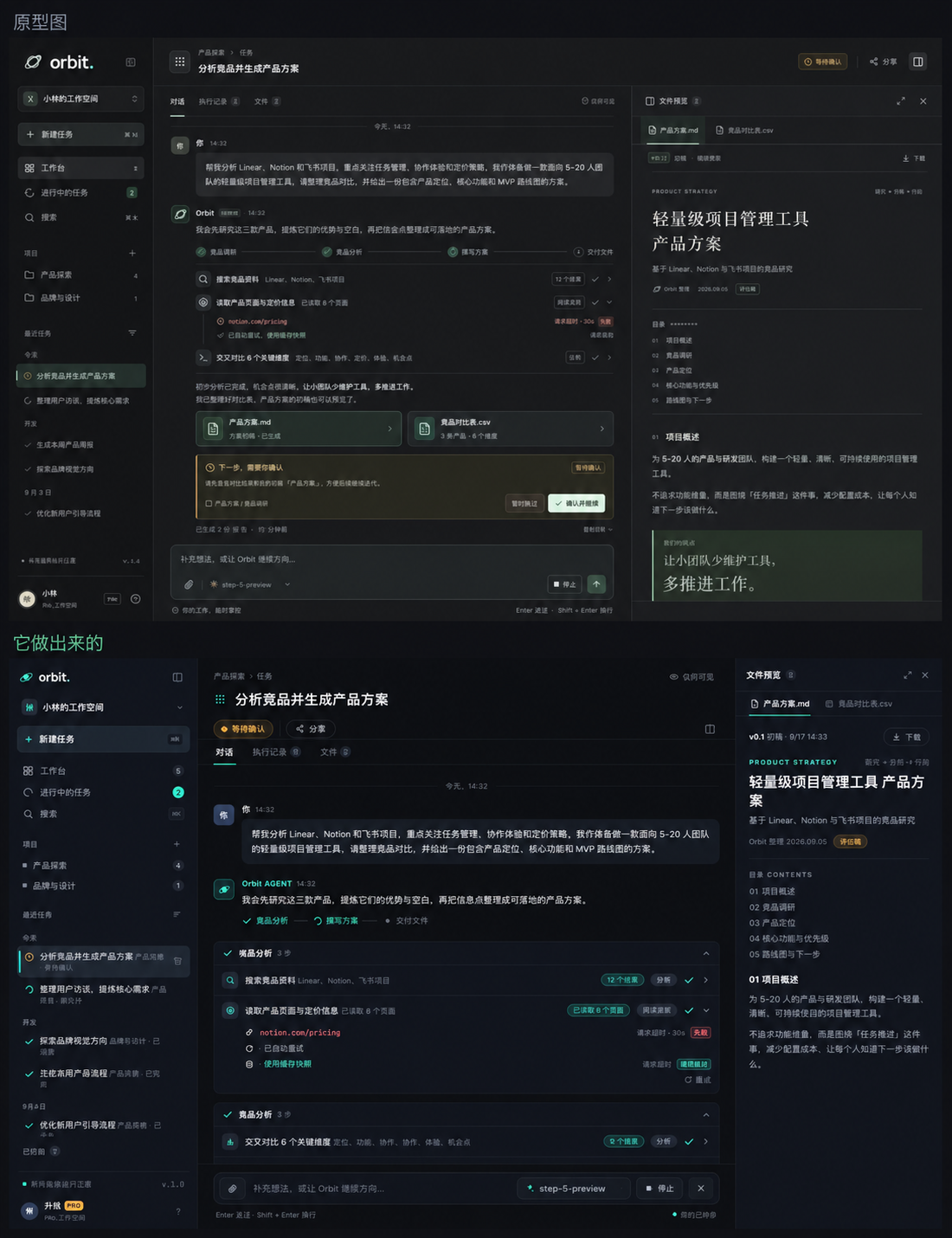
The Agent workbench prototype (top) and Step 5 Preview's finished interface (bottom).
The first useful detail is small: the mockup was too large for the model to inspect in one view, so it enlarged and split the image. The requirements document then named four task states and described where they appeared in the interface. The model also linked UI areas to proposed interactions instead of simply listing visual elements. That is the kind of work a screenshot-only coding prompt often misses.
For the prototype, the model chose plain HTML, CSS, and JavaScript for the front end, Node.js with Express for the back end, and local JSON files for storage. Lin asked it to persist tasks, sessions, logs, and files, then start the service and test its endpoints. Those choices suit a small local demo. The article does not establish that this storage design would be appropriate for multiple users or production deployment.
Did the finished interface actually work?
Lin reports that he could use the workbench to run a product research task, refresh the page, and still see a newly sent message. He also found a real UI defect: after expanding the file preview panel, the close action left the panel on screen and the conversation area did not reclaim its space. He described the steps to the model, which changed the code; he repeated the sequence and says the panel then closed correctly.
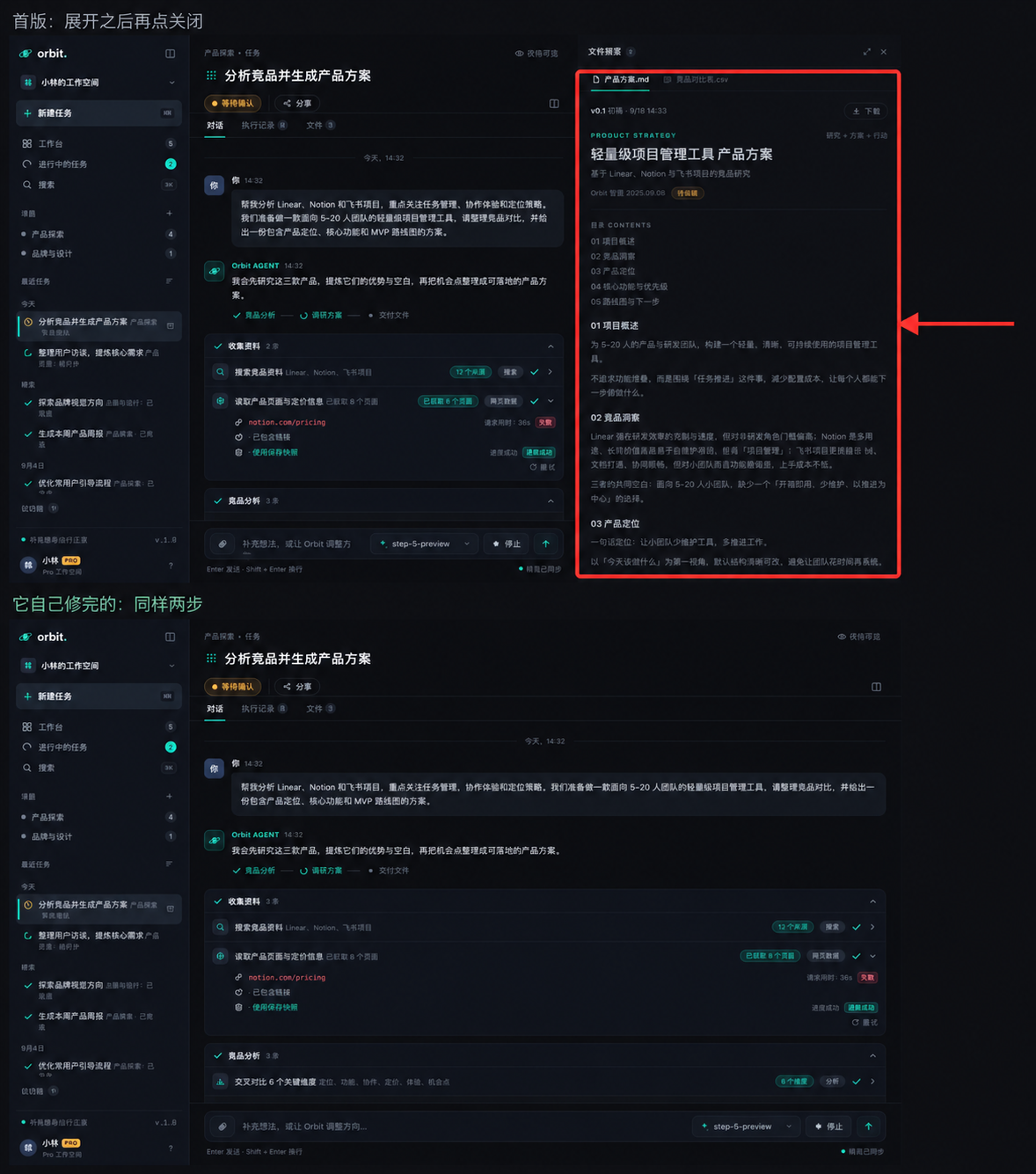
The preview panel before the fix (top) and after Lin retested it (bottom).
Lin's account shows a specific iteration: he found the bug, described how to reproduce it, asked the model to change the code, and repeated the same steps to check the fix.
How much did Lin's run cost?
According to Lin's September 20 account, the build took 2 hours and 7 minutes and made 306 requests. He recorded roughly 45.24 million input tokens and 244,000 output tokens. About 97.1% of the input tokens hit the prompt cache. At the rates shown in his article, the API bill was 29.47 yuan. That figure describes this run at those historical rates, not a current quote or a likely bill for every project.
| Part of the run | Rate quoted in the review | Reported cost |
|---|---|---|
| Cached input | ¥0.35 per 1M tokens | ¥15.37 |
| Uncached input | ¥7 per 1M tokens | ¥9.22 |
| Output | ¥20 per 1M tokens | ¥4.87 |
| Total | Author's September 2026 calculation | ¥29.47 |
Cache behavior matters more here than the model's headline context length. Repeatedly sending the same long project context can generate a very large input-token count, while cached tokens may be charged differently. Check StepFun's current platform pricing before estimating a new job; rates and cache terms can change.
What should developers take from this test?
Step 5 Preview looks capable of carrying a small application through several connected stages: interpreting a mockup, writing specifications, building an API, wiring a UI, and responding to a bug report. The strongest part of Lin's story is the sequence of checks and corrections, not the claim that the first output was perfect.
If you want to try it, give the model a concrete artifact and acceptance criteria, then test persistence, layout, and broken interactions yourself. A large context window helps it keep the project in view. It does not remove the need to inspect the result.
Quick questions
Is Step 5 Preview open source?
StepFun has published official model weights. The exact rights to use and redistribute them are governed by the repository license, so “open-weight” is the more precise description for this article.
Does 600B mean 600B parameters run on every token?
No. StepFun states 600B total parameters and 27B active parameters per token in its sparse MoE architecture.
Explore Chinese open-weight models, visit coding plan.
Source
Lin's Step 5 Preview hands-on review on Zhihu, September 20, 2026.