Chinese Open-Source Model Developer Zhipu Releases Ultra-Fast New Model — GLM-5.3 Highspeed
Zhipu is gray-testing GLM-5.3 Highspeed inside ZCode, and early screenshots show output approaching 500 tokens per second — more than double GLM-5.3-FlashX's peak and roughly eight times the API pace of GLM-5.3-Flash. The catalog specs match the standard model; only the speed changes.
Zhipu has put a new model into circulation: GLM-5.3 Highspeed, turning up inside ZCode, the company's coding client. There's been no launch post, just users noticing a new name in the model list and starting to share screenshots.
The number getting passed around is 490 tokens per second, from a speed screenshot posted by an early user. That is within reach of 500 TPS.
TPS counts the tokens a model generates each second. Hold that pace and the generation stage of a 10,000-token output takes about 20 seconds.
For scale: GLM-5.3-FlashX, which Zhipu released only last month, tops out at 200 tokens/s. By Artificial Analysis' measurements, GLM-5.3-Flash on the Z.ai API produces roughly 60 tokens/s of output. So what exactly has Zhipu been feeding this one?
The catalog listing was already out there
The GLM-5.3 Highspeed name had left traces before anyone spotted it in ZCode. Pi's model catalog carries a listing under the zai provider, and the specs read like the standard model: a 1,000,000-token context window, a 131,072-token output ceiling (about 128K), and three reasoning-effort settings — low, high, and max. Nothing about the configuration is new. The only thing that seems to have changed is the pace.
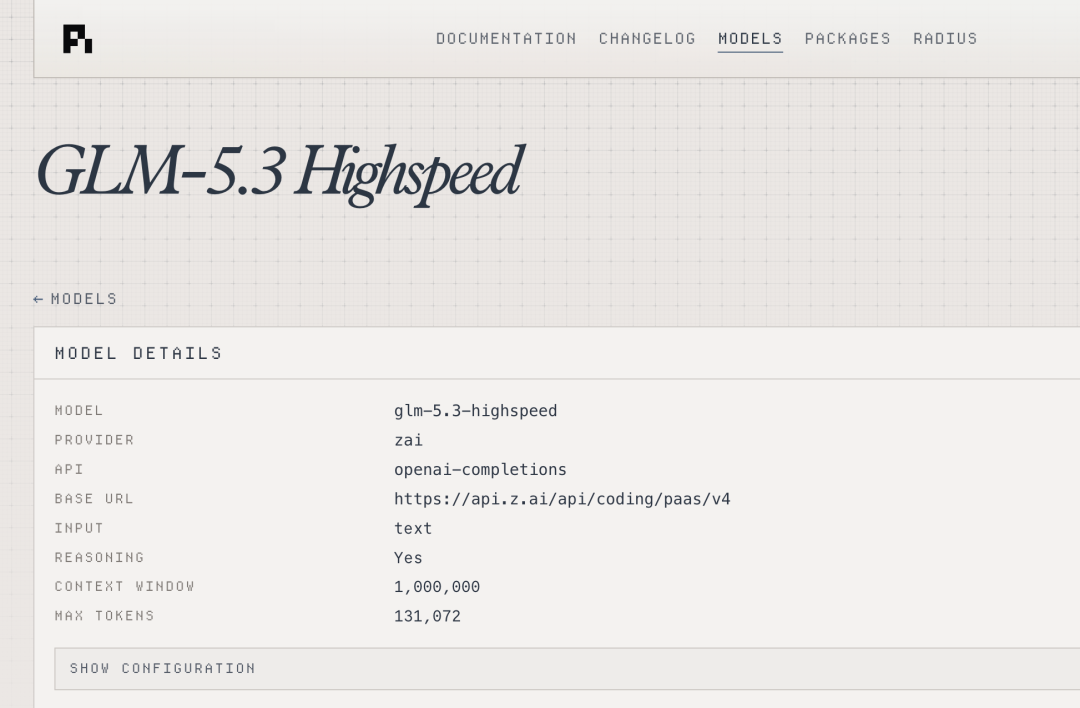
Pi's model catalog already lists glm-5.3-highspeed under the zai provider: 1M-token context window, 131,072-token output ceiling, reasoning supported.
The Omen Alpha question
Reddit users have been circling this model for weeks, and the leading theory ties it to Omen Alpha, an anonymous model that appeared in OpenCode's testing ground in September. In the same thread, Omen Alpha gets described as "almost identical to 5.3 flash but 3 times the amount of tk/s."
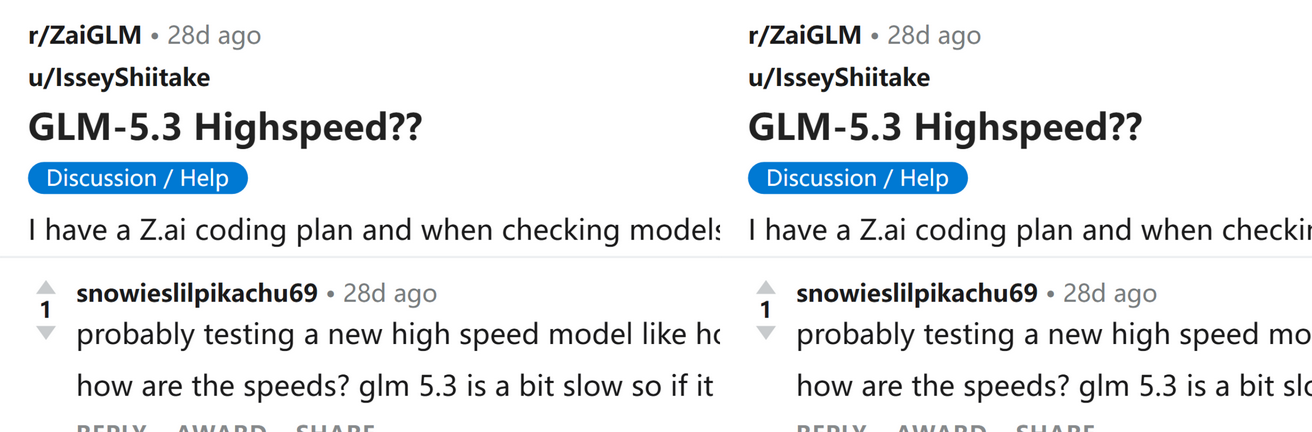
The r/ZaiGLM post that started the thread, 28 days ago. Screenshots are English-localized recreations; Reddit's machine-translated subtitles are shown as the original English comments.
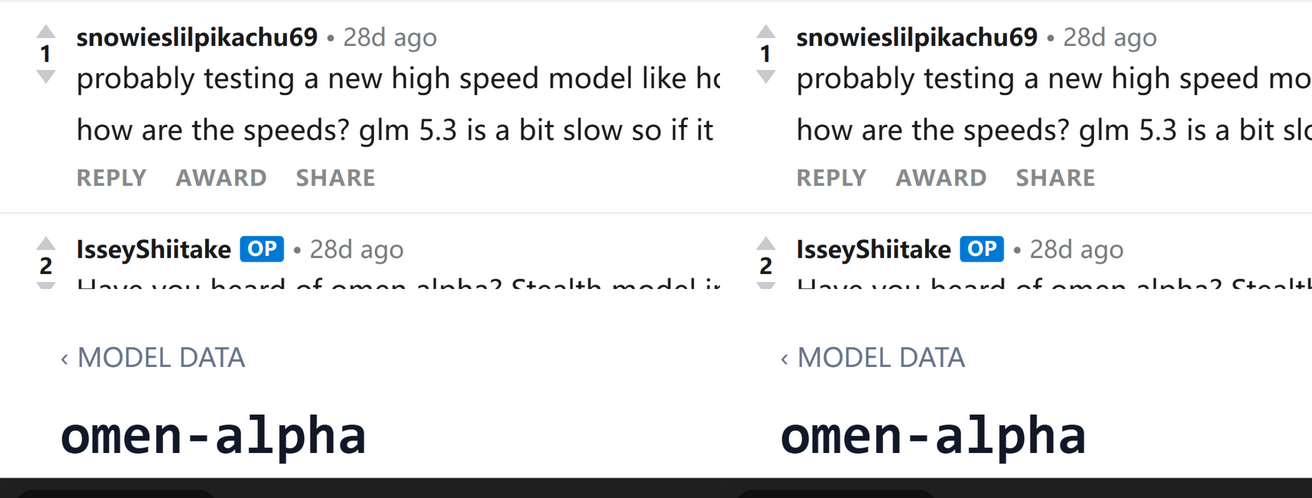
In the same thread: Omen Alpha, the stealth model in OpenCode's testing ground, reportedly "3 times the amount of tk/s" over GLM-5.3 Flash.
The community has more or less traced Omen Alpha back to Zhipu already: inside OpenCode, its identifier reads zhipu/omen-alpha.
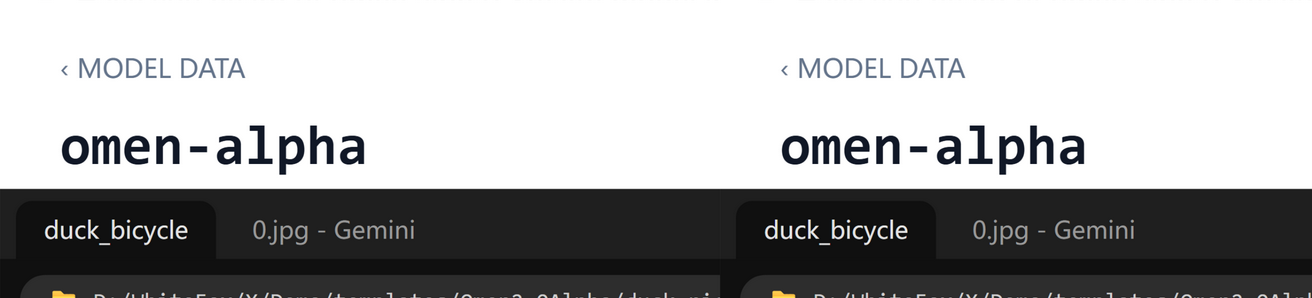
Inside OpenCode, the anonymous model resolves to zhipu/omen-alpha — hence the GLM speculation. UI text localized from German.
Someone else ran the classic generation test, a pelican riding a bicycle, on the stealth model. The clip that came back stars a duck pedaling a bicycle.
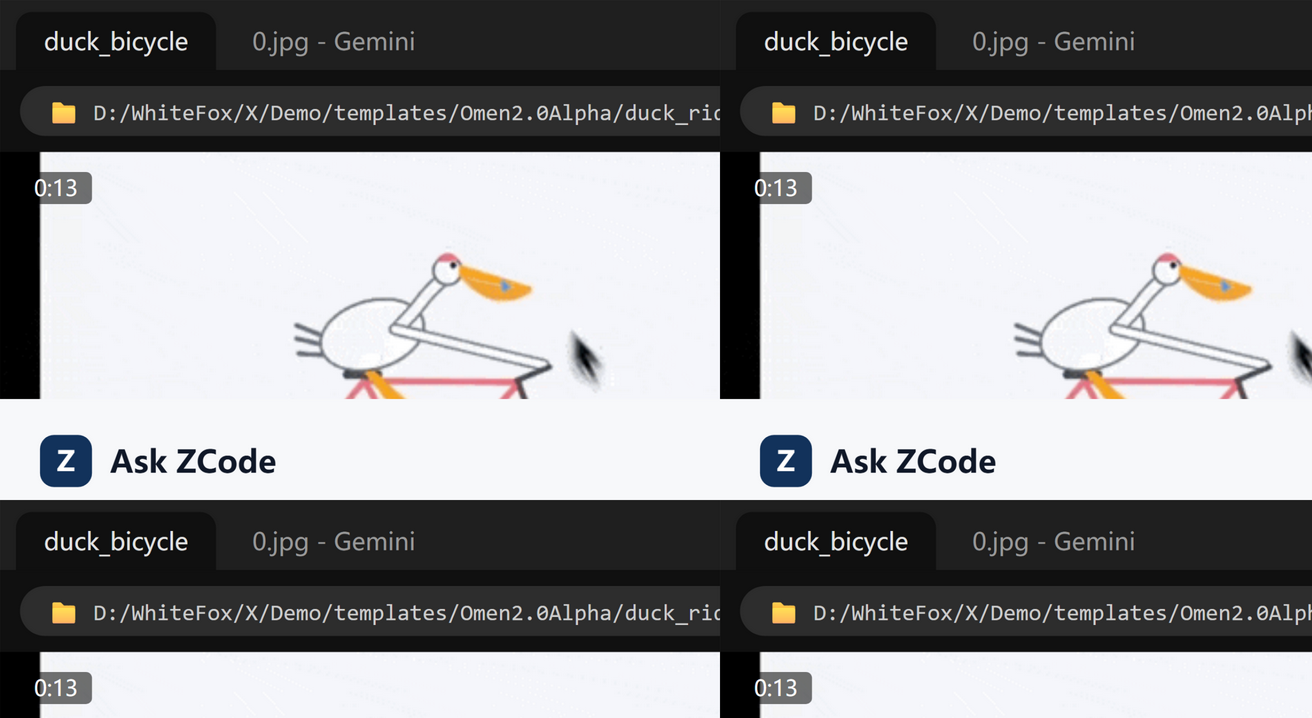
The pelican-riding-a-bicycle test, community edition: the clip that came back stars a duck. The tester's folder is named "Omen2.0Alpha". Browser chrome localized from Chinese.
The short version of the community's verdict: fast, willing to think for a long time, and the output quality holds up.
What Omen Alpha actually is remains unsettled. Some say it is GLM-5.3 Highspeed itself; others are guessing GLM-5.3-Omni or GLM-5.4-Flash.
Zhipu has run this play before
This is not Zhipu's first highspeed model. In May the company shipped GLM-5.1 Highspeed, which generated at 400 tokens/s and essentially reset the output-speed ceiling among major model providers' APIs at the time. If GLM-5.3 Highspeed genuinely sustains 490 TPS, long agent runs get meaningfully shorter to sit through.
For now the new model is in randomized gray-release inside ZCode. An Ask ZCode answer citing the changelog describes GLM HighSpeed as a subscription-side perk handed out at random: after the update, the system picks a subset of subscribers and grants them the accelerated experience. Picked users get the speed; everyone else is unaffected. Whether you're in, and where the entry point appears, is shown by prompts inside the client.
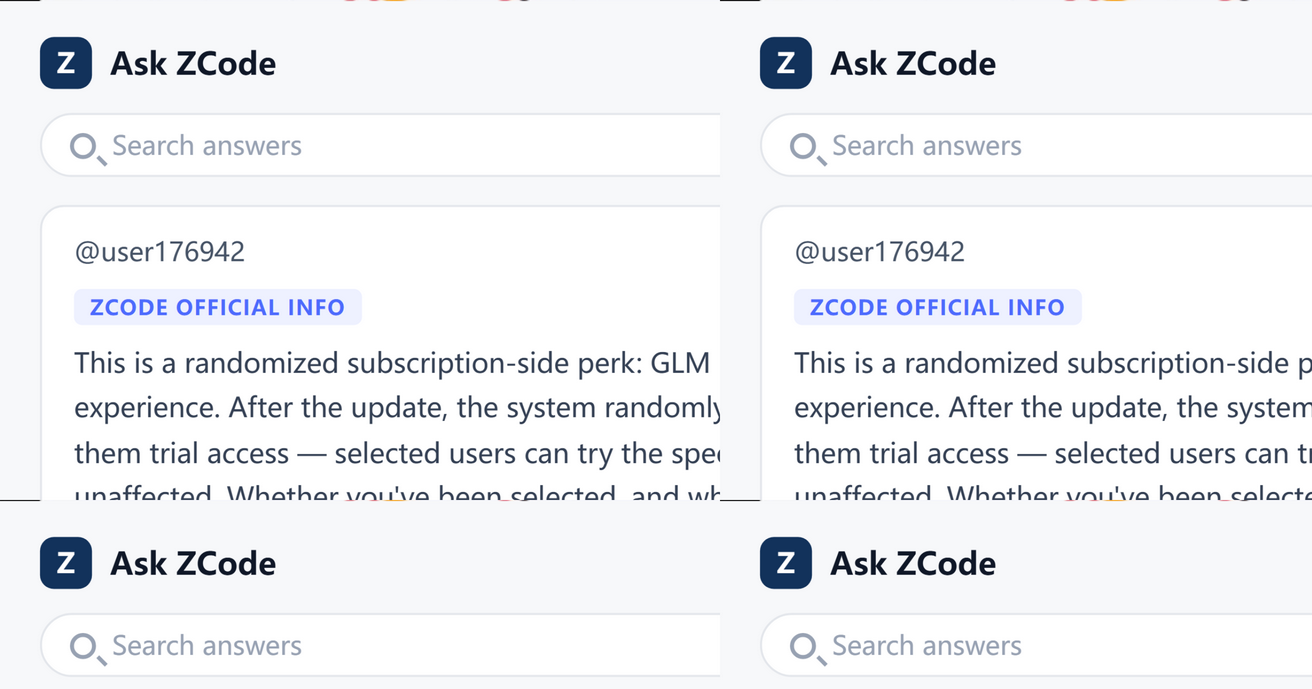
ZCode's official answer on the rollout: GLM HighSpeed is a randomized perk for a subset of subscribers, per the changelog. Interface localized from Chinese.