DeepSeek's Open-Source Storage System Hits 6.6 TiB/s — It's Not for Your Laptop
TL;DR3FS is DeepSeek's open-source distributed file system for AI training and inference. It pools thousands of NVMe SSDs behind one namespace, moves data over RDMA, and keeps metadata in FoundationDB, so GPUs rarely wait on storage. Published peak read throughput is about 6.6 TiB/s across 180 storage nodes. It is cluster plumbing, not laptop software.
By Cameron Voss · Updated October 30, 2026
Your GPU is usually not the slow part of training. A cluster can hold thousands of expensive accelerators and still lose hours because the file system cannot hand over data fast enough. 3FS, short for Fire-Flyer File System, is DeepSeek's fix for that problem. The company built it for its own AI infrastructure and released it under the MIT license in February 2025.
What is 3FS?
3FS makes a pile of separate storage servers look like one very fast disk to a lot of GPU machines at once. A training job opens a path, reads bytes, and closes the file without knowing which server holds the data.
It is not a model or a database. It is the storage layer underneath both.
Why do AI clusters stall on storage?
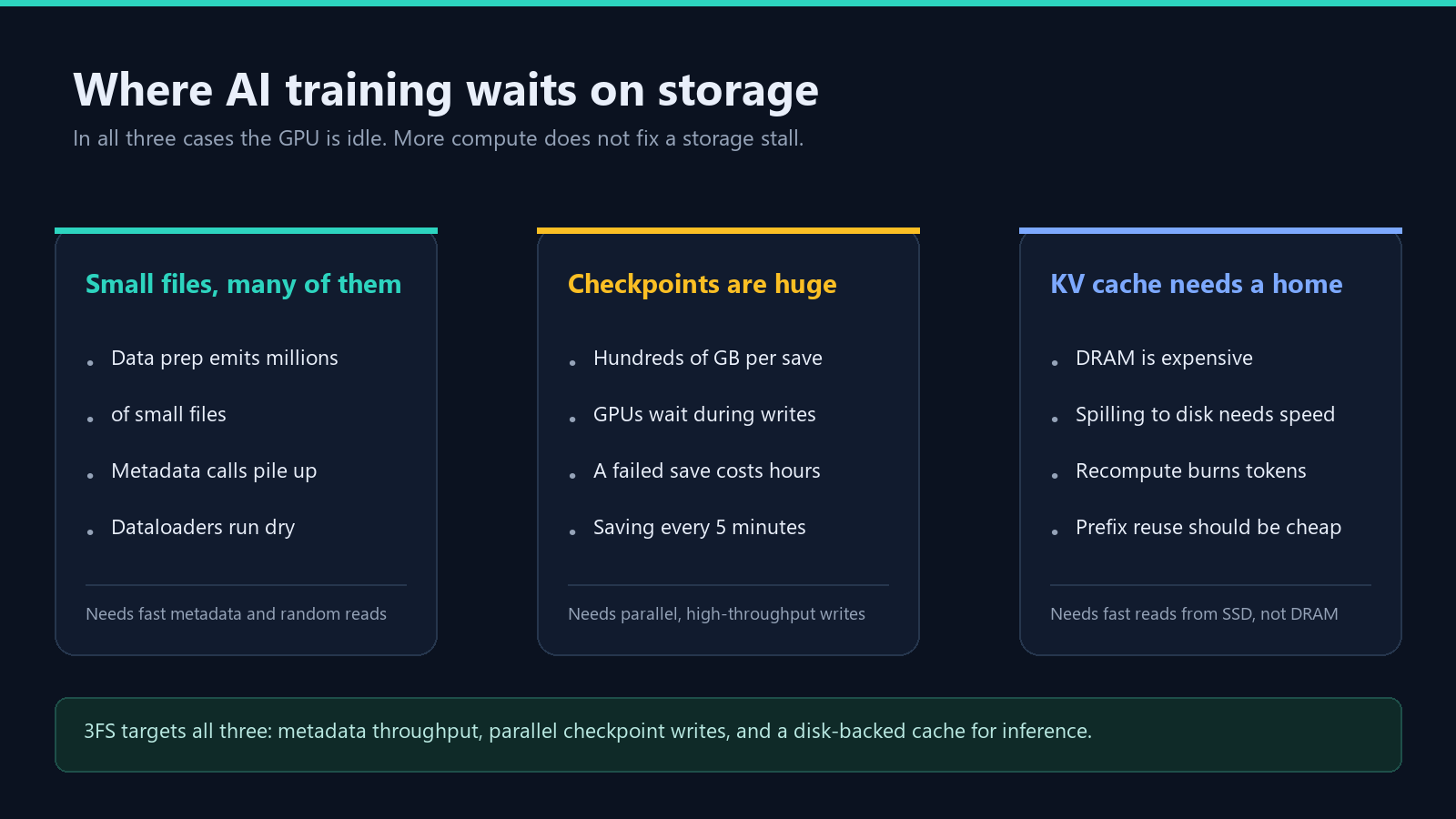
Three workloads cause most of the pain. Small files: data preparation and dataloaders touch millions of them, and metadata lookups pile up while GPUs sit idle. Checkpoints: a large model writes hundreds of GB per save, and a slow write path turns every save into a pause. KV cache: inference servers reuse attention state instead of recomputing it, and spilling that cache from DRAM to disk only helps when reads are fast.
A traditional file system can handle any one of these. All three on one cluster, at the same time, is the hard part.
How is 3FS built?
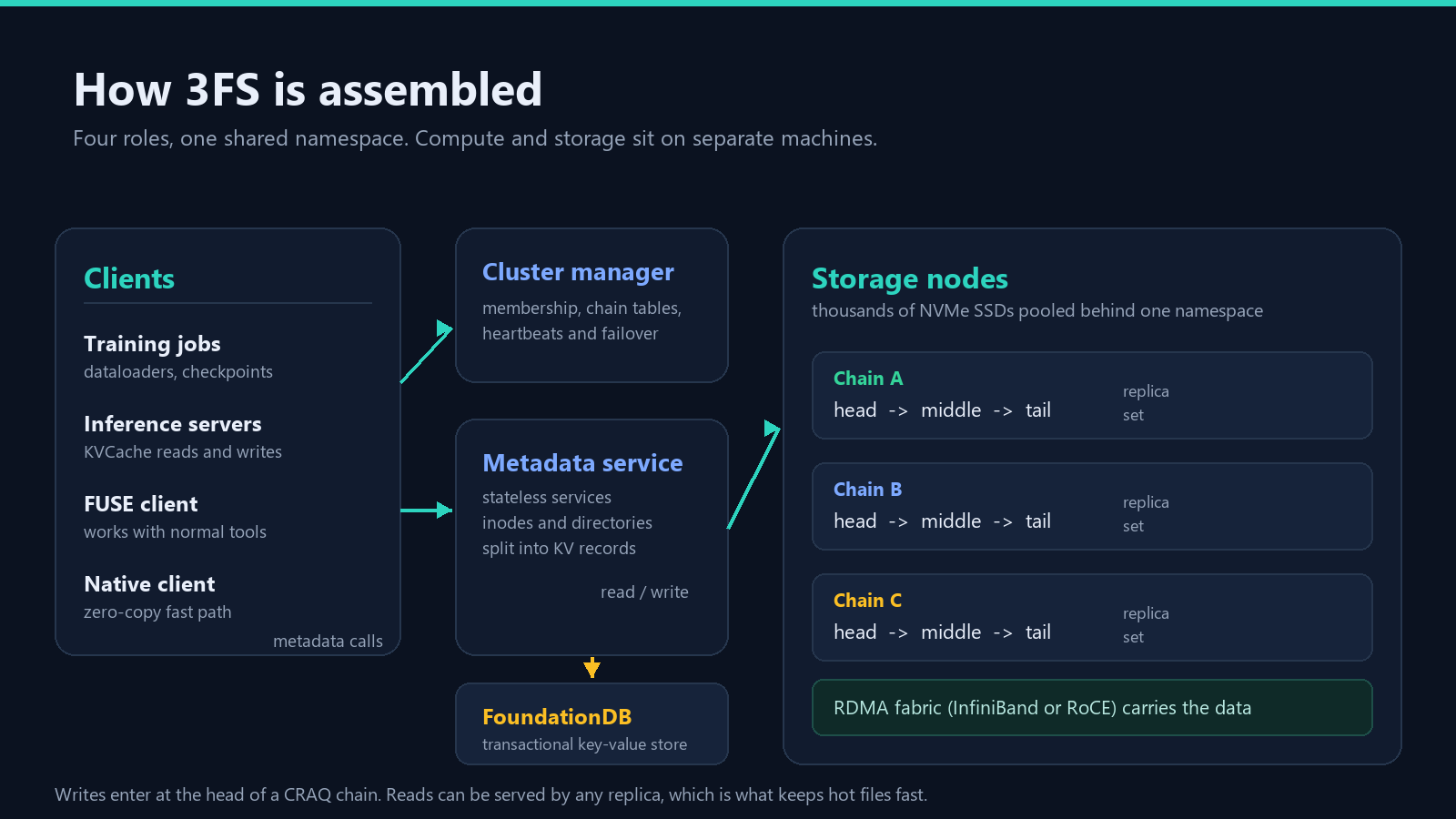
Four roles do the work: a cluster manager, metadata services, storage services, and clients. Metadata is stateless and lives in FoundationDB, a transactional key-value store. Files are split into chunks and replicated with CRAQ, which stands for Chain Replication with Apportioned Queries. Writes enter at the head of a chain. Any replica can serve reads, so hot data fans out across machines instead of funneling through one node.
Everything runs over RDMA on InfiniBand or RoCE networks, which moves data between machines with little CPU cost. A FUSE client makes 3FS look like a normal mounted file system, and a native client adds a zero-copy fast path. The interface stays familiar, though 3FS is not strict POSIX in every detail: file length is only eventually consistent while writes are in flight, and becomes exact after a close or fsync.
How fast is it?
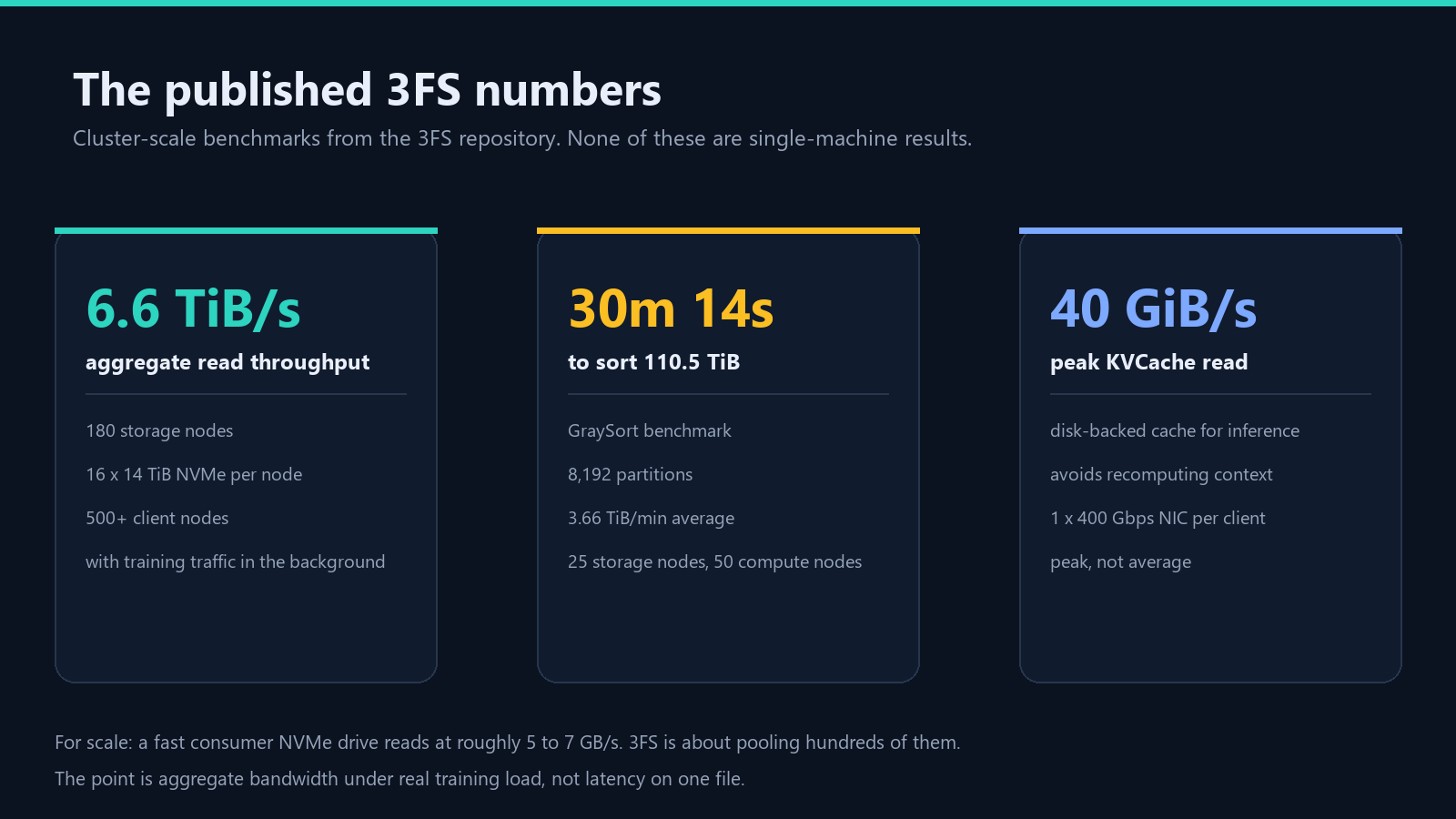
| Test | Result | Setup |
|---|---|---|
| Aggregate read | ~6.6 TiB/s | 180 storage nodes, 2 x 200 Gbps InfiniBand NICs and 16 x 14 TiB NVMe each, 500+ clients, training traffic in the background |
| GraySort | 110.5 TiB in 30m 14s | 25 storage nodes, 50 compute nodes, 8,192 partitions, 3.66 TiB/min average |
| KVCache read | Up to 40 GiB/s peak | Disk-backed cache clients with 1 x 400 Gbps NIC each |
These are cluster benchmarks, not laptop numbers. The read test ran with training traffic in the background, not on an idle system.
Where does it fit in DeepSeek's stack?
DeepSeek uses 3FS for training and inference. The repo lists data preparation, dataloaders, checkpointing, and KVCache as target workloads, which puts it in the storage layer behind model releases like V3 and R1. The repo does not break usage down by model, and 3FS was open-sourced in February 2025, after those models shipped.
Do you need to run it?
Probably not. If you use DeepSeek through the API or DeepSeek Harness, you never touch it. One GPU plus a fast NVMe drive needs no cluster. The real audience is training-cluster operators, who should budget for Linux servers, an RDMA network, FoundationDB, and someone who can run a distributed system.
| 3FS is | 3FS is not |
|---|---|
| A distributed file system for AI clusters | A model or an inference engine |
| Open source under the MIT license | A replacement for the disk in your laptop |
| Built around NVMe SSDs and RDMA networks | A managed service |
| Compatible with a familiar file interface | A database or an object store |
Frequently asked
Can I run 3FS on my home PC?
Technically, you can compile it on Linux. Practically, there is no point: it expects multiple storage nodes, an RDMA network, and FoundationDB. On one machine, a local NVMe drive is faster and much simpler.
How does it help my API calls?
Indirectly. When you send a long prompt from Harness or the API, the server can reuse cached attention state instead of recomputing it. If that cache sits on 3FS, reads are fast and more GPU time goes to generating your tokens.
Do I need to read the C++ and Rust source?
Not unless you plan to operate or modify it. The README and design notes cover the architecture, the benchmarks, and the deployment requirements.
DeepSeek's storage stack supports fast, stable model inference for your token requests. Get a managed endpoint without running a cluster.
See the DeepSeek Coding PlanAvailable while stock lasts. Access is delivered as a key after payment.