What is a reasoning model, in plain English?
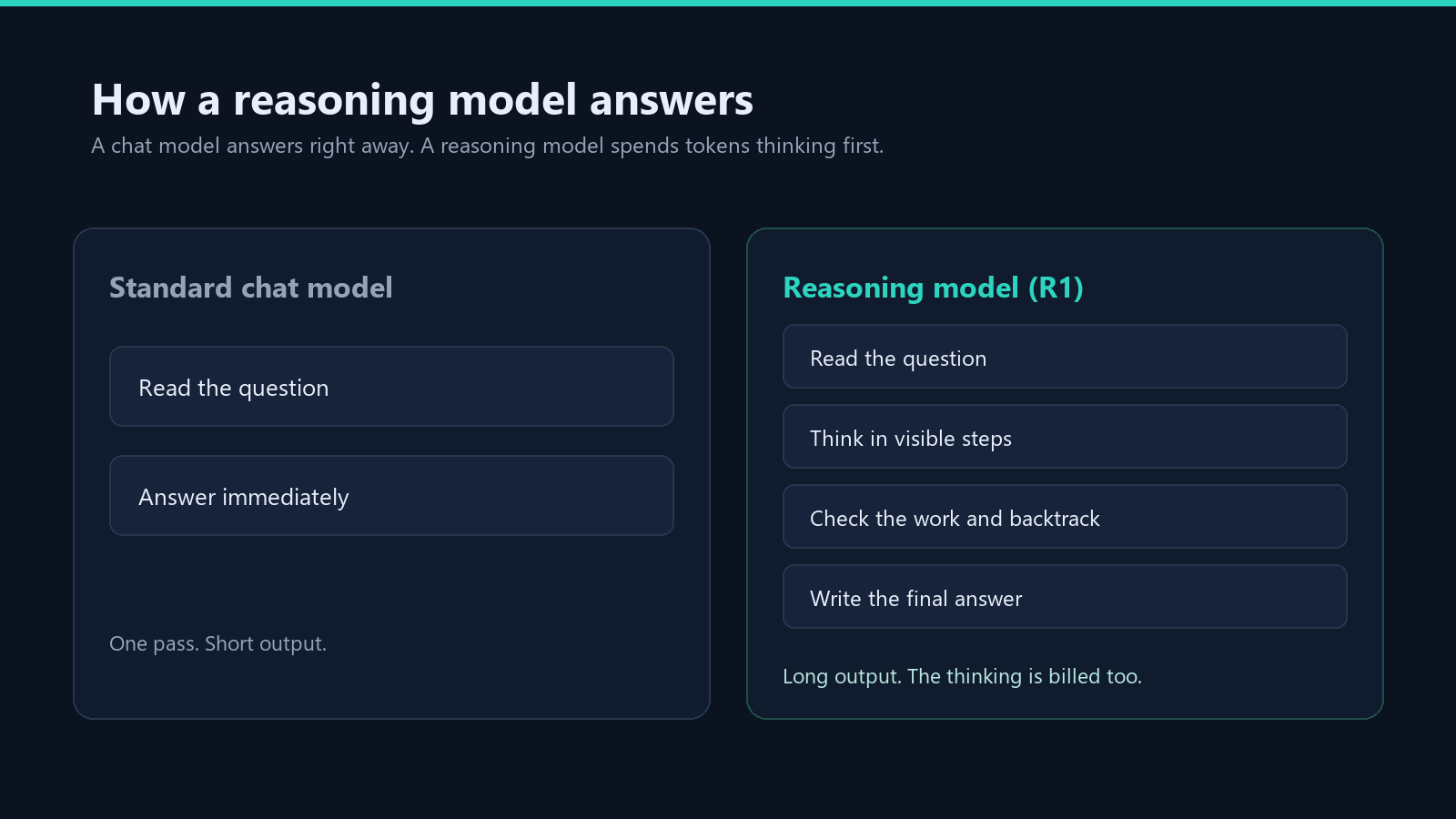
A normal chat model reads the question and starts writing the answer. A reasoning model writes a scratchpad first: restate the problem, try a step, notice it is wrong, back up, try another. Only then does it answer.
That scratchpad is not hidden state. It is text generated one token at a time, and you can read it. In DeepSeek’s current Chat Completions API, thinking output appears in reasoning_content and the answer in content. Other APIs and local runtimes may expose it differently.
That one choice sets the tradeoff below. Long thinking helps multi-step problems, gets in the way of single-fact answers, and costs money either way.
What made R1 different from earlier reasoning models?
OpenAI introduced o1 in September 2024 with closed weights. R1 followed with open weights and a technical report describing its training approach.
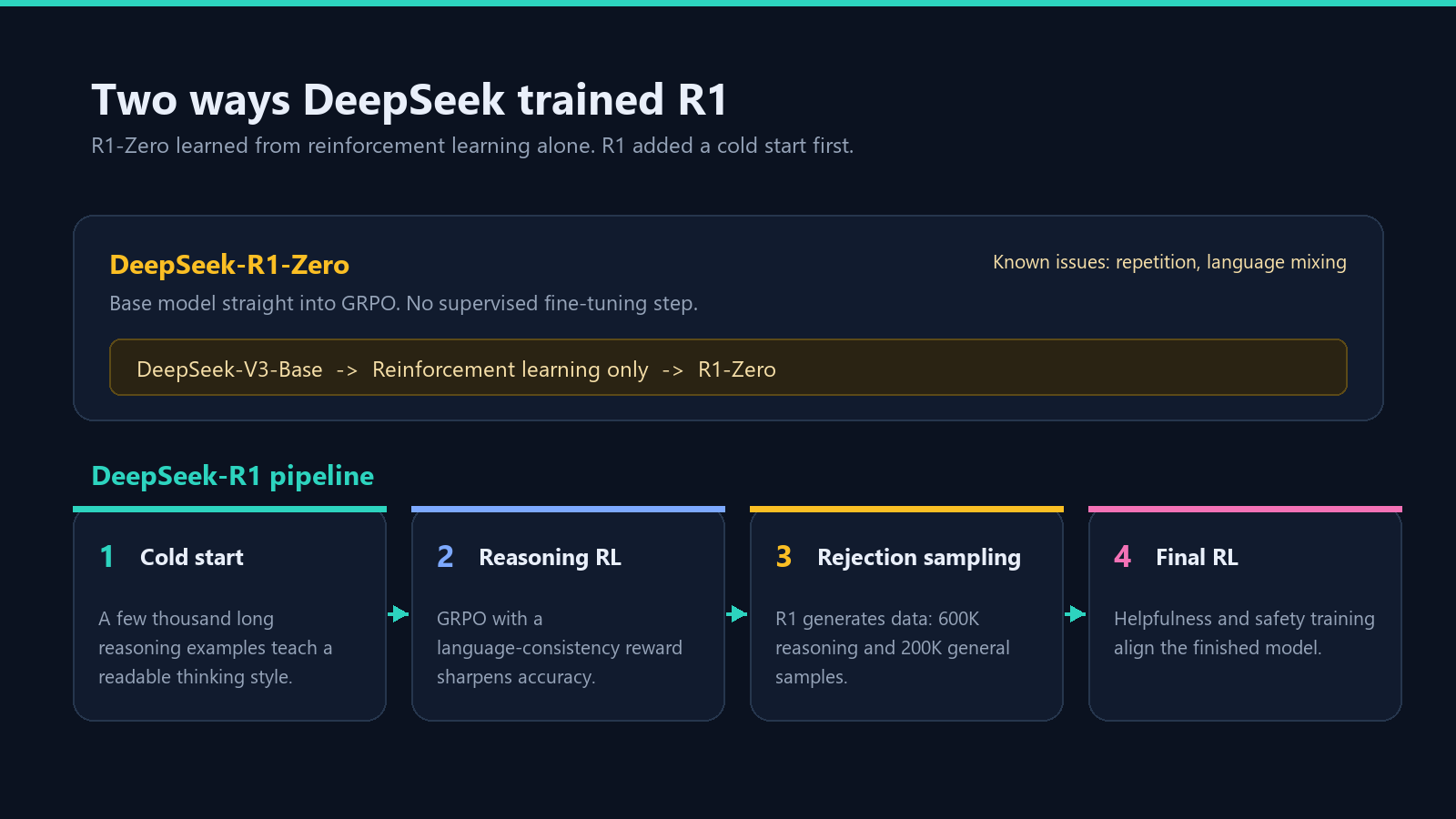
DeepSeek also trained R1-Zero, which put the base model straight into reinforcement learning. No supervised fine-tuning preceded this RL stage. Its rule-based rewards assessed answer accuracy and output format. The model learned to check its own steps and to backtrack without being shown how.
R1-Zero repeated itself, switched languages mid-answer, and read badly. So R1 added a cold start: a few thousand long, well-formatted examples that teach a readable style before RL begins. After that came reasoning-focused RL, rejection sampling on 600K reasoning and 200K general samples that R1 wrote itself, and a final RL pass for helpfulness and safety.
What is GRPO, and why is it cheaper?
GRPO is Group Relative Policy Optimization, and both R1 models were trained with it.
PPO, the standard method, trains a second network that predicts how good an answer should score, then uses that prediction as a baseline. It costs memory and compute on every step.
GRPO removes that network. Each question is sampled as a group of answers, all of them are scored, and the group average becomes the baseline: answers above it get reinforced, answers below get pushed down. No critic to train, more sampling instead, which is a good trade when you are generating anyway. DeepSeek introduced the method in its DeepSeekMath paper back in February 2024.
What about the smaller distilled models?
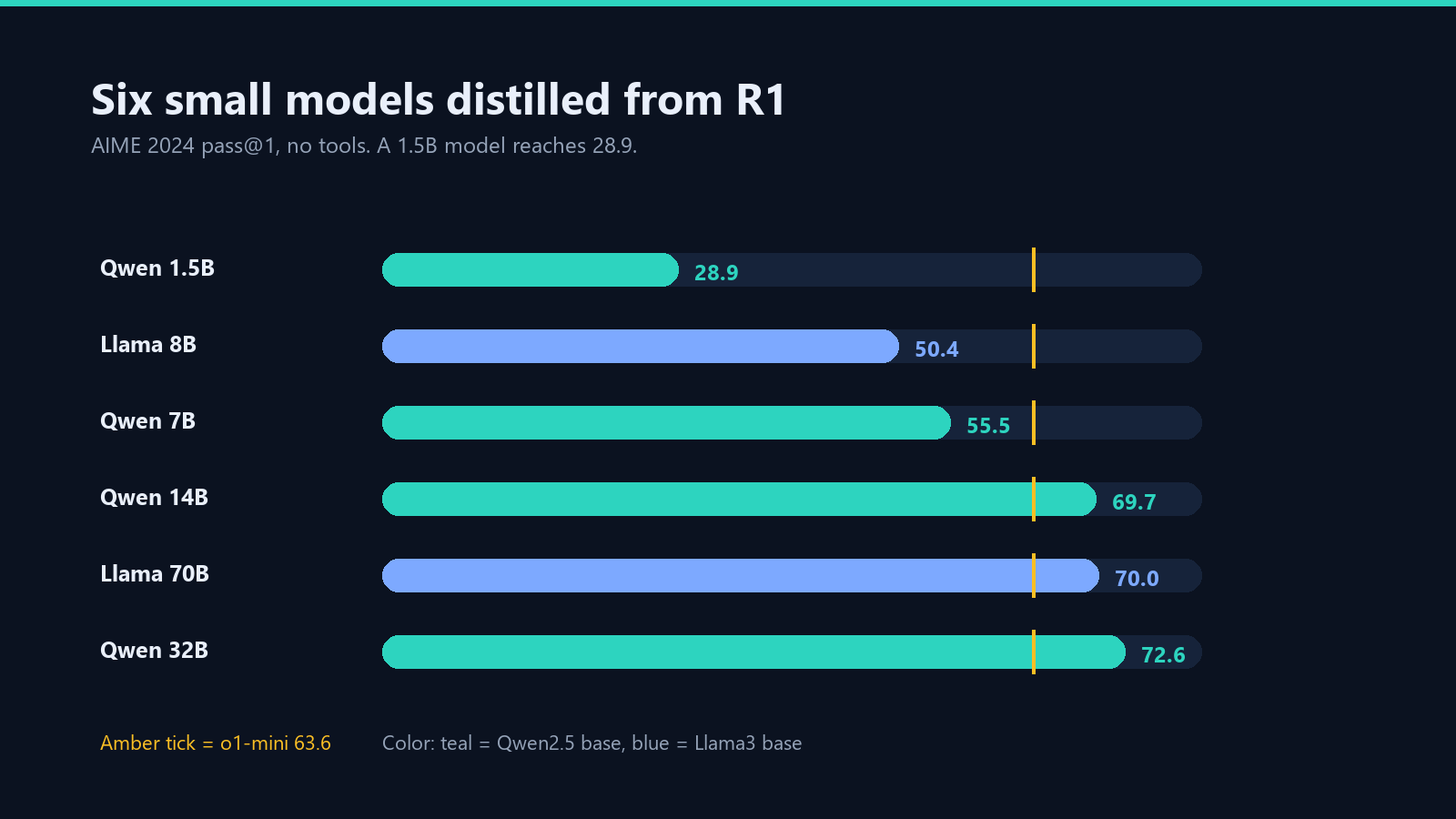
DeepSeek fine-tuned six dense models on reasoning data that R1 generated, built on Qwen2.5 and Llama3, from 1.5B to 70B parameters.
The 70B Llama build scores 70.0 on AIME 2024 and 94.5 on MATH-500. The 32B Qwen build scores 72.6, ahead of o1-mini's 63.6. Even the 1.5B build reaches 28.9.
These are not shrunken copies of R1. They are ordinary dense models imitating R1's output, and DeepSeek's paper reports that this beat running RL on the small models directly. The 32B model can fit on one sufficiently large GPU depending on precision, context length, runtime, and available memory.
When is R1 the right tool?
- Competition and olympiad math, where one wrong step ruins a long solution.
- Logic and constraint puzzles, the kind with five suspects and three lies.
- Planning: give it options and constraints, ask which plan breaks first.
- Debugging where the fault is in the reasoning, not the syntax.
It is the wrong tool for a single-fact lookup, for autocomplete, or for anything where nobody will read the reasoning.
How does R1 relate to DeepSeek-Math?
DeepSeekMath, from February 2024, was a 7B model trained on 120B math tokens, and its paper introduced GRPO. It showed that math-heavy pretraining plus RL could grow real reasoning in a small model. R1 builds on that line of research at 671B parameters with a mixture-of-experts base and a different multi-stage training pipeline.
What do the benchmarks say?
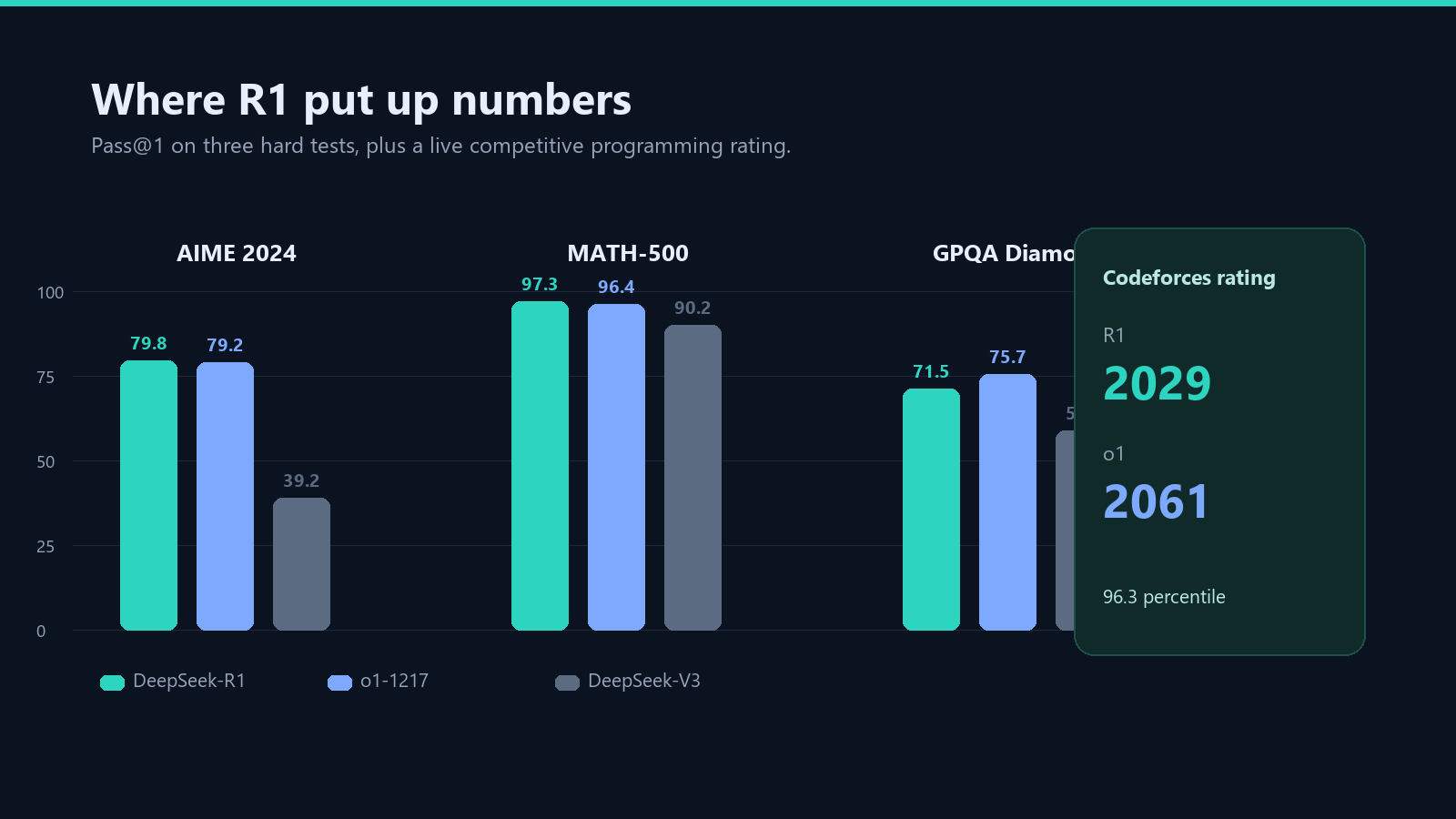
In DeepSeek’s original 2025 evaluation, R1 was close to o1 on these math tests and behind on science questions and competitive programming:
| Benchmark | DeepSeek-R1 | o1-1217 |
|---|---|---|
| AIME 2024, pass@1 | 79.8 | 79.2 |
| MATH-500, pass@1 | 97.3 | 96.4 |
| GPQA Diamond, pass@1 | 71.5 | 75.7 |
| Codeforces, rating | 2029 | 2061 |
| MMLU, pass@1 | 90.8 | 91.8 |
The gap that matters in daily use is AIME. V3, a general model from the same family, scores 39.2 on that test against R1's 79.8.
FAQ
What is the difference between R1 and V3?
The original V3 is a general model; R1 builds on V3-Base with additional training that emphasizes reasoning. On AIME 2024 that is 39.2 against 79.8. Use V3 for volume and ordinary difficulty, and R1 for the cases you would otherwise hand to a person.
Does R1 cost more tokens?
Often, because generating a reasoning trace adds output tokens before the final answer. Cost depends on the provider and its pricing. For the original R1 weights, DeepSeek recommends putting instructions in the user message instead of using a system prompt; check current documentation when using newer models.
Sources
DeepSeek-R1 model repository and technical report · DeepSeek thinking mode documentation · DeepSeek models and pricing.
For current DeepSeek access, the Coding Plan page lists available plans and supported models. The original R1 weights are not implied to be included.
Check plans and prices