AI Agents / DeepSeek Harness
DeepSeek Harness (DSH) Super-agent Puts an AI to Work on a Real GitHub Repo.
TL;DR
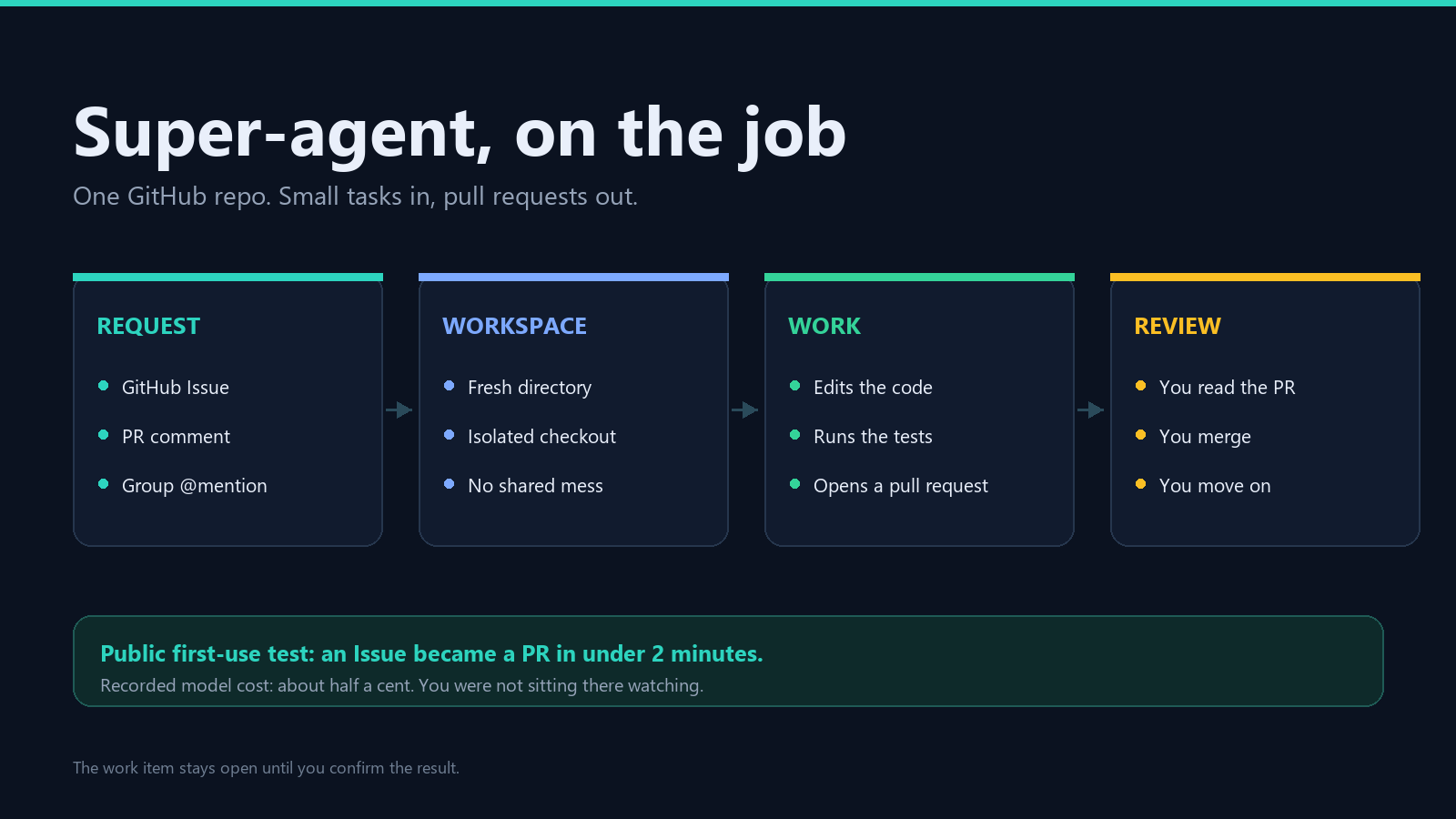
DeepSeek Harness Super-agent is a research prototype that can turn eligible GitHub events into tracked work. A worker can make changes, run appropriate checks and prepare a pull request; the task can remain open while a person reviews the outcome. It is best evaluated on a small repository with clear permissions and human review.
Most AI tools wait for you. This one waits for GitHub.
Most AI coding tools sit in a chat window and wait for you to type. They move when your hands are on the keyboard and stop when you close the laptop. You are still the person who has to remember "I will fix that README later."
Super-agent listens for GitHub activity, including issues, pull request discussions and CI events. Policy and the agent’s evaluation determine whether an event becomes work. A Ticket tracks that work independently of the worker session, including through review when an outcome is still pending.
This separation changes the workflow: the Ticket can retain its identity when a worker session ends or execution is retried. The service still needs to be running and correctly configured for the queue to move.
A useful first experiment is a narrowly scoped documentation issue: check whether the prototype accepts the request, makes the intended change and returns a reviewable result. Results will depend on the task, configuration and model.
What it actually takes off your plate
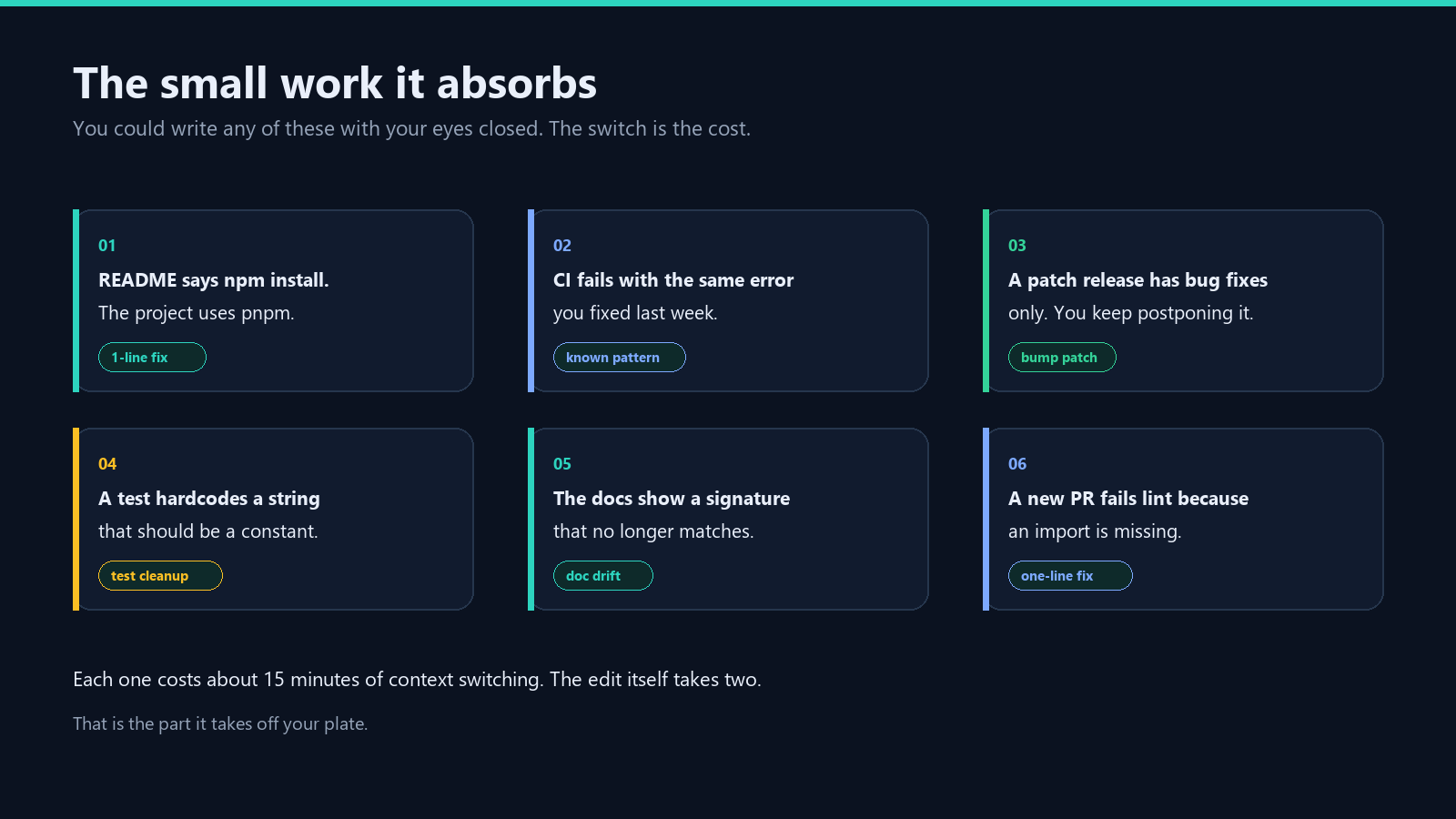
Here are the jobs that pile up in a normal week. A new Issue arrives with clear reproduction steps, but the README install command no longer matches the project. You mean to fix it, then a meeting starts. CI turns red and the log shows the same error you fixed last week in another module. A patch release lands with nothing but bug fixes, and you know you should bump it, but the task never reaches the top of the list. A test hardcodes a string that should be a constant. A reader files an Issue because a function signature in the docs no longer matches the code. A new PR fails lint because an import is missing.
These tasks vary in difficulty, but each can interrupt the work already in progress. A review queue can help group small changes together when the tasks and checks are well defined.
For an eligible task, the worker can prepare a workspace, make a change, run checks and propose a pull request. Review the diff and test results yourself; completion and quality are not guaranteed.
The potential benefit is fewer context switches, balanced against the time needed to configure the service, review its output and resolve mistakes.
On Friday afternoon you open the PR list and review six small changes in a row. Your brain stays in review mode instead of switching between writing and fixing. That is the real product: a buffer between you and the small work that keeps breaking your focus. The tasks are small enough that saying no feels silly, and frequent enough that they ruin the afternoon.
Who should start now
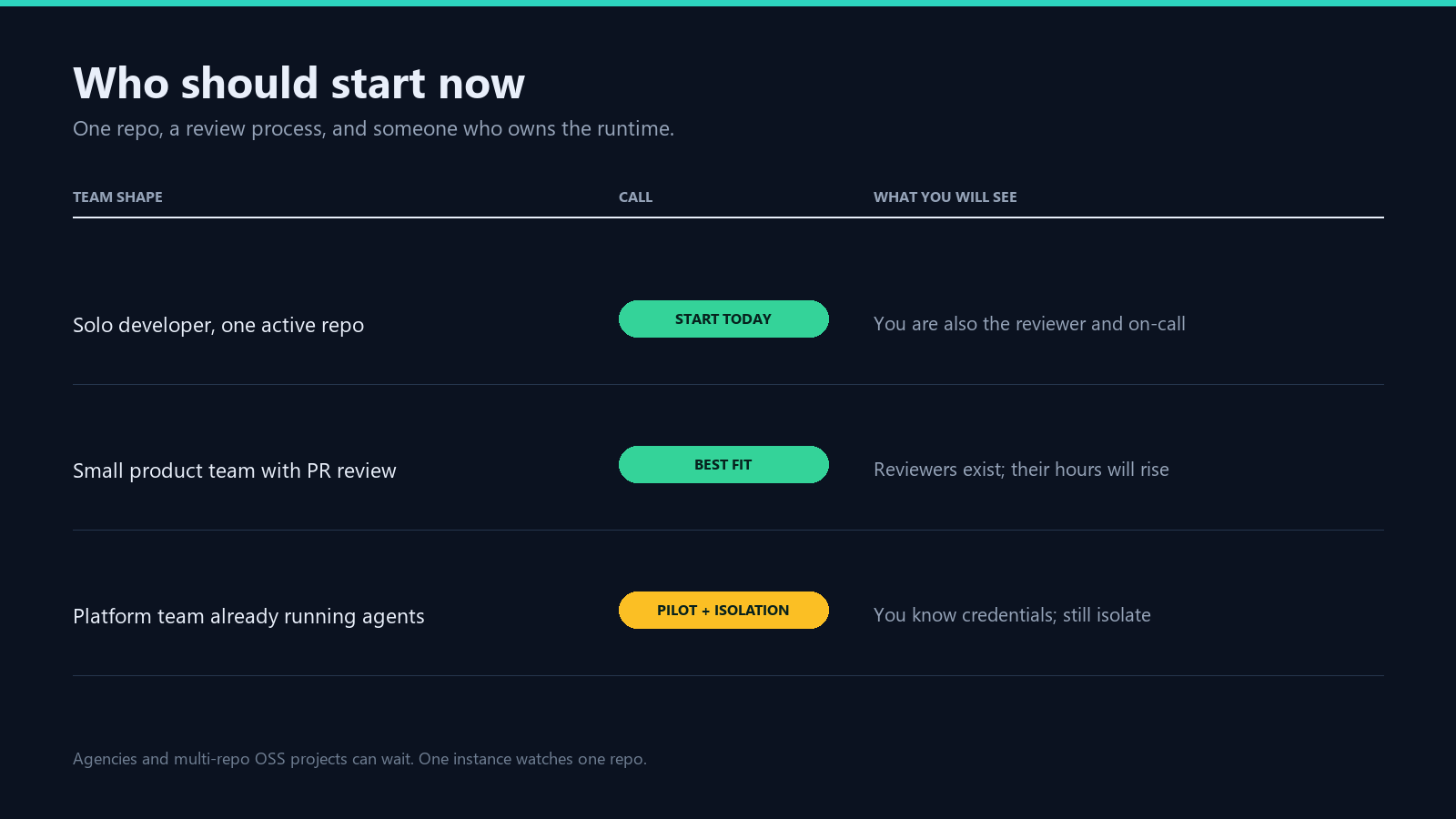
Three groups may find the prototype useful if they have a suitable repository and can maintain the runtime.
Solo developers maintaining one active repository can try batching small documentation and test changes for review. The agent still needs an owner, a running service and appropriately scoped credentials.
Small product teams that already review pull requests can add agent-proposed changes to their existing review process. Each change still needs the same scrutiny as any other contribution.
Platform teams that already run agents. You can try it. Credentials and upgrades are your comfort zone, and you can own the operational side. The work still needs a dedicated runtime account, but that is familiar territory for you.
The three groups share a shape: one repository that produces a steady stream of small work, a review step that already exists, and one person who can own the runtime. Team size is not the variable.
Teams managing several repositories should account for separate instances and the extra operational work. Teams without an owner for credentials, updates and failures should wait until they can assign one.
What to give it, and what to keep
Give it work you could write with your eyes closed: reproducible bug fixes, missing tests, documentation that no longer matches the code, patch-version dependency bumps, known CI failures, and Issues with clear reproduction steps. The test is simple. If the task needs no product decision, it is a candidate. If you already know exactly what the diff should look like, it is a good candidate.
Keep the rest. Do not give it a requirement that needs back-and-forth with product, a question that spans several systems, an open-ended feature design, or anything where the first step is deciding what to build. If the work needs judgment about direction, it is a conversation, not a work item.
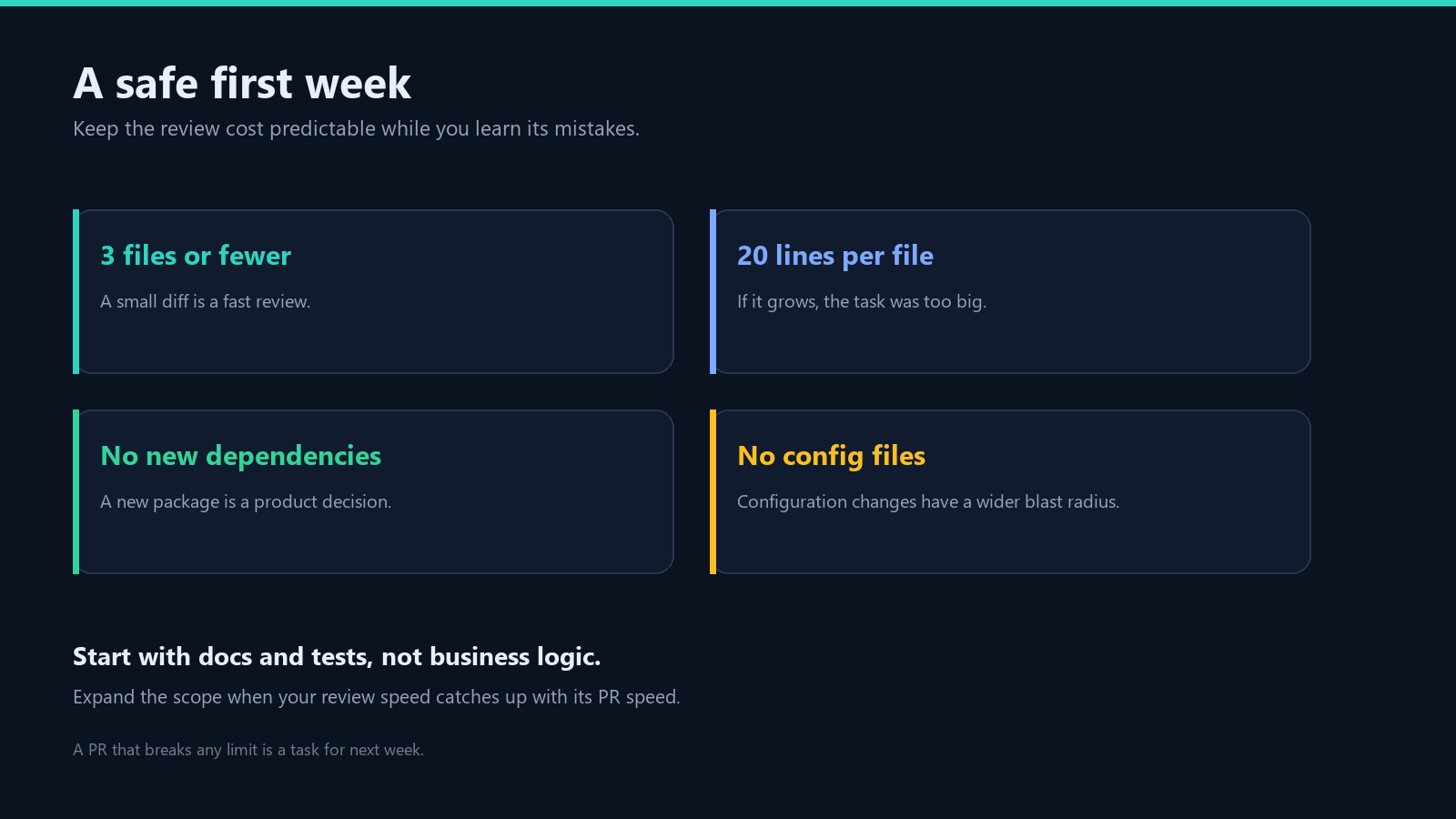
For the first week, restrict it to documentation and tests. Do not let it touch business logic. Use a concrete diff budget: no more than three files, no more than twenty changed lines per file, no new dependencies, and no configuration files. If a task breaks any of those limits, do not assign it yet. Expand the scope when your review speed catches up with its PR speed. Until then, a small queue you can actually review is more useful than a large queue you cannot.
This diff budget is a suggested starting policy, not a built-in guarantee. Enforce it through review and repository controls, and adjust it as you learn what is practical.
What it really costs you
Model cost depends on the provider, model, task size and retries. Track actual usage during a pilot alongside setup, maintenance and review time; a per-task estimate should not be treated as a monthly budget.
Review time also varies with the change and the quality of the tests. Batching small pull requests may reduce interruptions, but the benefit should be measured against the time required to review and correct them.
Before starting, document what the agent may do, who can request work and which actions require human approval. Review those rules as your use changes.
Plan for upgrades, credentials and process isolation. If you use Feishu, configure its bot separately; check the deployment instructions and permissions for your installation.
Include model usage, operational ownership and human review when estimating the total cost.
Two red lines
Require human review before changes reach the default branch. Disable auto-merge and configure branch protection in GitHub; do not assume the prototype enforces your repository policy for you.
The same identity or permission problem must not happen twice without an owner. The first time, it is a missing permission. The second time, it is a design gap: nobody has decided what the agent is allowed to read. Fix the boundary, not the symptom.
If either rule breaks, stop. Treat them as the safety rope that lets you use it without watching every move.
Start this afternoon
Start with a disposable test repository. Restrict who may assign work, disable auto-merge and ask the agent to improve a small README section. Check whether a Ticket is created, a pull request is prepared and a reply reaches the original conversation.
If those three checks succeed, you have a useful first result. Repeat with a few bounded tasks and compare review time, failures and operating costs before expanding access.
For setup details, see our Super-agent setup and cost guide. Check the current DeepSeek Coding Plans and confirm compatibility before choosing a provider.