DeepSeek's App Was the Demo: Building Your Own Clone With the New APIs (Nov 2026)
TL;DRThe November 13 release is easier to read as a build plan than as a feature list. DeepSeek took the parts of its chat app that used to require separate vendors, search, page fetching, file parsing, speech and a moderation pass, and exposed them as parameters on deepseek-flash. That removes the middle layer of a chat product, not the whole product. What stays with a builder is the source policy, the upload flow, the latency budget, the refusal UX and the data you index. Two-part billing, tokens plus a per-tool rate, decides whether a clone is a cheap experiment or an expensive one, and the release publishes no quality numbers, no tool-call ceiling, and no statement that the demo client is production ready.
By Cameron Voss and West Mao
On this page
DeepSeek's announcement on November 13 lists five capabilities. Read as a feature list, it is a search tool, a file parser, a link reader and a safety switch. Read as a build plan, it says something more useful: the company has stopped treating its chat app as the product and started treating it as the reference implementation for its API.
That shift decides what a builder still has to own. Most of the middle layer of a chat product can now be deleted or bought with a flag, and what remains is the part that was never the model's job.
What is left for you to build?
The release absorbs retrieval, page fetching, extraction, speech and a moderation pass. Those are the jobs that used to force a small team to sign three vendors and write four adapters before the first user message reached the model.
Scroll horizontally to see all columns.
| Job | What it used to take | What it takes now | What stays yours |
|---|---|---|---|
| Search with citations | A search vendor, result ranking, citation formatting | One tool flag and a tool name | Deciding which sources an answer may cite, and what to do when none is good enough |
| Reading a page | Crawler, retry logic, JavaScript rendering, truncation rules | deepseek_read_url | Which URLs are in scope, and the fallback when a page returns an empty shell |
| Uploading a document | Converter, OCR, chunking, a vector store | File input in the request | Chunking policy if the document also has to be indexed for later turns |
| Voice | An ASR vendor, a TTS vendor, turn-taking logic | Standalone ASR and TTS, or voice inside the app loop | Latency budget, interruption handling, and how the transcript is stored |
| Safety review | A classifier or a moderation vendor | Safety check parameter | How a refusal surfaces in your interface, and the filing duties you still owe |
The middle two columns are what the November 13 release covers. The last column is the part no endpoint can take over.
Scroll horizontally to see the full figure.
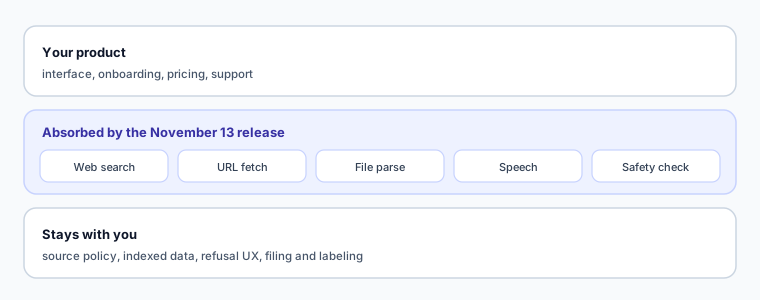
The last column is the honest one. A search endpoint can return results, but it cannot decide that one source is unacceptable for your product. A parser can read a document, but it cannot decide how long that document should stay in context when a conversation runs to thirty turns. Those calls stay with you, and they are where a clone stops being a clone and becomes a product.
Why treat the app as a reference implementation?
DeepSeek's closing paragraph is where this reading comes from. The company says interaction between people and models still has a lot of unexplored room, and that the chat product it ships today is only a relatively basic form of that interaction. Everything behind the product, in its account, is now callable and combinable through the API.
That is a vendor telling you where it thinks the value sits. If the interface was the valuable part, you would not expose the machinery under it and invite people to rebuild it. Exposing the machinery implies the interface is the cheap part, and that DeepSeek would rather sell the layer underneath to everyone building their own.
Coverage of the release pushed the same point harder, describing the endpoints as enough to reproduce the app one to one. That is close enough to true for planning. What reproduces is the interaction pattern, not the product. A rebuilt app gets search, citations, file reading and voice; it does not get the ranking decisions, the onboarding, the latency tuning or the abuse handling.
Who should rebuild, and who should not?
A solo builder shipping a vertical assistant gets the most out of this. If the product was going to be a search-plus-documents assistant for one profession, the release removes the month of plumbing that usually comes before the first demo. The build becomes a prompt, a policy and an interface.
A team with a working retrieval pipeline should take a narrower step. Their index is probably the valuable part, tuned to their own corpus. Replacing the crawl and parse edges and keeping the index is the move that preserves work, and it is also the move that lets them compare citation quality against what they already have.
A product that sells the chat interface itself should be careful. If the interaction pattern was the differentiator, the release just commoditized it. Rebuilding faster does not create an advantage; it confirms there was none.
There are also reasons to wait a quarter. If your answers need a fixed citation format for compliance, a release that does not document its format is not ready for you. If your legal team needs a data processing agreement per vendor, you are trading one vendor for another and should price the paperwork. If your volumes are small and your tool calls per task are large, the new billing model can cost more than the search API you already pay for.
What happens to the moat?
Retrieval with citations used to be a moat for anyone who built it well. It is now a parameter. That does not make products identical, but it moves the differences to places the release does not touch: a proprietary corpus, a workflow with real switching costs, distribution, and the operational detail of keeping answers fast and correct under load.
This is our read, not DeepSeek's claim. The company's own framing is closer to an invitation, and invitations usually mean the vendor expects the layer below to be crowded.
How does two-part billing change a small product?
The announcement says tool use is charged on top of the standard token fee, with a separate price for each tool in the official table. This piece does not repeat those rates, because per-search and per-page prices are the kind of number that changes without a launch post.
What matters for a small product is the ratio. A question that needs one search is a predictable cost. An agent that searches, opens three pages and searches again is a different budget, and the difference grows with conversation length. The metric to track is tool calls per resolved task, not tokens per request: the second one stays flat while the first one quietly multiplies.
Model that before you celebrate the deleted integrations. A saved vendor contract is not a saved cost if the replacement bills per call and your usage is chatty.
What should you test in the first week?
- Citation stability. Ask the same question with search on five times and record how often the source list changes. If it changes on every run, build your own caching layer before showing citations to a paying user.
- Refusal rate on benign prompts. Send a hundred ordinary business questions with the safety parameter on and count the refusals. A refusal marker you cannot characterize is a support ticket you cannot answer.
- Empty shells. Try five pages that build their text in the browser and five behind a login. Note which ones come back empty rather than failing loudly.
- Scanned documents. Upload a text PDF, a scanned PDF and a slide deck with text inside shapes, then check what the model can quote back and what it invents.
- Context growth. Run a twenty-turn conversation with a large file attached and watch the cost and the latency curve. File context that grows per turn is the most common way a cheap feature becomes an expensive one.
What is still missing from the release
The announcement is an availability statement. It publishes no accuracy numbers for cited answers, no ceiling on tool calls per request, and no statement about the demo client beyond the fact that it is open source.
The search engine behind the tool has a claim attached from October 17: hundreds of millions of requests a day, hundreds of billions of pages indexed, and filters for SEO spam, GEO manipulation and low-quality generated pages. Those numbers come from DeepSeek, and nobody outside the company has published a measurement of how well the filters work. If your product depends on clean sources, that is a gap to test rather than trust.
There is also no documented answer to what happens when the tool budget runs out mid-answer. A truncated research loop returns a confident paragraph built on partial reading, which is worse than a visible error. Until the behavior is documented, put your own ceiling on tool use and log when it trips.
Frequently asked
Can I ship a DeepSeek app clone as a commercial product?
The endpoints are sold to API customers, so the technical path is open. The commercial path is a contract question with DeepSeek, plus the filing and labeling duties your own market imposes. Nothing in the release grants brand rights, so a clone should not present itself as an official DeepSeek product.
Do I still need my own search API?
Not for a first version. Keep a separate one only if you need domain filtering, licensed sources, or a citation format the release does not give you. For most builders the tool flag removes a vendor and a month of work.
Is the open-source demo client ready for production?
It is a demo and reads like one. Treat it as a reference for how the parameters fit together. Authentication, rate limiting, persistence and billing are yours to add.
Does per-tool billing make a small app uneconomic?
It depends on how many tool calls a finished task needs, which is a number you have to measure on your own traffic. A single search per question is cheap; an agent that searches and fetches ten times per turn is a different budget. The official pricing table carries the per-tool rates.
How is this different from the release notes?
The release notes cover what shipped and which parameter enables each capability. This piece covers what a builder has to own afterwards, what the vendor's framing implies, and what to test before shipping. The technical write-up is at /news/deepseek-opens-app-apis-web-search-file-input-url-reading.