DeepSeek Harness RC.8 Adds Multimodal Input and On-Demand Codex Subagents
DeepSeek Harness RC.8 adds native image-request configuration for DeepSeek adapters, image input for core commands, and on-demand Claude Code and Codex subagent bundles. The official release also improves search concurrency, Windows PowerShell sessions, storage, and the Python SDK.
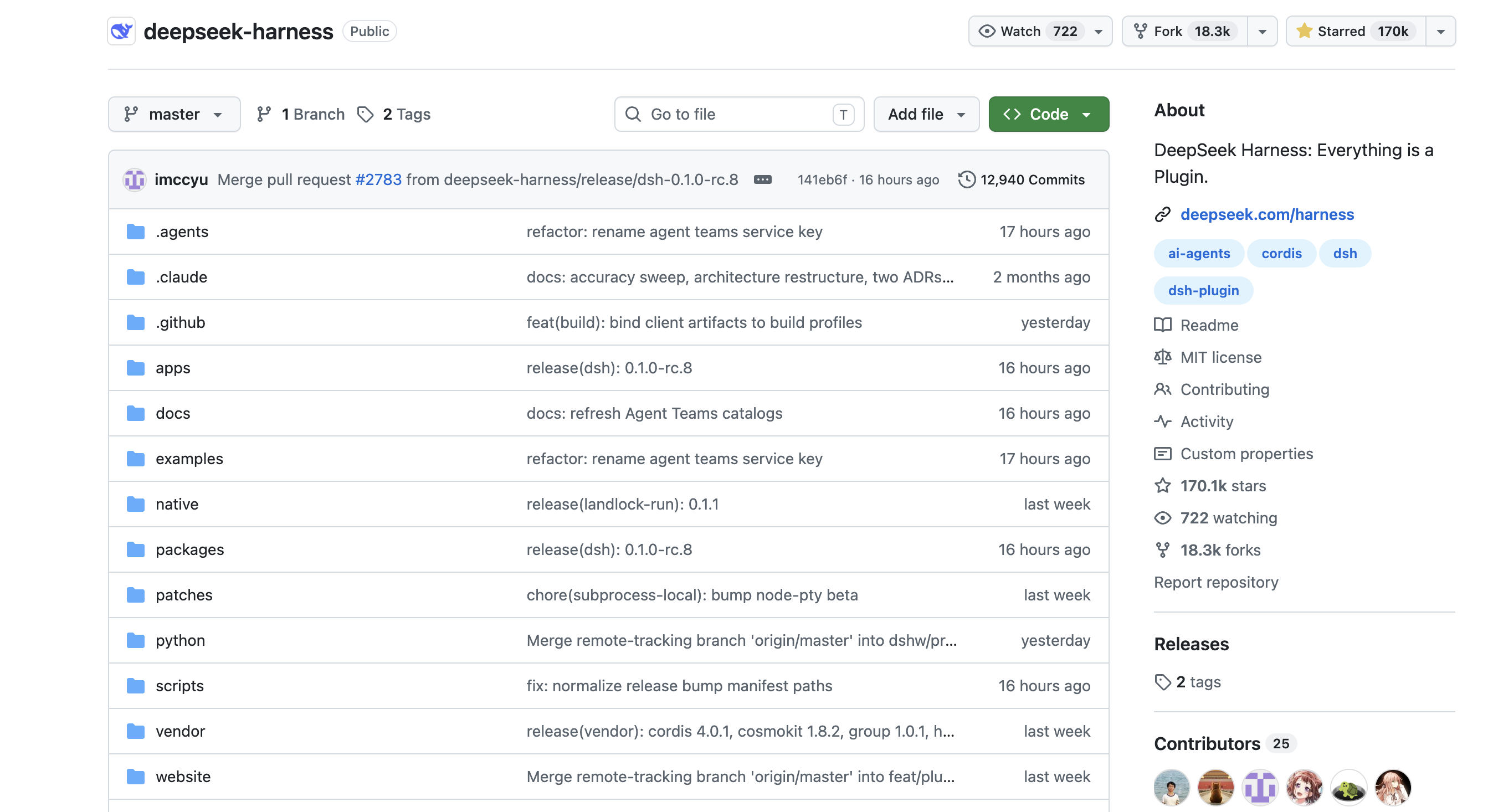
DeepSeek released DeepSeek Harness v0.1.0-rc.8 on August 19, two days after RC.7. The developer-preview update expands how the open-source agent harness accepts input, launches subagents, and manages longer-running work. It also comes with a compatibility warning: the release changes the SQLite storage format.
The headline is not that DeepSeek has announced a new multimodal model. RC.8 changes the Harness layer around a model. Its official notes say DeepSeek adapters can be configured to send native image requests, while /goal and /plan can now accept image-and-text input. The @ menu can reference local files and earlier sessions.
Image input reaches the core workflow
For an agent framework, the practical difference is where a file enters the task. A developer can now include an image when setting a goal or plan, then reference a local file or earlier conversation as the work continues. Whether a particular model can understand the image still depends on the selected provider and model. RC.8 documents the request path in Harness; it does not turn every connected model into a vision model.
The release also fixes two image-related failure modes: oversized images and accumulated image payloads from history that could cause model requests to fail. That matters for agents working across several visual inputs, where the active context can quietly become much larger than a single upload.
Codex and Claude Code become installable subagent bundles
RC.7 had already put Codex and Claude Code subagent jobs into the Job Panel. RC.8 takes the next step: both can be installed on demand as Profile Bundles and called as subagents. For Codex, the release adds non-interactive permission modes and support for several named instances.
That supports a clearer division of labor. Harness can own the parent task and schedule work, while Codex or Claude Code handles a delegated coding step. Calling Harness a universal agent control plane would go beyond the release notes, but the bundle and subagent design moves it in that direction.
Faster fan-out, better handoff
The web_search tool now supports concurrent queries. A subagent’s reportDelivery can also return its result promptly and wake the parent task. Together, those changes should reduce idle time in workflows that gather several sources in parallel before a parent agent synthesizes the answer. The exact gain will depend on the tools, network latency, and task design.
RC.8 also improves the plumbing around those tasks. Windows PTY terminals gain persistent PowerShell sessions, enabled by default in the Minimal preset. Local dsh web runs can open the browser automatically, and the release says dependency downloads are smaller.
Storage migration and compatibility fixes
The SQLite backend receives read, write, and fork-performance improvements plus lower storage use, but the data structure is incompatible. Existing users should treat that as a migration concern, not a routine patch detail.
Other fixes cover cancelled streaming output that was not being preserved for later prompts or forks, plus custom OpenAI-compatible gateways that could fail because of request-format differences or return incomplete reasoning content. The Python SDK runtime now covers all four built-in Agent Presets and includes dependencies for rg, glob search, and MCP stdio tools.
What to do before upgrading
Read the release notes, back up any SQLite-backed data, and test RC.8 with the exact provider, tool bundle, and permission configuration used in production. Developers trying image input should confirm that their selected model and provider support it before treating the new Harness request path as end-to-end vision support.
DeepSeek calls Harness a developer preview and says compatibility-breaking changes should be expected. RC.8 is a substantial workflow update, but it is still an early release rather than a promise of a stable, uniform agent runtime.