DeepSeek V4.1 Flash vs Gemini 4 Carbon: Price, Context and Native Tooling
TL;DRDeepSeek V4.1 Flash is available now through its public API. It offers a 1M-token context, image input, tool calls, MIT-licensed weights, and off-peak prices of USD 0.15 input and USD 0.60 output per million tokens. Google describes Gemini 4 Carbon as its strongest model for long-horizon engineering and security work. It plans introductory pricing of USD 2 input and USD 10 output per million tokens. As of November 2, 2026, public access, a model ID, and a context window have not been announced; initial access is limited to selected cyber defenders. DeepSeek exposes Search and Fetch as separate APIs. Google’s Gemini API supports search grounding and URL reading inside a request, but Carbon-specific tool availability has not been confirmed.
By Cameron Voss
How do they compare at a glance?
| Dimension | DeepSeek V4.1 Flash | Gemini 4 Carbon |
|---|---|---|
| Availability | Public API now. Model ID deepseek-flash, version V4.1-Flash-1017 | Gated. Selected cyber defenders first. No public model ID as of November 2, 2026 |
| Context | 1M input tokens, up to 384K output | Not published. Argon, the base model, offers 1M |
| Price per 1M tokens | Off-peak USD 0.15 input, USD 0.60 output. Peak USD 0.30 and USD 1.20 | Introductory USD 2 input, USD 10 output |
| Cached input | USD 0.003 off-peak, USD 0.006 peak | 95% off input, so USD 0.10 during the introductory period |
| Web tools | Tool calls, plus separate Search and Fetch APIs at USD 0.75 per 1,000 successful requests each | Gemini API supports search grounding, URL context and function calling on supported models; Carbon support is unconfirmed |
| Weights | 1017 checkpoint under MIT | Hosted only |
What do they cost?
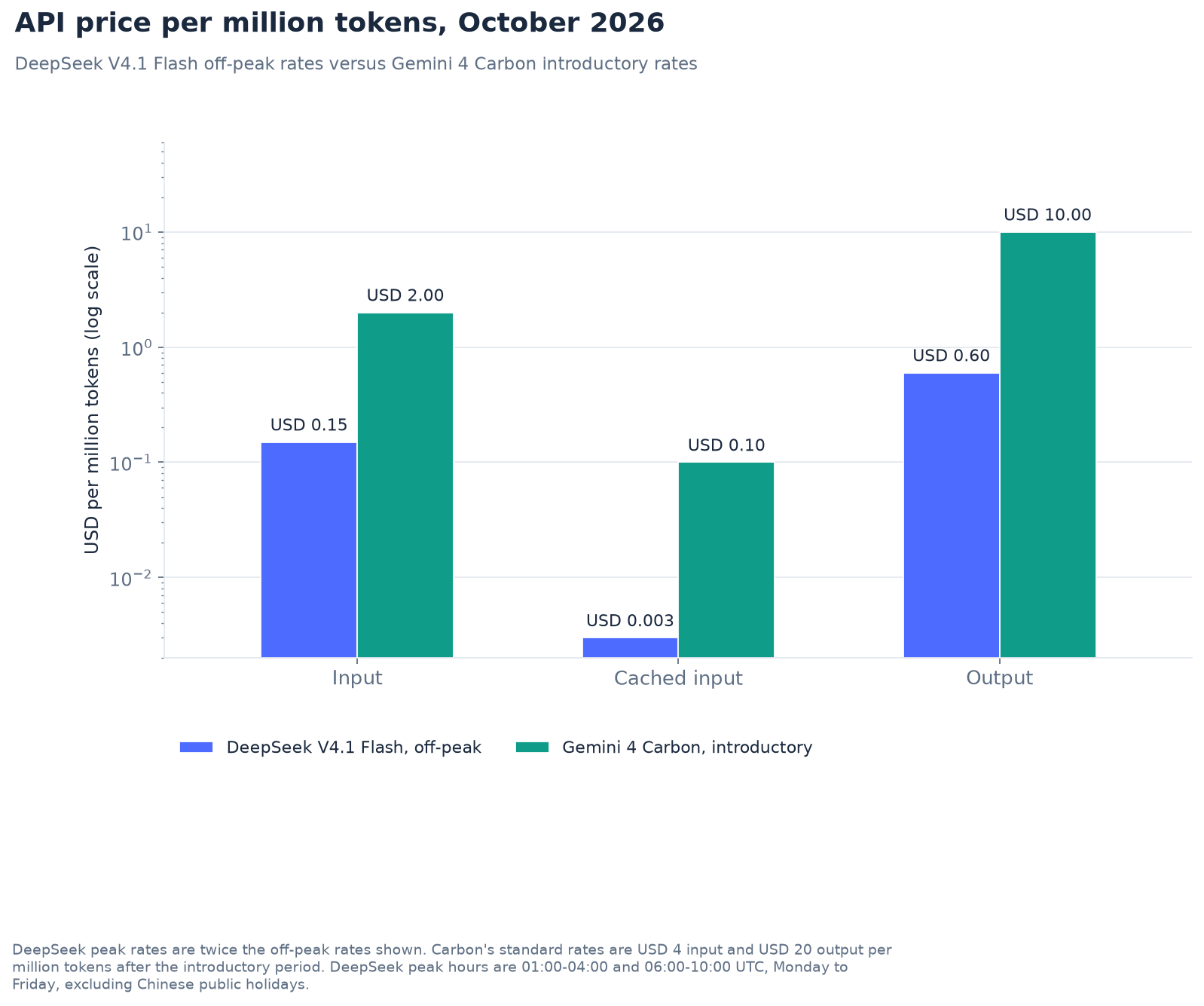
DeepSeek peak hours are 01:00 to 04:00 and 06:00 to 10:00 UTC, Monday to Friday, excluding Chinese public holidays. Off-peak rates are half the peak rates, and a cache hit costs USD 0.003 per million input tokens off-peak.
Across requests, 1M uncached input plus 250K output costs USD 0.30 off-peak or USD 0.60 at peak. At Carbon’s announced introductory rates, the same usage would cost USD 4.50. Google says Carbon will later cost USD 4 input and USD 20 output per million tokens; its announcement does not give a Carbon-specific end date for the introductory period. Tool charges and cache storage fees, where applicable, are extra.
How much context and access do you get?
DeepSeek publishes 1M input tokens and 384K maximum output. Google has not published Carbon's context window. Its GraphWalks score of 96.2% covers 256K to 1M tokens, but that is a benchmark, not an API limit.
Access is the bigger difference. DeepSeek's API is open now, and the 1017 weights are MIT-licensed. Carbon is limited to a subset of cyber defenders, with wider access through Fairwind and a public launch promised but undated.
How does native web access differ?
DeepSeek keeps retrieval outside the model. Search returns raw JSON from its own index, and Fetch returns one page as Markdown. Each costs USD 0.75 per 1,000 successful requests. Your app decides when to call them and how to assemble the results.
For supported Gemini models, google_search lets the model run queries and return citations. Google lists search grounding charges after a free monthly allowance; url_context reads up to 20 URLs per request, with retrieved text billed as input. Confirm Carbon compatibility and current pricing before relying on these features.
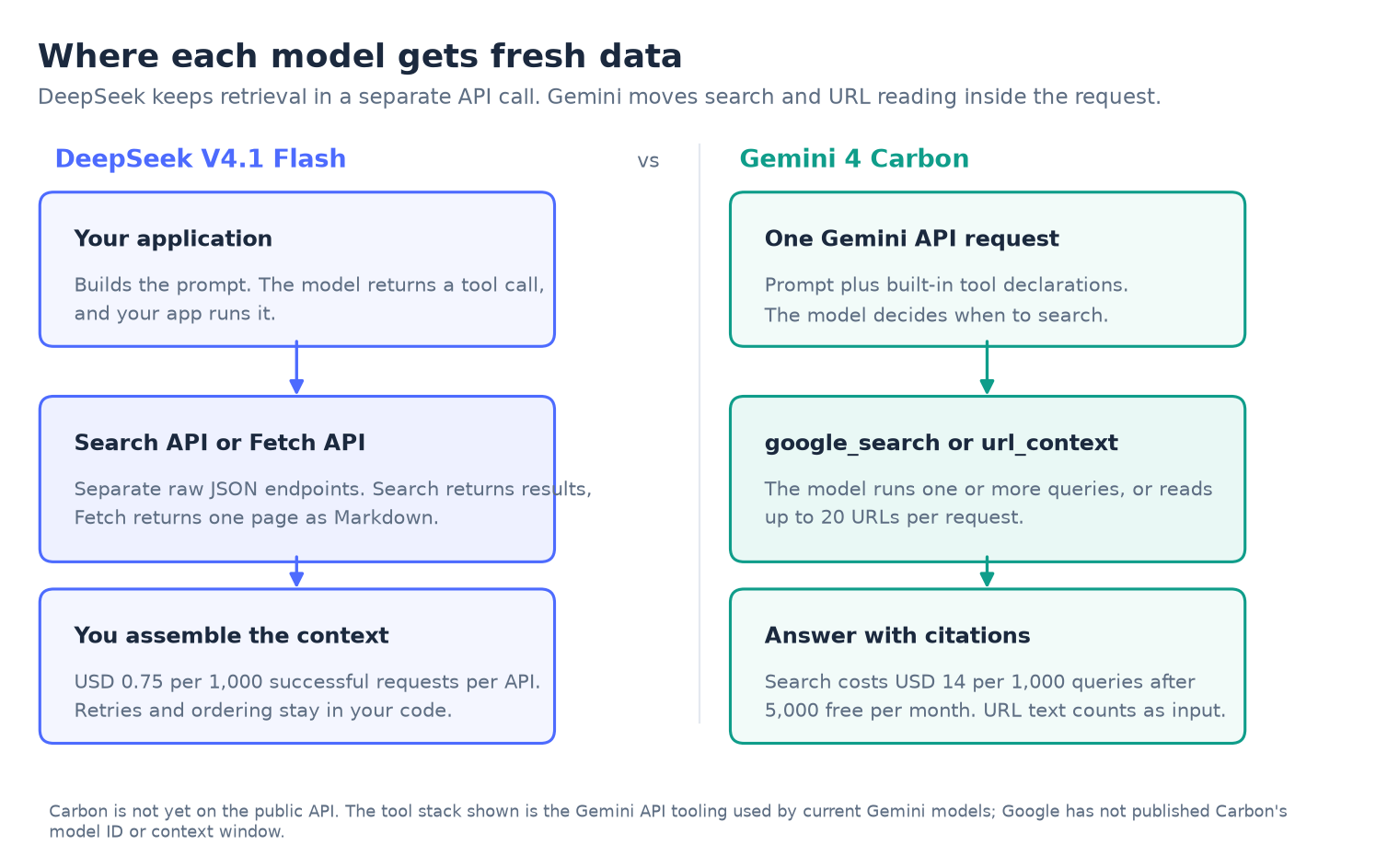
DeepSeek gives your application a separate, inspectable retrieval step. For supported Gemini models, grounding can reduce integration work; evaluate tool availability and charges for the model you actually use.
What do the benchmarks show?
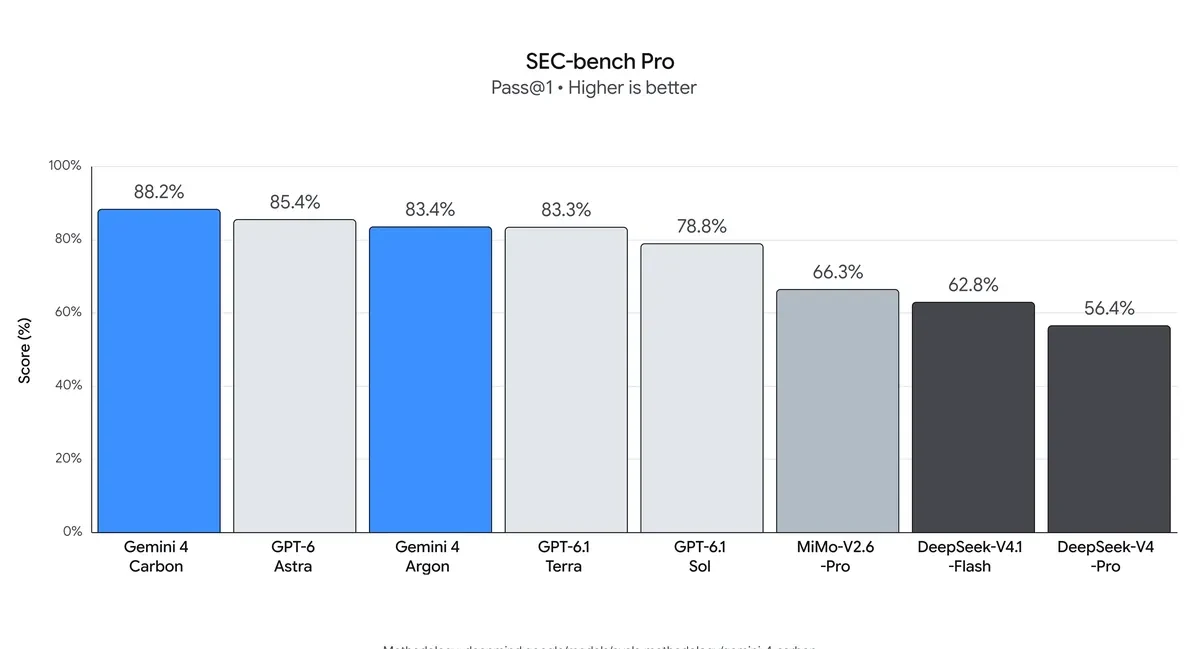
Google reports Carbon at 59 on the Artificial Analysis Intelligence Index v5.0, 88.2% on SEC-bench Pro, 54.8% on ExploitGym, and 71.0% on CWE-bench. WebDev Arena puts it at 1768, fourth. DeepSeek's own table lists 42.3 on Terminal-Bench 4.0 and 77.0 on DeepSWE v1.1. The harnesses differ, so these are not a head-to-head ranking. Google's SEC-bench chart also includes DeepSeek V4.1 Flash at 62.8%.
Which workflow fits which model?
DeepSeek fits work that needs a public endpoint now: code assistants, document pipelines, and agents that call their own tools. The 1M window and low cache price help repeated long-context work. Open weights allow self-hosting, though this model needs real infrastructure.
Carbon is aimed at security remediation and long-horizon engineering runs. Google says initial access is limited to a subset of cyber defenders, with access expanding to trusted partners through Fairwind. A broader public launch has not been dated.
FAQ
Is Gemini 4 Carbon available in the API?
As of November 2, 2026, Google has announced limited initial access but no public model ID or launch date. It has announced introductory pricing, though the public Gemini API pricing page does not yet list Carbon.
Which costs less?
At the published rates, DeepSeek is less expensive per token. Across requests, 1M uncached input plus 250K output costs USD 0.30 off-peak or USD 0.60 at peak. At Carbon’s announced introductory rates, the same usage would cost USD 4.50. Actual task costs also depend on token usage and any tool charges.
If you want to run DeepSeek V4.1 Flash through a managed plan, see the current Coding Plan options on our pricing page.