DeepSeek V4 Flash Vision Exp Launches on the Multimodal API
DeepSeek has launched the experimental V4 Flash Vision Exp model on its API, with mixed image and text input, three request formats, and a free Files API for reusable uploads.
DeepSeek launched DeepSeek-V4-Flash-Vision-Exp on its API platform on August 21, 2026. The experimental model adds visual understanding while keeping the text performance of the standard V4 Flash release. It is available with model='deepseek-v4-flash-vision-exp'.
Source: DeepSeek Official.
Balancing text and multimodal performance
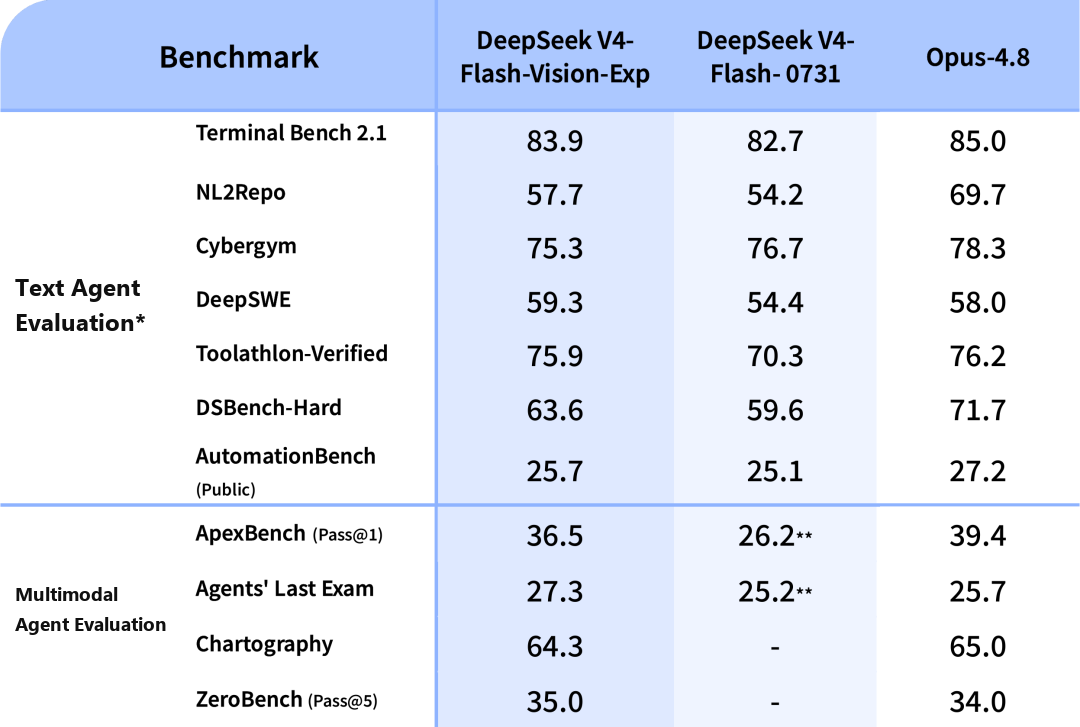
DeepSeek says V4 Flash Vision Exp matches the official V4 Flash model on text-only work, including agent tasks, reasoning, and world knowledge. The difference appears when a task needs visual understanding. In DeepSeek's published agent benchmarks, the experimental model improves substantially over V4 Flash and approaches Opus 4.8 on multimodal agent tasks.
The scores below are listed as V4 Flash Vision Exp / V4 Flash 0731 / Opus 4.8.
Text agent evaluations
- Terminal Bench 2.1: 83.9 / 82.7 / 85.0
- NL2Repo: 57.7 / 54.2 / 69.7
- Cybergym: 75.3 / 76.7 / 78.3
- DeepSWE: 59.3 / 54.4 / 58.0
- Toolathlon-Verified: 75.9 / 70.3 / 76.2
- DSBench-Hard: 63.6 / 59.6 / 71.7
- AutomationBench (Public): 25.7 / 25.1 / 27.2
Multimodal agent evaluations
- ApexBench (Pass@1): 36.5 / 26.2* / 39.4
- Agents' Last Exam: 27.3 / 25.2* / 25.7
- Chartography: 64.3 / n/a / 65.0
- ZeroBench (Pass@5): 35.0 / n/a / 34.0
Benchmark note: For text-based Code Agent tasks in public benchmark sets, DeepSeek tested its models with DeepSeek Harness in Minimal mode, using the Max setting, temperature=1.0, and top_p=0.95.
Multimodal benchmark note: In ApexBench and Agents' Last Exam, the text-only DeepSeek V4 Flash model ignores multimodal elements.
More agent workflows with visual input
DeepSeek tested V4 Flash Vision Exp across several agent frameworks and tools. The launch article shows three examples: a commercial travel presentation, a redesign of the DeepSeek Harness website, and an animated front-end demo.
A custom Tibet road-trip presentation
The first example asks an agent to produce a one-month private driving guide covering Southern and Northern Tibet. The translated prompt reads:
Create a PowerPoint travel guide for a one-month self-drive trip through Southern and Northern Tibet. This is a premium private tour, not a standard group trip. The tone should feel wild, raw, and exploratory. It should go beyond familiar check-in spots and show a journey deep into uninhabited regions. Use a grand, rugged visual style with real weight. Avoid cute, delicate, or influencer aesthetics. The deck is for high-net-worth clients, so it must feel expansive, wild, premium, and polished. Finish with three realistic pricing packages, and use images with the look of real travel photography.
The model produced the following full presentation. Every visible Chinese heading and caption in the source image has been localized into English while the original photography and layout remain in place.
Interactive presentation
The Third Pole Expedition
1 / 12
A second take on the DeepSeek Harness website
For the second example, the model was asked to rebuild the official DeepSeek Harness site with a black and deep-blue ocean palette, glass UI elements, and ASCII-inspired atomic pixels. After an extended, multi-turn session, it produced a futuristic developer website.

An animated clay-monster demo
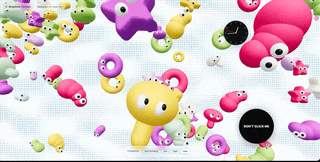
The third example is a small front-end demo inspired by a group of cute 3D clay monsters joining a pulsing retro dance-floor party.
API support
Developers can access V4 Flash Vision Exp by setting the model to deepseek-v4-flash-vision-exp. Images are converted into tokens and billed by token count. DeepSeek says one image uses no more than 384 tokens, with the same token pricing as V4 Flash.
The multimodal API supports Chat Completions, Messages, and Responses. Requests can mix images and text, and images can be supplied as inline base64 data, external URLs, or Files API references.
Files API is now available
DeepSeek has also opened its Files API at no charge. A developer can upload an image once, reference it later with a file_id, and reuse the same file across several requests. This reduces repeated uploads and the bandwidth they consume.