DSH Go Put DeepSeek Harness on Android. The 20,000-Star Claim Is a Week Off
TL;DRDSH Go is a solo-built, open-source Android client for DeepSeek Harness. It runs the harness inside a bundled Ubuntu environment on the phone, or connects to one already running on a desktop over SSH or WebRTC. On November 11, 2026 the repository had 18,532 stars, 814 forks and 469 open issues plus 32 open pull requests. The viral "nearly 20,000 stars in 10 days" version is about a week off: the project had roughly 8,400 stars at day 10 and would reach 20,000 around day 18 at its recent pace. Combined with the same author's earlier dsh-TUI plugin, the two projects now hold about 25,900 stars.
By Cameron Voss
On this page
What is DSH Go?
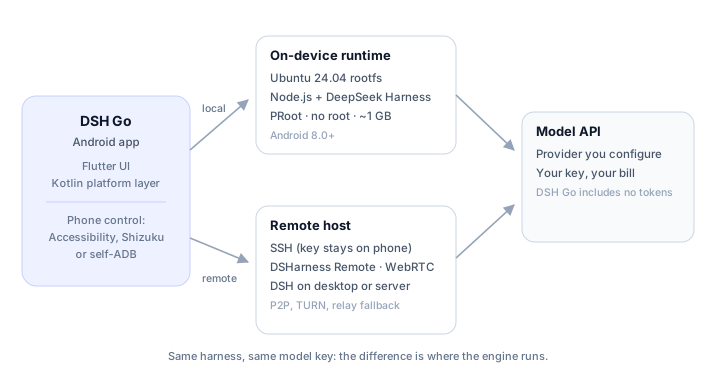
DSH Go is a free, open-source Android client for DeepSeek Harness, built by one independent developer rather than by DeepSeek. The app can unpack a small Ubuntu environment and run the harness directly on the phone, without root and without a separate Termux install, or it can connect over SSH or WebRTC to a DSH instance already running on a desktop or server.
The project lives at github.com/ccch1mneyyy/dsh-Go. On November 11, 2026, 17 days after the repository was created, it had 18,532 stars, 814 forks, 469 open issues and 32 open pull requests. The first public release, v1.0.0, arrived on October 30; v1.0.15 shipped on November 10, the sixteenth release in 12 days.
The README is explicit about what this is not: DSH Go is an unofficial community project, not affiliated with, endorsed by, or representative of DeepSeek. Model requests go to whichever provider the user configures, and that provider bills the user's own account.
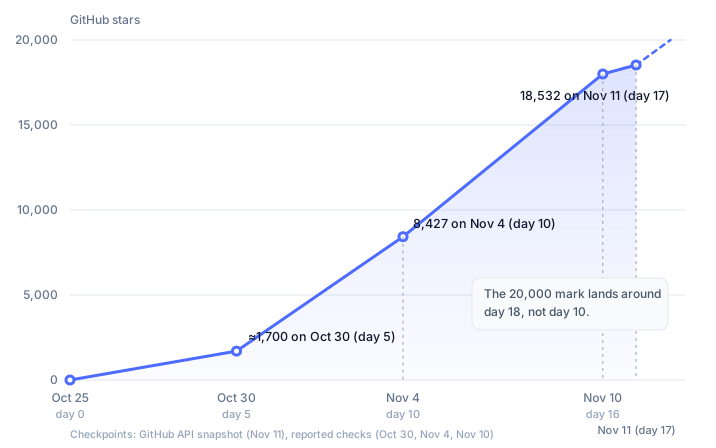
How fast did DSH Go actually grow?
The version of the story spreading on WeChat says the project collected nearly 20,000 stars in 10 days. The public record supports a fast project, but not that sentence.
- October 25: repository created.
- October 30, day 5: about 1,700 stars and more than 6,000 APK downloads, according to Zhidx coverage syndicated on NetEase. Trendshift also placed it at the top of its all-language daily chart around this point.
- November 4, day 10: 8,427 stars, according to a community tracker that queried the GitHub API that day.
- November 10, day 16: roughly 18,000 stars, 780 forks and 480 open issues, per another community check-in.
- November 11, day 17: 18,532 stars, 814 forks, 469 open issues and 32 open pull requests, from the GitHub API.
After the first five days, it was adding roughly 1,300 to 1,600 stars a day, which is fast in absolute terms. At its recent pace it would cross 20,000 around day 18, not day 10. At day 10 it had about 8,400 stars, less than half the viral figure.
The other number in circulation, 25,000 or so combined, is also true today rather than on day 10: 18,532 for dsh-Go plus 7,411 for the author's earlier dsh-TUI plugin comes to 25,943. On November 4 the two together would have been roughly 15,000.
This correction does not make the project less interesting. It makes the curve easier to read: a steady climb that kept going after the first week, rather than a single spike that stalled. The mismatch is easy to miss: a star count and a time window get paired in a headline, then copied without the date.
What can DSH Go do that a browser tab cannot?
Three capabilities explain most of the interest, and they are separate features rather than one product.
Run DeepSeek Harness on the phone
The app ships a packaged Ubuntu root filesystem, Node.js and the harness itself. On first run it unpacks that environment into private app storage and starts it through PRoot, a user-space compatibility layer that does not need root. The setup takes about 1 GB of free storage. Android 8.0 (API 26) or later is required, with arm64 packages for normal phones and an x86_64 build for emulators.
This is the part that makes the phone a real host rather than a remote control. The terminal-first harness becomes an app with a native interface, and the same conversation can be opened in the built-in web view when a wider layout helps.
Drive a harness that is already running
The second path leaves the heavy environment on a computer. DSH Go connects over SSH, using a password or private key that stays on the phone, or through DSHarness Remote, an open-source project by Li Guobao that carries the session over a WebRTC data channel. The remote path tries a local network or peer-to-peer connection first, then a TURN relay, then a fallback relay.
Remote mode has limits the README lists plainly: images are the only attachment type it currently accepts, the web interface does not open inside the app, plugin management is limited to enabling or disabling what is already installed, and DS Bot and conversation-log export are unavailable. A remote-only setup does not need the 1 GB local runtime.
Control the phone itself
The app can also let the model operate the phone through Android's accessibility service: read the screen, tap, type, and switch apps. A non-disruptive mode needs Android 14 or later plus Shizuku or self-ADB. Confirmation is tiered, and sensitive actions such as payments, passwords and one-time codes are handed back to the user by default.
That is a large permission surface, and the project treats it that way. The app's own risk section warns that tools have real effects, that relaxing confirmations reduces safeguards, and that limits should not be lifted on a phone that holds payment or banking details.
Who built it?
The author's GitHub handle is ccch1mneyyy, with the display name Chimney. He is a solo developer, not a DeepSeek employee, and the project is not part of DeepSeek's GitHub organization.
DSH Go is his second project in this ecosystem. dsh-TUI, a terminal interface for the harness, was created on August 13, 2026, is MIT licensed, and had 7,411 stars on November 11. On September 26, Tianyi Cui, the DeepSeek Harness team lead, recommended it on X: "I recommend dsh-TUI, which has been continuously developed since the DeepSeek Harness beta. It is made with great care, fills in the TUI interface that DSH was missing, and keeps updating and polishing features with DSH versions." (translated from Chinese)
That is a personal endorsement, not an official listing: the official repository does not name the plugin among its recommended community work, and the official community-plugins link points to a general GitHub topic. The dsh-TUI README's phrase "officially top-recommended" describes the team lead's pick, which is accurate as far as it goes but easy to read as more.
A widely shared WeChat post adds a human-interest layer: it says the author is 22, a non-computer-science senior who studied international trade and is headed to Beijing Normal University for a master's in international business, and that he goes by Xiao C. The nickname checks out: a November 7 hands-on review calls him Xiao C. The solo, unofficial status is confirmed by the project itself and by Zhidx. The age, major and graduate-school details could not be verified outside that post, so treat them as the post's account rather than established fact.
Why did a phone client matter this much?
DeepSeek Harness began as a terminal-first tool. Its desktop app arrived on September 29, 2026, and by November 4 the team reported 1.54 million daily active users and about 92 trillion tokens a day. What it did not have was a first-party mobile client.
DSH Go arrived less than four weeks after the desktop launch and filled that gap without waiting for the official roadmap. The local runtime removed the usual mobile workaround, which is to install Termux, fight with Node, and keep the screen awake. The remote mode met a different group where they already were: people whose projects, keys and long-running sessions live on a laptop or a server.
The project also inherited trust. dsh-TUI had already been recommended by the harness team lead and had thousands of stars, so a follow-up from the same author started with an audience and a track record. The launch then rode the same community channels that made the plugin ecosystem grow: WeChat posts, Bilibili videos, GitHub trending and word of mouth in group chats.
DeepSeek's own numbers describe the soil this grew in. As of November 4, the team says about 35,000 third-party plugins exist and roughly 60% of active users have installed or built one. In that culture, a mobile client is not an edge case. It is the expected next plugin.
What are the risks?
The honest case against installing DSH Go today is longer than the feature list, and most of it is normal for a fast-moving community project.
- It is unofficial and sideloaded. The APK comes from GitHub Releases or the project's download page, not Google Play, so there is no store review in the path.
- The issue count is real, though inflated by one audit series. Of 501 open items on November 11, 469 were issues and 32 were pull requests. Twenty-four of the open issues came from a single contributor posting performance audits on November 10, so the number is not 469 angry users. It is also not zero: the list includes OEM security software blocking the app, a SIGSYS crash on Android 17 devices that falls back to PRoot, a blank web view returning a 401 authentication error, and runtime upgrade loops on recent builds.
- Phone control collides with phone security. The most consequential open issue describes Xiaomi's security service labeling the installed app a risk because of its accessibility use and revoking the permission within a second on HyperOS and Android 16. Background-kill behavior on Chinese Android builds is a recurring support theme.
- Anonymous usage statistics are on by default. The app collects device model, OS build, language, message counts and a random identifier rotated every 90 days, and says it excludes account details, API keys, conversations, files, prompts and host addresses. It can be switched off during onboarding or in settings. Google's ML Kit, used for on-device machine learning, has its own telemetry that the app's switch does not control.
- The license is AGPL-3.0. That is friendly for personal use and study, and a real consideration for anyone shipping a modified build as a network service. The name, logo and mascots sit outside the code license.
- Your model bill is yours. The app is free; the tokens are not. A local runtime turns a phone into a client for whichever API key it is given, and long agent sessions on a phone can burn quota as quickly as they do on a desktop.
How do you try it?
- Open the repository linked at the top and go to Releases, or use the download page listed there.
- Pick the arm64 APK for a normal 64-bit phone, or the x86_64 build for an emulator. Allow installs from that source when Android asks.
- Choose local or remote on first launch. Local needs about 1 GB free and a few minutes to unpack; remote needs an SSH host or a DSHarness Remote connection.
- Configure the model provider and key inside DSH. DSH Go does not include a model subscription.
- Leave the default confirmations and permissions in place until you understand what each one allows, especially for phone control.
If the goal is simply to use DeepSeek Harness from a phone occasionally, remote mode is the lighter setup: nothing large is installed on the device, and the session stays on the machine that already has the project files. Local mode is the one that makes the phone independent of a computer.
Whichever mode you pick, the app still needs a model key. Our DeepSeek subscription page lists the coding plans currently in stock if you do not have one yet.
What does this say about DeepSeek Harness?
The star count is the least interesting part. A terminal-first agent got a polished mobile client from one developer before the official team shipped one, and the client was built around the harness rather than by forking the product. That is the "everything is a plugin" thesis working in practice: the official project supplies the engine, and the community grows the shapes it did not prioritize.
It also shows the cost of that model. Unofficial clients carry support load, security questions and platform-policy risk that an official app would absorb. The 469 open issues, the OEM blocks and the accessibility permissions are not arguments against community clients; they are the bill for shipping one at this speed.
The next test is durability. If DeepSeek ships official mobile apps, DSH Go will have to compete on features, polish and trust rather than on being the only way to put the harness in a pocket. If it does not, the project becomes infrastructure for a large group of users who never wanted a terminal in the first place.
FAQ
Is DSH Go an official DeepSeek app?
No. The README states that it is an unofficial community project, not affiliated with, endorsed by or representative of DeepSeek. It is built on the open-source DeepSeek Harness.
How many GitHub stars does DSH Go have?
18,532 on November 11, 2026, with 814 forks and 469 open issues plus 32 open pull requests. The author's earlier dsh-TUI plugin had 7,411, for a combined 25,943.
Did DSH Go really get 20,000 stars in 10 days?
No. It had about 8,400 stars on day 10 and roughly 18,000 on day 16, crossing 20,000 around day 18 at its recent pace. The "10 days, nearly 20,000" phrasing pairs a later star count with an earlier time window.
Can DSH Go run DeepSeek Harness without a computer?
Yes, if the phone has Android 8.0 or later, an arm64 or x86_64 build and about 1 GB of free storage. The app unpacks a bundled Ubuntu environment, Node.js and DSH, then runs them through PRoot without root or Termux.
Is there an iOS or HarmonyOS version?
Not yet. The author says both are planned, and iOS work is visible in open issues on a feature branch. A separate community HarmonyOS port exists but is not part of this repository.
Is DSH Go free?
The app is free and the code is AGPL-3.0, with the SDK and examples under MIT. Model usage is billed by whichever provider the user configures; the project does not include tokens or a subscription.
Sources
- ccch1mneyyy/dsh-Go GitHub repository: README, README.en.md, releases, issue counts and repository metadata, checked November 11, 2026.
- ccch1mneyyy/dsh-TUI GitHub repository: README, license and repository metadata, checked November 11, 2026.
- Zhidx, "3 hours to 1,000 stars: DeepSeek Harness mobile app arrives," syndicated on NetEase, October 30, 2026.
- Community star-count check-ins published on WeChat, November 5 and November 10, 2026.
- Tianyi Cui (@tianyi) on X, DSH community plugin recommendation, September 26, 2026.