Google's Gemini Decision 1 Scores Answers Instead of Writing Them (Nov 2026)
TL;DRGoogle released Gemini Decision 1 and the Gemini Decisions API on November 11, 2026. The model does not generate text. It scores a fixed set of candidate answers in a single pass and returns probabilities, at $0.10 per million input tokens with no output charge. One request can carry up to 1,000 questions over a shared 256K token multimodal input, with quoted latency of 150 to 250 milliseconds. Google reports first place on 7 of 9 benchmarks and a top-1 calibration error of 0.0250, the lowest in its comparison. The same table shows TypeSafe Jev 1.14 still ahead on tool-calling and web navigation, which are two of the workloads Decision 1 was built for.
By Cameron Voss and West Mao
On this page
- What did Google announce?
- How is a decision model different from a generative model?
- What can the Gemini Decisions API actually do?
- What are the input limits and latency?
- How much does the Gemini Decisions API cost?
- How did Gemini Decision 1 score against GPT-6 Luna and TypeSafe Jev?
- Why does calibration error matter more than raw accuracy?
- Where is Google already using it?
- What the benchmark does not prove
- Is Gemini Decision 1 in our Coding Plans?
- Frequently asked
What did Google announce?
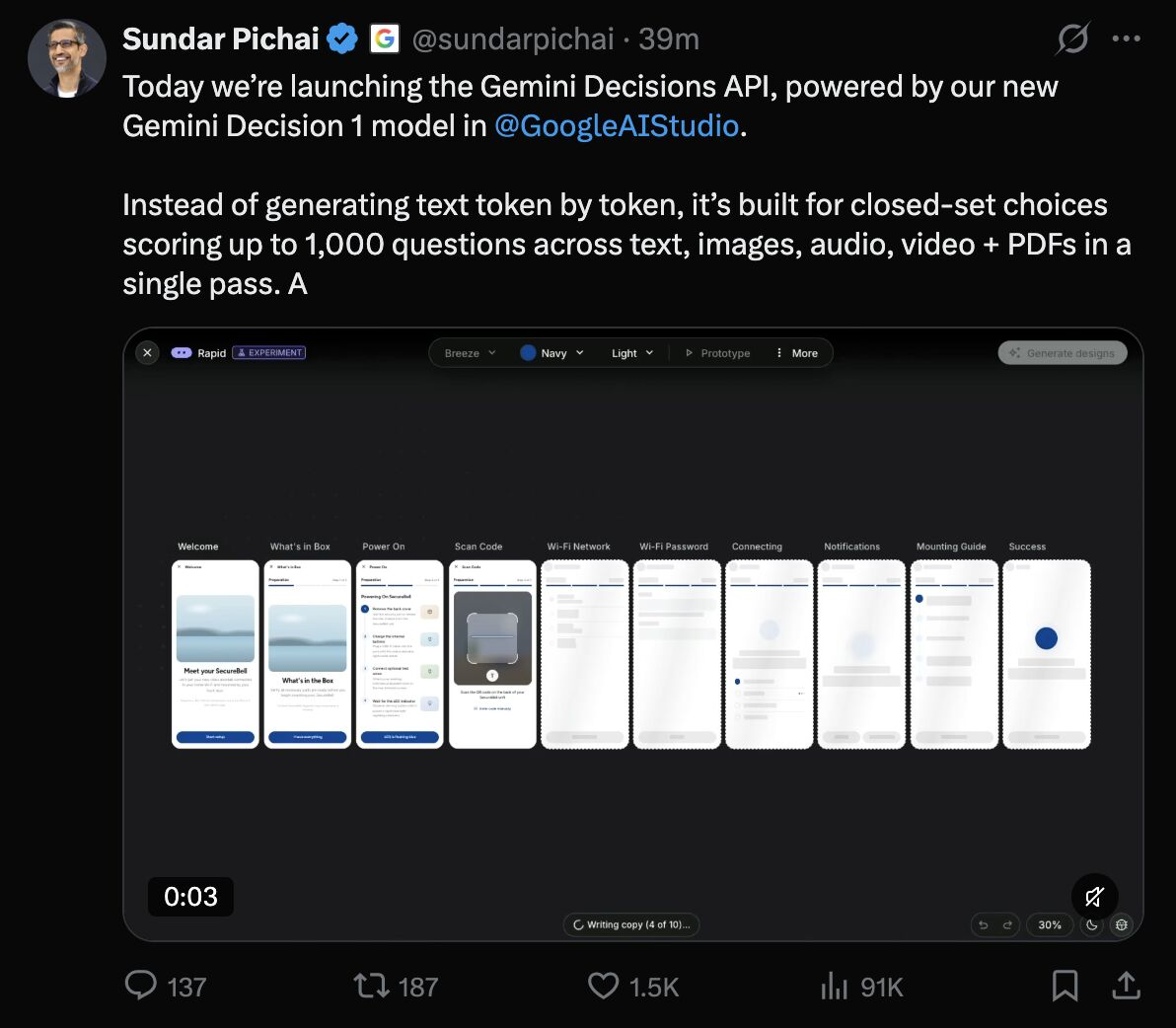
Google released Gemini Decision 1 and the Gemini Decisions API that it powers on November 11, 2026. Both are available through Google AI Studio and the Gemini API. Sundar Pichai announced the launch on X and framed it as a break from token-by-token generation.
That framing is accurate. Decision 1 does not write answers. It scores answers you already listed as possible, and it returns the score as a probability.
Scroll horizontally to see the full figure.
How is a decision model different from a generative model?
A normal chat model produces text one token at a time. If you want to know whether an email is spam, you ask a question, the model writes a sentence, and your code parses the sentence to find the answer. For a yes-or-no outcome, you paid for a paragraph and then wrote a parser.
Decision 1 removes the paragraph. You send the input once, list the questions, and list the allowed answers. The model scores each candidate in a single forward pass and returns the winning label with a probability and a confidence value between 0 and 1.
The tradeoff bounds where the model is useful. Decision 1 cannot write anything, so any workflow that needs a summary, a reply, or an explanation still needs a generative model for that part. What it does is pick the branch.
What can the Gemini Decisions API actually do?
Google ships three decision types, and a single request can mix all three over the same input.
Scroll horizontally to see all columns.
| Type | What you supply | What comes back |
|---|---|---|
| Yes / no (noul) | A statement to confirm or deny, with optional true and false criteria | Probability that the condition holds, plus a confidence value |
| Multiple choice (choice) | Between 2 and 255 candidate options for the same input | The winning option and a normalized probability for every option |
| Ordered rubric (score) | A rubric you define, ordered from lowest to highest level | A weighted continuous score and the probability of each rubric level |
All three can run in the same request against one shared input, which is what makes the per-question cost small.
The API names them noul, choice and score. The noul type is a statement you want confirmed or denied, with optional criteria describing what counts as true. The choice type takes between 2 and 255 options and returns a winner plus normalized probabilities for every option, so you can read the runner-up and the margin. The score type takes a rubric you write yourself, ordered from low to high, and returns a weighted continuous score alongside the probability of each rubric level.
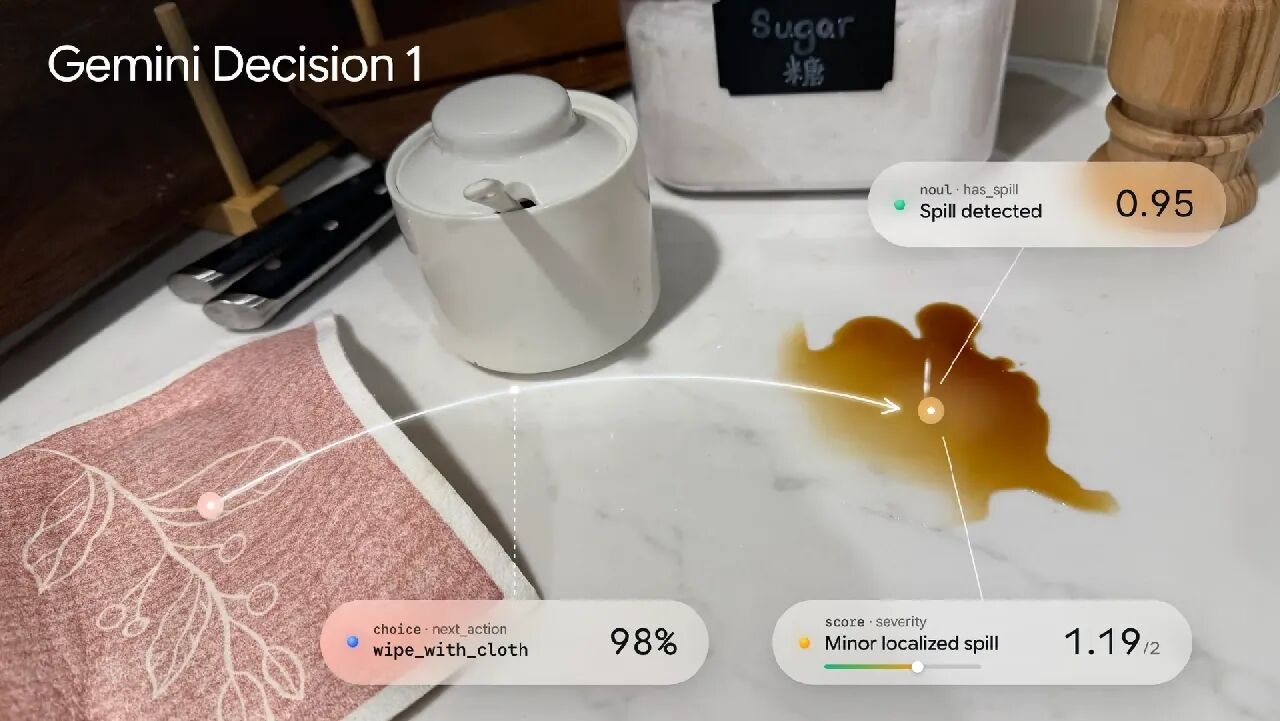
Google's own sample request uses all three at once. A photo of an office kitchen counter goes in with a question about whether liquid has spilled on it, a question about which cleanup action applies, and a rubric question about severity.
Scroll horizontally to see the full figure.
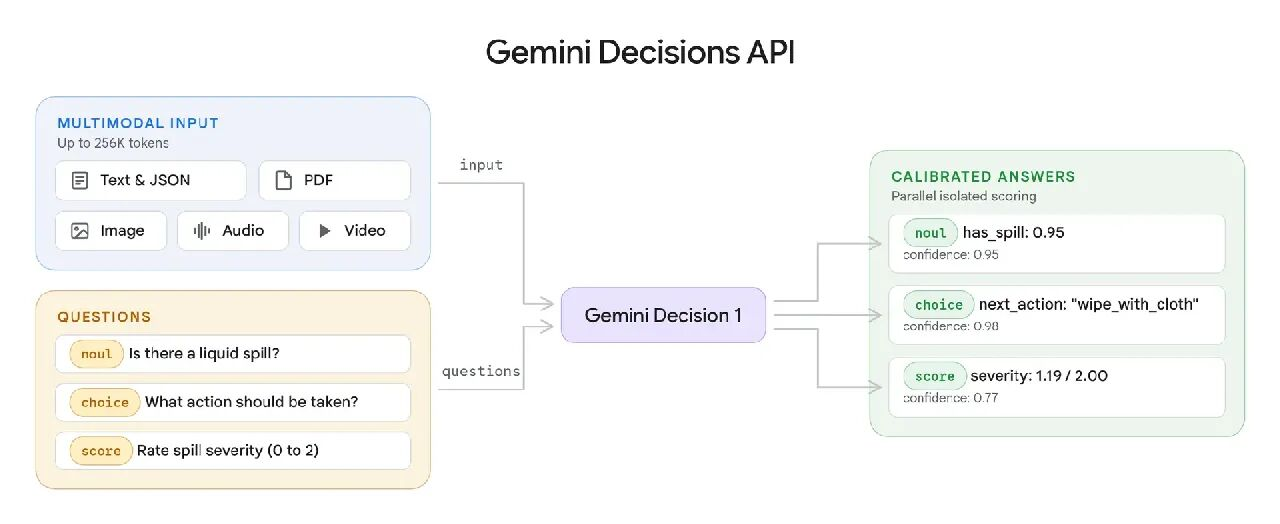
The older approach to that job is a stack: an object detector for the spill, a separate text classifier for the action, and a third prompt for severity. That stack pays three latencies and gives three prompts room to disagree with each other. Decision 1 answers all three questions from one shared input, which is why Google bills the input once.
Scroll horizontally to see the full figure.
What are the input limits and latency?
The published limits are generous for classification work and narrow for general reasoning:
- One multimodal input bundle, up to 256K tokens, covering text, images, audio, video and PDF.
- Up to 1,000 independent questions in a single request.
- Between 2 and 255 options for a choice question.
- End-to-end latency of 150 to 250 milliseconds, with median model compute at 50 to 100 milliseconds.
The 1,000 questions figure is the part that changes design decisions. In a conventional setup, tagging a thousand rows of a customer support log means a thousand round trips, a thousand prompts and a thousand chances to hit a rate limit. Here the document or transcript is read once and a thousand judgements come back together.
Google scopes the latency figures to contexts of 16K tokens or less, which is a small fraction of the 256K ceiling, so long-document jobs should expect a different number. The same figures show latency staying roughly flat as questions per request climb from 1 to 100, so the model pass barely repeats. Prompt tokens for each question still cost money, and they are what the input price actually bills.
How much does the Gemini Decisions API cost?
Input costs $0.10 per million tokens. Output tokens cost nothing, because the usual output stream does not exist. Google states there are no separate charges for audio transcription or OCR, which is a meaningful change for document pipelines that currently pay one vendor to read a scan and another to classify it.
Google also claims the API costs close to five times less than calling Gemini 3.5 Flash-Lite through the Interactions API on the same benchmark suite. That comparison is Google's own and runs on Google's chosen tasks, so treat the multiple as a direction rather than a guaranteed ratio.
The billing shape matters as much as the rate. Because the input is shared across questions, question 500 costs the instruction text and the rubric text, not another pass over the document.
How did Gemini Decision 1 score against GPT-6 Luna and TypeSafe Jev?
Google compared Decision 1 against three named alternatives: OpenAI's GPT-6 Luna, TypeSafe Jev 1.14, which is built specifically for classification decisions, and Google's own Gemini 3.5 Flash-Lite. Decision 1 took first place on 7 of the 9 benchmarks.
Scroll horizontally to see all columns.
| Benchmark | Gemini Decision 1 | GPT-6 Luna | TypeSafe Jev 1.14 | Gemini 3.5 Flash-Lite |
|---|---|---|---|---|
| JevBench | 92.2% | 90.9% | 90.0% | 86.6% |
| Amazon ESCI (macro-F1) | 58.7% | 54.7% | not listed | 47.2% |
| New Yorker Caption | 79.7% | 68.4% | not listed | not listed |
| PubMedQA | 79.8% | 74.4% | not listed | not listed |
| Global-MMLU-Lite | 86.0% | 79.6% | not listed | not listed |
| Mind2Web Multimodal | 86.2% | not listed | 86.8% | not listed |
| When2Call | 79.9% | not listed | 82.0% | not listed |
| MMAU (audio) | 71.8% | not listed | not listed | lower |
| Video-MME (video) | 69.1% | not listed | not listed | lower |
| Top-1 ECE (lower is better) | 0.0250 | 0.0721 | 0.0494 | 0.2104 |
Scores come from the comparison chart in Google's launch material. Rows marked not listed are cells the chart did not fill for that model. Google has not published these numbers in the written announcement, and no independent reproduction exists yet.
The widest margins are on caption selection and product search relevance. On the New Yorker Caption task, which asks a model to pick the right caption for a cartoon, Decision 1 scores 79.7% against GPT-6 Luna at 68.4%. On Amazon ESCI, a product search relevance set scored by macro-F1, it reaches 58.7%, which is 4 points over Luna and 11.5 points over Flash-Lite. Medical question answering on PubMedQA lands at 79.8% against 74.4%, and the multilingual Global-MMLU-Lite set at 86.0% against 79.6%.
Scroll horizontally to see the full figure.
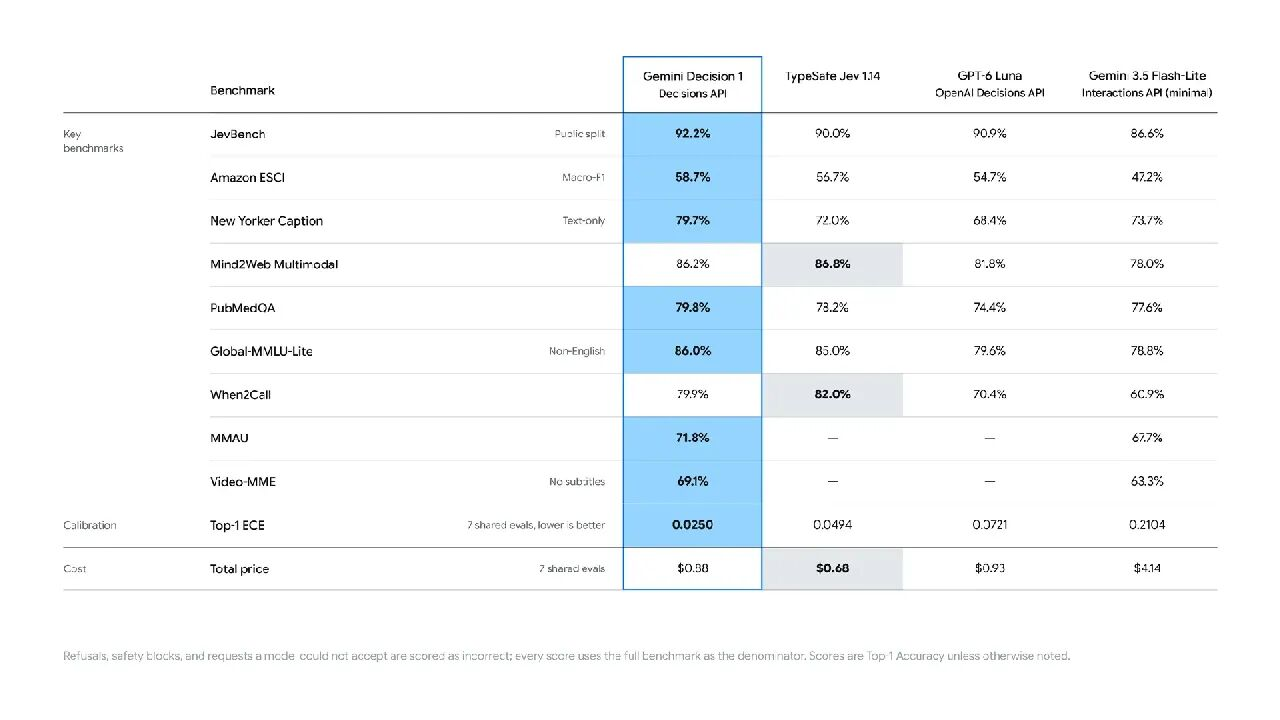
The two losses are the interesting part. On Mind2Web Multimodal, a web navigation task, TypeSafe Jev 1.14 scores 86.8% and Decision 1 scores 86.2%. On When2Call, which tests whether a model knows when to invoke a tool, Jev scores 82.0% and Decision 1 scores 79.9%.
Tool selection is one of the workloads Google names as a target for this model, so a dedicated decision model from a competitor holding a 2.1 point lead on exactly that task is worth noting. It does not make Decision 1 a weak product. It does mean the routing claim should be tested on your own tools before it goes into a production agent.
Why does calibration error matter more than raw accuracy?
Top-1 expected calibration error measures whether a model's stated probability matches how often it is right. A model that says 0.9 should be correct about 90% of the time.
Decision 1 posts 0.0250. GPT-6 Luna posts 0.0721, TypeSafe Jev 1.14 posts 0.0494, and Gemini 3.5 Flash-Lite posts 0.2104. In relative terms, Decision 1's calibration error is about 65% lower than Luna's and about 88% lower than Flash-Lite's.
Agent systems usually act on thresholds rather than labels. When an agent decides whether to auto-approve a refund, quarantine a file, or route a ticket to a human, the code compares a probability against a cutoff. An overconfident model gets that comparison wrong in a way accuracy scores do not reveal, because it clears the cutoff on cases it should have escalated. A calibration error of 0.2104 becomes a policy that quietly approves a large share of the cases that were meant for review.
For anyone building a gate that hands uncertain cases to a human, this metric is the one worth reading first.
Where is Google already using it?
Four internal products use the API, and they map cleanly onto the three decision types.
Gemini Notebook uses it as a live model router. Each incoming request gets classified by difficulty, and the system sends easy queries to a cheaper, faster model tier while reserving deep reasoning for harder ones. Google reports latency for everyday queries dropping by up to 40%. The router is the clearest example of the pattern: a small model making a cheap decision so that a large model is consulted less often.
Stitch uses it in a feature called Rapid Canvas, which turns a prompt into a playable wireframe in seconds and applies voice or tap edits without a full regeneration.
CC, a Google Labs product, uses it to pick a reaction from more than 200 emoji options in a fraction of a second. Google Search uses it as a safety layer for MCP tools, checking for adversarial input before a tool runs.
Audio and video scores also appear in the comparison table, with 71.8% on MMAU and 69.1% on Video-MME, both above Flash-Lite. Those are the numbers to watch if you want to classify call recordings or screen captures rather than text.
What the benchmark does not prove
None of these numbers come from an independent evaluation.
Google selected the comparison set. A table that includes GPT-6 Luna and a specialised TypeSafe model, and also includes Google's own Flash-Lite, is a table Google designed to make a point. It does not include every competitor in the category.
The published blog post does not carry the numeric table. The scores above come from the comparison chart in Google's launch material, not from an independent evaluation. Nobody outside Google has reproduced them yet.
The latency figures assume short contexts. The 16K token scope covers most classification jobs and excludes exactly the long-document cases where the 256K limit would earn its place.
Nothing published yet covers behaviour on genuinely ambiguous inputs, or how the model handles adversarial prompts embedded in a PDF it is asked to score. For a component that sits in front of tool calls, that is the gap to close before production use.
Is Gemini Decision 1 in our Coding Plans?
That is not a judgement on the model. A decision endpoint and a coding model solve different problems, and the honest way to evaluate either one is on your own tasks rather than on a vendor chart. If you are building an agent that needs a cheap routing layer, the model to test is the one your gateway already serves.
Frequently asked
What is Gemini Decision 1?
It is a Google model released on November 11, 2026 that scores a fixed set of candidate answers instead of generating text. Given one multimodal input and a list of questions, it returns the chosen label with a probability and a confidence value. Google positions it as a routing and classification component for AI systems rather than a chat model.
What is the Gemini Decisions API?
It is the hosted endpoint for Gemini Decision 1, available through Google AI Studio and the Gemini API. A request carries one shared multimodal input plus up to 1,000 independent questions, and can mix yes or no, multiple choice and rubric scoring in the same call.
How much does the Gemini Decisions API cost?
Input is $0.10 per million tokens and output tokens are free, because the endpoint does not stream generated text. Google says there are no separate charges for audio transcription or OCR, and that the API costs close to five times less than calling Gemini 3.5 Flash-Lite through the Interactions API on the same benchmark suite.
How fast is Gemini Decision 1?
Google quotes 150 to 250 milliseconds end to end, with median model compute between 50 and 100 milliseconds, for contexts up to 16K tokens. Latency stays roughly flat as a request grows from 1 to 100 questions.
Can Gemini Decision 1 replace a chat model?
No. It cannot write prose, summaries or code, because it does not decode text. It scores answers you already listed as possible. Workflows that need generated text still need a generative model alongside it.
How does Gemini Decision 1 compare with TypeSafe Jev 1.14?
Gemini Decision 1 leads overall with 7 first places out of 9 benchmarks, and it has the lowest top-1 calibration error at 0.0250 against 0.0494 for TypeSafe Jev 1.14. Jev still leads on two tasks: 86.8% to 86.2% on Mind2Web Multimodal and 82.0% to 79.9% on When2Call, the tool-invocation test.
Where does Google already use the Decisions API?
Four internal products. Gemini Notebook uses it as a live model router and reports up to 40% lower latency for everyday queries. Stitch uses it for Rapid Canvas wireframes. CC in Google Labs uses it to pick one reaction from more than 200 emoji options. Google Search uses it as a safety layer for MCP tools.
Is Gemini Decision 1 included in your Coding Plans?
No. Our Coding Plans list DeepSeek V4 Pro, DeepSeek V4 Flash, GLM 5.3, GLM 5.2, MiniMax M3 and Kimi K3. Gemini Decision 1 is sold through Google AI Studio, and it does not appear as a plan card here.