Breakout: Kimi K3.1 Pro Hits Global Top 4, Outranks GPT‑6 and Gemini 4
By Cameron Voss
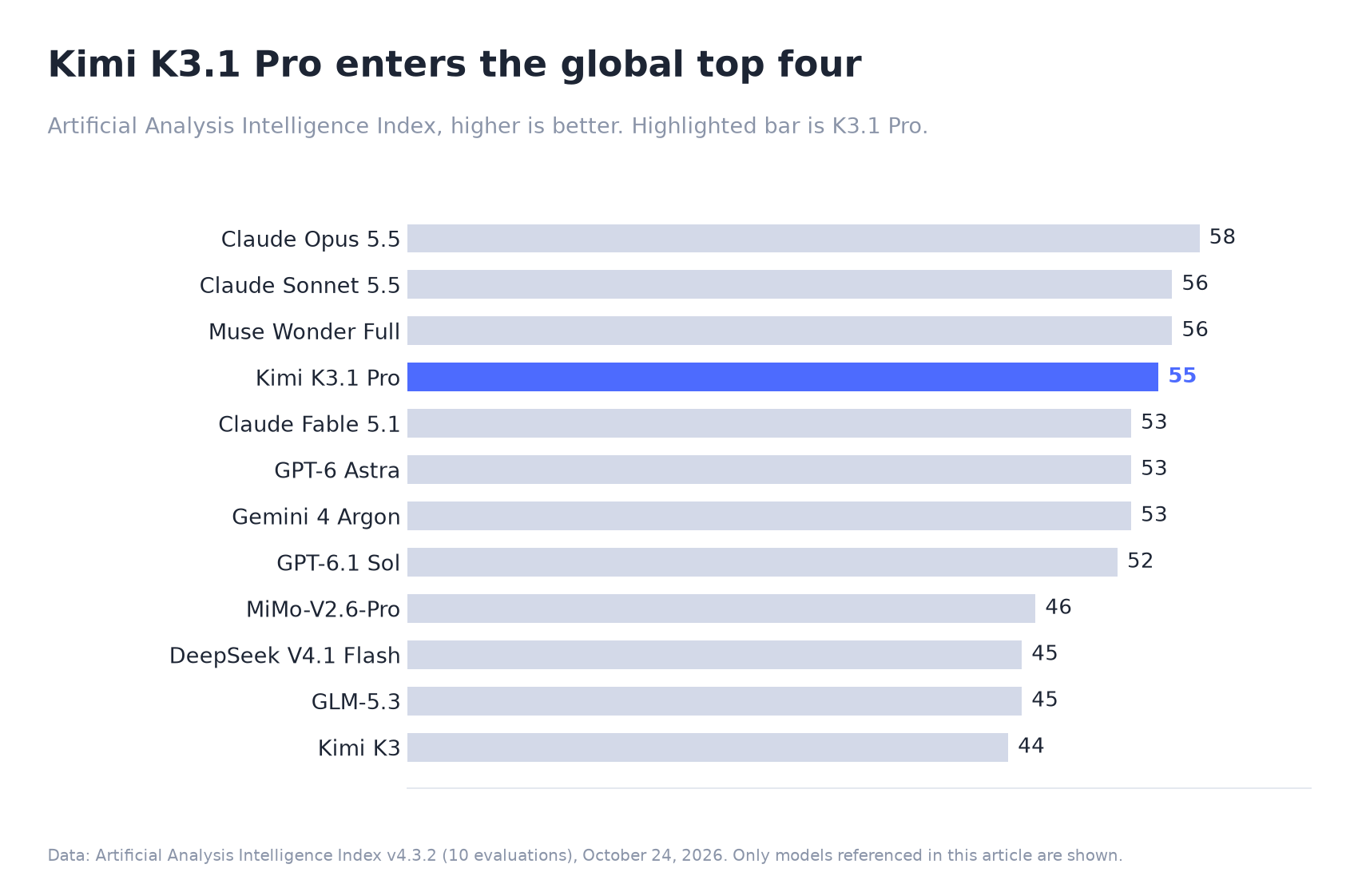
TL;DRKimi K3.1 Pro scores 55 on the Artificial Analysis Intelligence Index, fourth worldwide behind Claude Opus 5.5, Claude Sonnet 5.5 and Meta's Muse Wonder Full, and two points ahead of GPT-6 Astra and Gemini 4 Argon. It has the same 2.8T total and 104B active parameters as K3; the 11 point gain came from post-training. It leads the independent Terminal-Bench 4.0 run at 67.2% and costs about $2 input and $10 output per million tokens, the same tier as Claude Sonnet 5.5. Weights are promised before November 4. Human voters still rank it eighth.
On this page
K3 landed on July 16 at 44. Three months later the new version sits at 55, and Moonshot did not add a parameter to get there. That is the interesting part: a cheaper model to serve, with a price cut to match.
The headline is accurate but narrow. K3.1 Pro beats GPT-6 Astra and Gemini 4 Argon on the index by two points. It does not beat Claude at the same price, and people who vote blind are less impressed than the automated suite.
What can you use today?
Almost everything except the weights. K3.1 Pro is live on Kimi.ai, the Kimi app, Kimi Work, Kimi Code and the Kimi API. The model ID is kimi-k3.1-pro. A Highspeed variant offers the same intelligence with two to three times the output speed at double the price. Enterprise access is off by default.
Moonshot says the weights arrive before November 4 but has not named a license. Artificial Analysis and Arena both expect it to become the strongest open-weight model once they ship.
How did it gain 11 points without new parameters?
Post-training. K3.1 Pro uses the K3 base, 2.8 trillion total parameters with 104 billion active per token, and adds a large amount of post-training compute across several hundred domains. Moonshot also rebuilt the reinforcement learning stack, sandboxes and scheduling to keep that pipeline fed.
The efficiency number matters more than the rank. MiMo-V2.6-Pro scores 46 with 1.02T parameters, and GLM-5.3 scores 45 with 753B. K3.1 Pro gets roughly ten more points from a larger but sparsely activated model.
Where is it actually better?
Agentic execution. The gains concentrate in tasks where the model acts in an environment instead of answering one question.
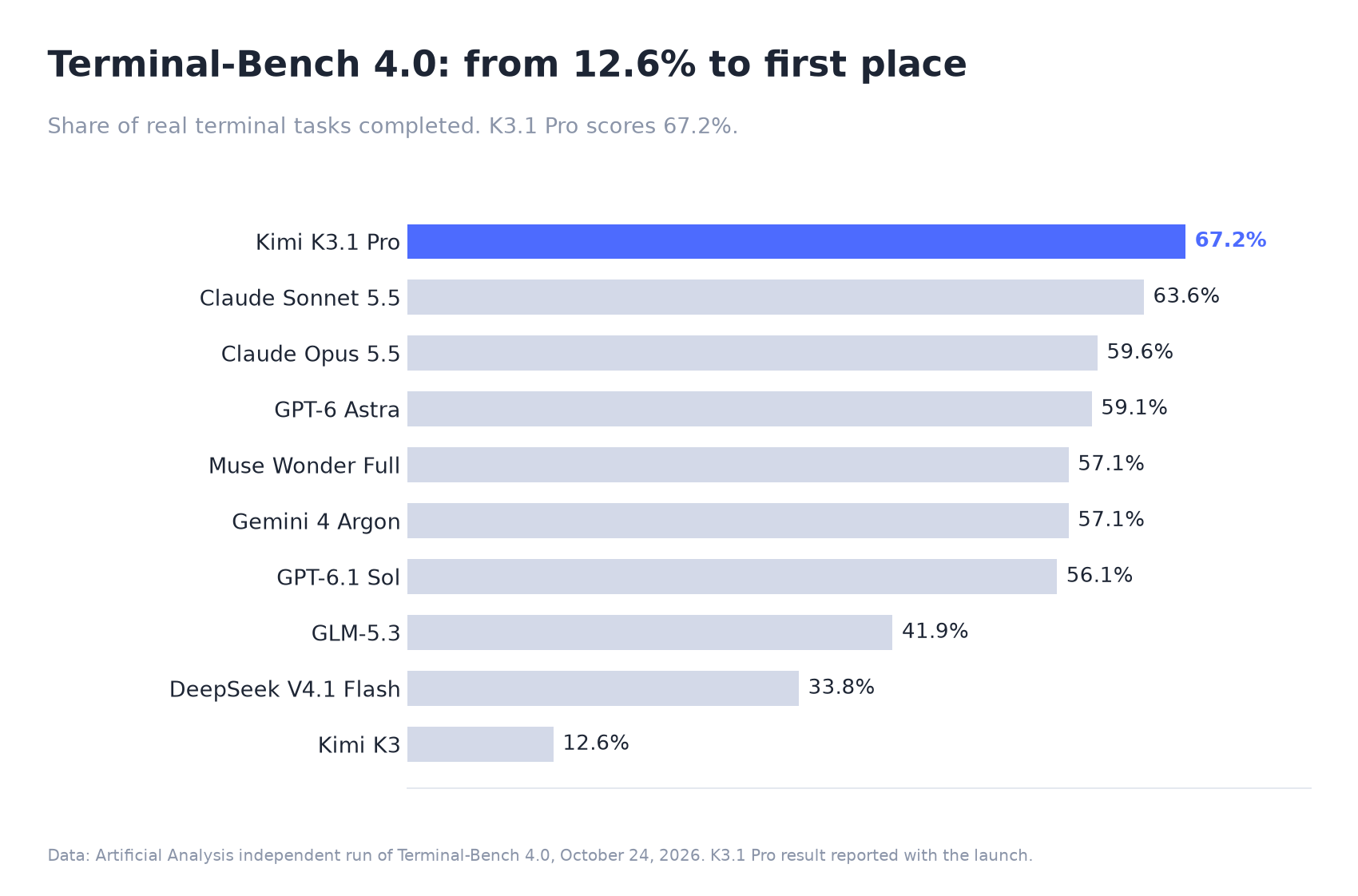
Terminal-Bench 4.0 is the strongest evidence because Artificial Analysis ran it independently. K3.1 Pro finished first at 67.2%, against 63.6% for Claude Sonnet 5.5 and 12.6% for K3. On GDPval-AA it placed third, 312 points above K3, and AutomationBench moved from 58% to 73%.
| Test | K3.1 Pro | Nearest rival | Run by |
|---|---|---|---|
| Terminal-Bench 4.0 | 67.2% | Sonnet 5.5, 63.6% | Artificial Analysis |
| GDPval-AA | 3rd, +312 vs K3 | Opus 5.5, Muse Wonder Full | Artificial Analysis |
| AutomationBench | 73% | Not disclosed | Artificial Analysis |
| SWE Marathon | 51.7 | Opus 5.5, lower | Moonshot |
| Terminal-Bench Science | 38.1 | GPT-6 Astra, 68.1 | Moonshot |
Moonshot's demos follow the same theme: a playable Unreal Engine 5.8 scene, a browser page for a 2,317-part robotic arm, a FreeCAD turbofan with 2,100 solids, and a simulated human that ran 167 tasks and 420 self-reviews before walking for 11.2 seconds. On BenchCAD, which asks for CAD code that rebuilds a part from renders, K3.1 Pro trails Opus 5.5 and GPT-6 Astra slightly with tools and matches Opus 5.5 without them. Solid, not ahead.
Why do human voters rank it eighth?
Because Arena WebDev is a blind preference vote, not a fixed test suite. Two models build the same page, and a person picks the better result without seeing the label.
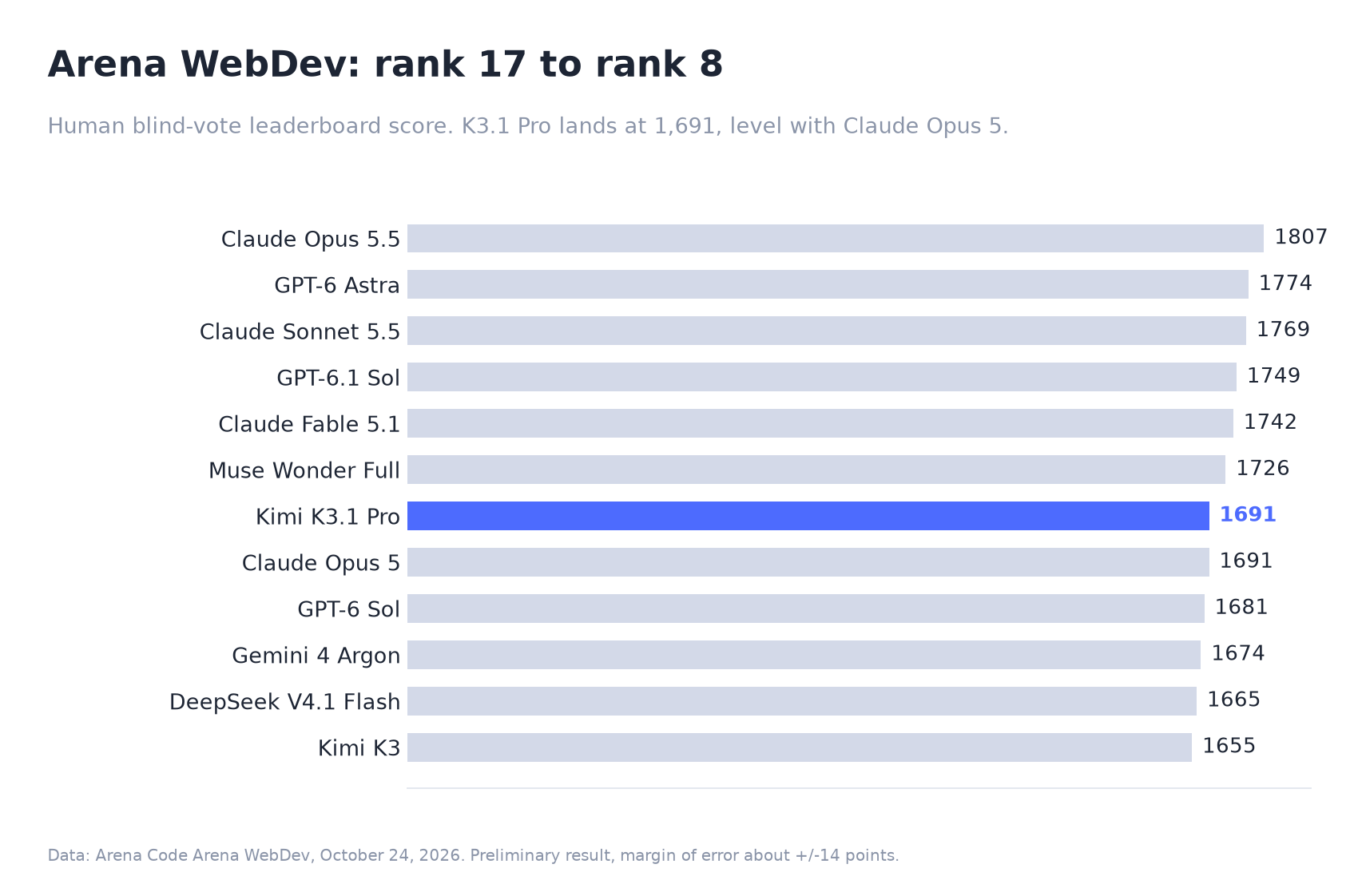
K3.1 Pro scored 1,691, up from 17th and level with Claude Opus 5. Claude Opus 5.5 leads at 1,807, with GPT-6 Astra at 1,774 and Sonnet 5.5 at 1,769. Among Chinese models it is now first, and it should lead open-weight models once the weights ship. The distance to the frontier is simply wider in human votes than in the index.
What does it cost?
List price is 13 CNY per million input tokens and 68 CNY per million output tokens, about $2 and $10. That is roughly one third below K3. Highspeed doubles it.
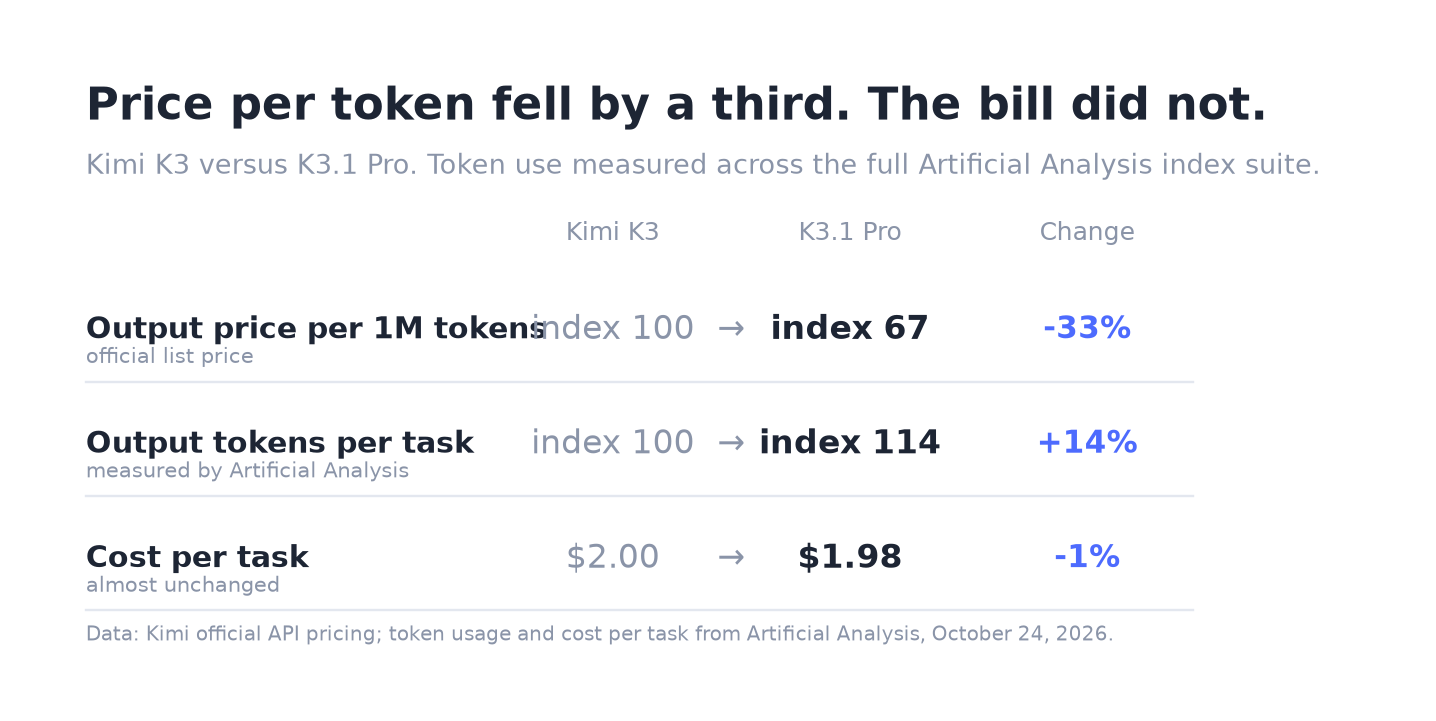
The discount has a counterweight. On the full Artificial Analysis suite, K3.1 Pro used 14% more tokens per task. The two effects nearly cancel: $1.98 per task against $2.00.
| Model | Input / output per 1M | AA score |
|---|---|---|
| Claude Opus 5.5 | $4 / $20 | 58 |
| Claude Sonnet 5.5 | $2 / $10 | 56 |
| Kimi K3.1 Pro | $2 / $10 | 55 |
| GPT-6 Astra | $10 / $50 | 53 |
| DeepSeek V4.1 Flash | $0.30 / $1.20 | 45 |
Official list prices, October 24, 2026. Scores use each model's highest reasoning tier.
Same price as Sonnet 5.5, Gemini 4 Argon and GPT-6.1 Sol. Half the price of Opus 5.5, one fifth of GPT-6 Astra. DeepSeek V4.1 Flash and GLM-5.3 cost far less but give up about ten index points. Arena puts the median cost at $1.23 per task, 29% below K3.
Where does it sit on value?
Plot score against list price and K3.1 Pro cuts off everything that costs more and scores no higher: GPT-6 Astra at about five times the price, plus Gemini 4 Argon and GPT-6.1 Sol at the same price.
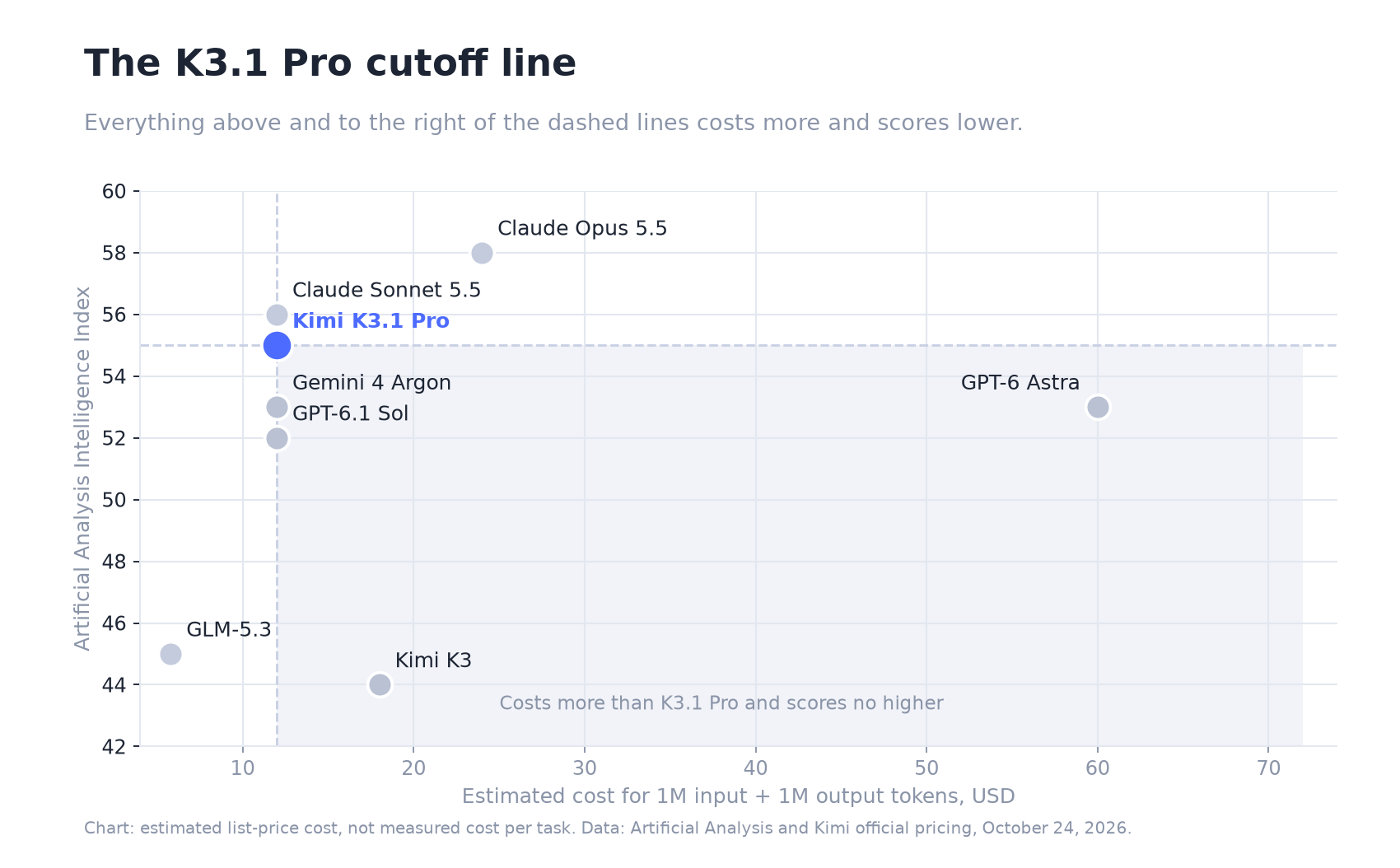
Only two models escape. Sonnet 5.5 costs the same and scores one point more. Opus 5.5 costs twice as much and scores three points more. Neither gap is large, and neither comes cheap.
What is still unproven?
Most of the launch numbers are vendor-run. OfficeQA Pro v2, SWE Marathon, Agents' Last Exam, the finance tests and the demos all come from Moonshot. Only Terminal-Bench 4.0, GDPval-AA, AutomationBench, Arena and the hallucination comparison are external. Moonshot also notes that some external models searched online during OfficeQA and were scored zero, which lowers their results.
Two specific weaknesses. Terminal-Bench Science is 38.1 against 68.1 for GPT-6 Astra. Output speed is about 77 tokens per second against a similar-price median of 81. Users also report that a five hour coding quota drains faster than it did on K3, which fits the 14% token increase.
One unusual detail: Moonshot removed cyberattack data before release. On its own exploit test, the version with the data scores 90.5% and the released model scores 81.0%, still far above K3 at 33.3%. The capability was reduced on purpose, not lost.
Should you switch?
For terminal work, long multi-step tasks and code changes that need to run and be verified, yes, run a trial. For web output judged by people, scientific analysis, or answers that must be right the first time, the case is weaker.
Check four things on your own traces: tokens per completed task, not price per token; whether the 600K-token context holds quality on your repository; latency against your timeout budget; and how fast your plan's quota drains.
For routine refactors and documentation, a cheaper model still makes sense. The usual setup is a split: DeepSeek V4.1 Flash for bulk calls and K3.1 Pro for hard agent runs. If you want to compare that against a fixed coding budget, our Kimi Coding Plan guide compares the membership and multi-model options, including the quota rules.
Verdict
Kimi K3.1 Pro is a real step up, and the method matters more than the rank. Eleven index points and first place on Terminal-Bench 4.0 from post-training alone, with no parameter increase and a lower price, is a good result for anyone paying per token.
The limits are equally clear. At the same price, Claude Sonnet 5.5 scores higher and wins more human votes. The 3D and finance stories are mostly vendor demonstrations. Read this as a strong agentic model at a fair price, not a new leader.
FAQ
What is the API model name?
kimi-k3.1-pro. It is available now on Kimi.ai, the Kimi app, Kimi Work, Kimi Code and the Kimi API.
How much does it cost?
About $2 input and $10 output per million tokens, one third less than K3. Per completed task, Artificial Analysis measured $1.98 against $2.00, because K3.1 Pro uses 14% more tokens.
Does it beat GPT-6 and Gemini 4?
On the Artificial Analysis index, 55 against 53 for both. On Arena WebDev human voting it ranks eighth at 1,691, behind GPT-6 Astra at 1,774.