Kimi K3.1 Pro vs Gemini 4 Argon: Two Ways to Build a Flagship
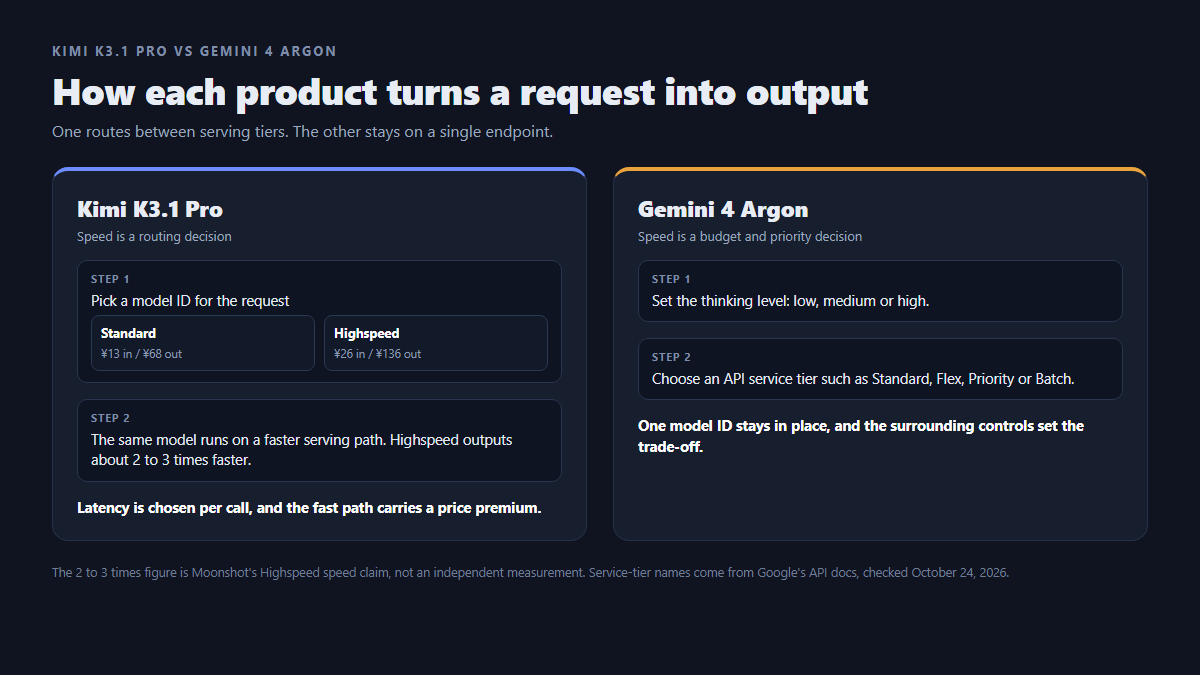
TL;DRBoth are top flagship models, but they structure speed and cost tradeoffs differently. Moonshot's Kimi K3.1 Pro offers one underlying model with two serving tiers: Moonshot says Highspeed delivers 2 to 3 times the output speed at double the token price. Gemini 4 Argon ships as a single flagship endpoint, with latency and cost tuned via thinking levels and API service tiers. For Kimi, you pick a model ID on each request. For Argon, you set a thinking budget and service level.
By Cameron Voss
On this page
What each vendor actually shipped
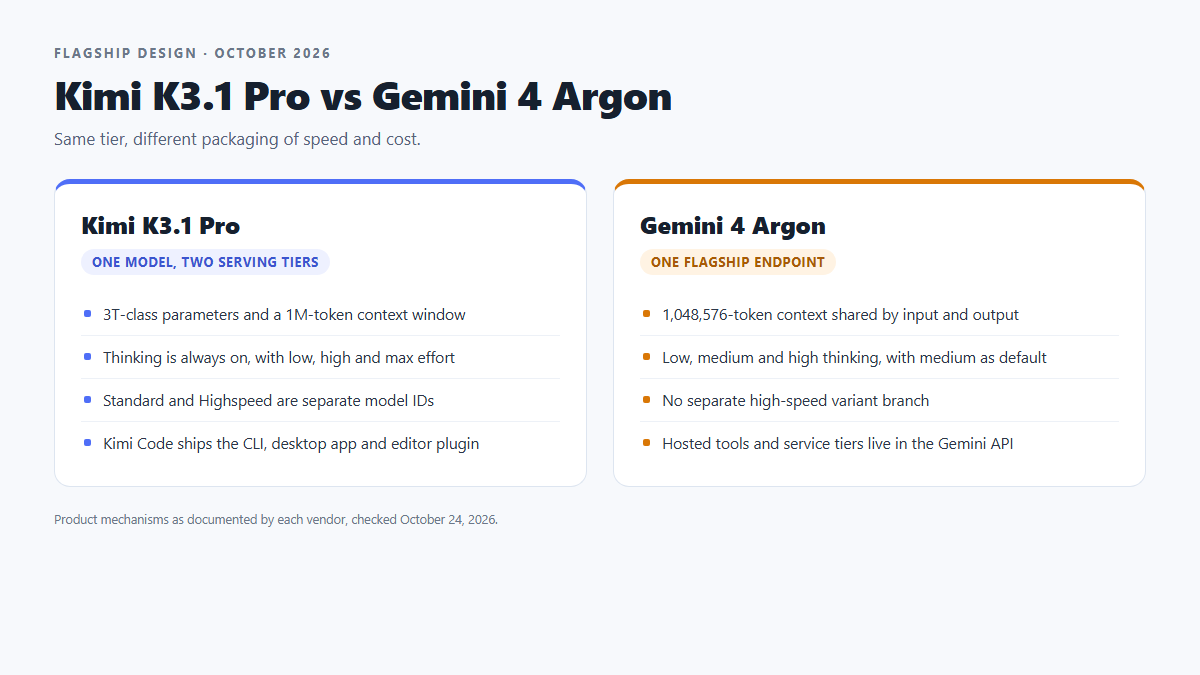
Moonshot released Kimi K3.1 Pro on October 23, 2026. It is a model in the 3-trillion-parameter class with a 1M-token context window. Moonshot positions it for coding, 3D modeling, financial research and long agent runs. Thinking is always on: the effort level can be set to low, high or max, and it cannot be disabled.
Google announced Gemini 4 Argon on September 30, 2026, and opened it to developers through the Gemini API on October 13. Argon is Google's flagship reasoning model. The API lists a 1,048,576-token context shared by input and output, with low, medium and high thinking levels. Medium is the API default.

| Item | Kimi K3.1 Pro | Gemini 4 Argon |
|---|---|---|
| Vendor | Moonshot AI | |
| Model IDs | kimi-k3.1-prokimi-k3.1-pro-highspeed | gemini-4-argon |
| Positioning | Flagship for coding, 3D work and long agent tasks | Flagship reasoning model for long, multi-step work |
| Context | 1M tokens | 1,048,576 tokens, shared by input and output |
| Open weights | Full weights planned for November 4, 2026; license pending | Not released as open weights |
| Multimodal input | Text, sketches and reference images | Text, images, video, audio and PDF |
| Thinking control | Low, high, max. Cannot be disabled | Low, medium, high. Medium is the default |
| Speed option | A second model ID, Highspeed | No separate high-speed variant |
| API currency | CNY | USD |
| Tool surface | Kimi Code desktop, CLI and editor plugin; MCP and plugins | Gemini API function calling; Search grounding, URL context and code execution |
Vendor documentation checked October 24, 2026. A 1M-token output window is available on Argon, but default synchronous output is capped at 65,536 tokens.
The product design difference: a speed SKU or a single endpoint
Kimi treats speed as a product decision. K3.1 Pro and K3.1 Pro Highspeed run the same model. Highspeed is a faster serving path that Moonshot says produces output about 2 to 3 times faster, and it costs twice as much per input and output token. The trade-off is fixed when you choose the model ID.
Google does not split Argon into a standard branch and a fast branch. There is one model ID, and the levers sit around it: how much thinking the model does, and which API service tier carries the request. Google documents Standard, Flex, Priority and Batch tiers with separate rates. A team that wants lower latency adjusts those controls instead of switching models.
Kimi prices speed per request. Argon prices it through service tiers.
Where tool calls enter the loop
Kimi K3.1 Pro is sold with a harness, not just an endpoint. Kimi Code ships a desktop app, a CLI and a VS Code extension. The runtime includes file, shell, media, web and scheduling tools, plus MCP servers, plugins, hooks and subagents. The API accepts Responses, chat-completion and message protocols, so the same model can sit behind different agent frameworks.
Argon runs inside Google's own API surface. Gemini's API documents function calling and hosted tools such as Search grounding, URL context and code execution. Argon also accepts text, images, video, audio and PDF input. The tool loop is assembled by the application, with Google's hosted tools covering retrieval and execution when you enable them.
Kimi owns more of the loop. Argon leaves orchestration to your app.
How the two cost models are built
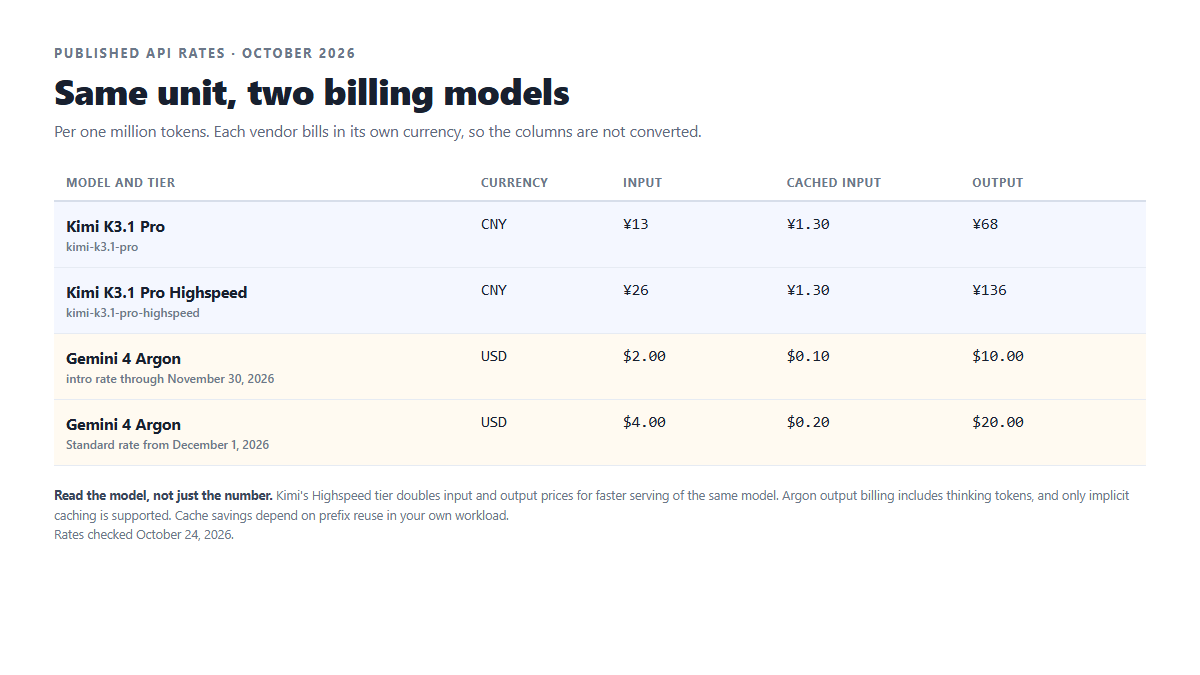
Kimi's price sheet follows the model choice. Standard input costs ¥13 and output ¥68 per million tokens. Highspeed doubles both to ¥26 and ¥136, while cached input stays at ¥1.30. Thinking cannot be disabled, so long reasoning runs add output volume. Within Kimi Code, the 1M context and Highspeed require higher membership tiers. The separate Kimi API platform uses pay-as-you-go billing, rather than a Kimi Code subscription.
Argon's sheet follows one model with time-limited pricing. The introductory Standard rate is $2 input, $0.10 cached input and $10 output per million tokens through November 30, 2026. On December 1 it becomes $4, $0.20 and $20. Output billing includes thinking tokens, and only implicit caching is supported. Hosted tools and service tiers are billed separately.
A Kimi estimate starts with the model ID. An Argon estimate starts with the thinking budget and service tier.
| Model and tier | Currency | Input | Cached input | Output |
|---|---|---|---|---|
| Kimi K3.1 Pro | CNY | ¥13 | ¥1.30 | ¥68 |
| Kimi K3.1 Pro Highspeed | CNY | ¥26 | ¥1.30 | ¥136 |
| Gemini 4 Argon, introductory rate to November 30 | USD | $2.00 | $0.10 | $10.00 |
| Gemini 4 Argon, Standard rate from December 1 | USD | $4.00 | $0.20 | $20.00 |
Prices are per 1M tokens. The two currencies are not converted. A cached-input rate applies only when the workload actually reuses a prefix. Kimi K3 API cache writes are billed separately by cache duration; those charges are not included in this table.
Which workload tends to fit which design
Kimi K3.1 Pro tends to fit interactive coding and agent work where the team wants one model family and a per-request latency switch. The Kimi Code harness is part of the package, so shell access, file edits and MCP tools do not need to be built from scratch. A team that can leave routine calls on Standard and reserve Highspeed for latency-sensitive steps gets a clear price for that choice.
Gemini 4 Argon tends to fit work that already lives in Google's API: document and multimodal analysis, search-grounded answers, code execution and multi-step workflows where the application orchestrates the tools. The single endpoint keeps model selection simple, and thinking levels let one model serve both lighter and heavier steps.
Teams with both kinds of work split by task shape.
Trade-offs to check before you commit
Kimi K3.1 Pro:
- Full weights were scheduled for November 4, 2026. License terms and hardware requirements were not published as of October 24.
- Thinking cannot be disabled, so short tasks still carry a reasoning pass.
- Highspeed doubles input and output token prices.
- Within Kimi Code, the 1M context and Highspeed require higher membership tiers.
Gemini 4 Argon:
- Introductory rates end November 30, 2026.
- Output billing includes thinking tokens.
- Only implicit caching is supported. Explicit cache writes are unavailable.
- There is no separate high-speed variant, so latency options come from thinking level and service tier.
- Hosted tools and service tiers carry separate rates.
If your coding workflow fits Kimi's per-request speed switch, you can try Kimi K3.1 Pro through our Kimi Coding Plan. The Kimi Coding Plan guide covers the current setup and plan limits.