Qwen 4-Max-Preview Is Live Before the Full Launch. What the Early Tests Show (Nov 2026)
TL;DRAlibaba announced Qwen 4 on November 11, 2026, but the full model is not out. Qwen 4-Max-Preview is live in QwenWork, Qoder, Qwen App and QwenStudio, with no release date for the stable version. The official pitch is deeper knowledge, richer world understanding, and stronger coding and agentic capabilities, aimed at complex coding, knowledge work, front-end builds and professional software workflows. Early public evidence is mixed: three working SVG animations with rough visuals, and a GameFeel RE score of 10.3 that trails Qwen3.8 Flash and Max. Qoder also says the preview changed daily during four anonymous test days, so every review is tied to a build.
By Cameron Voss and West Mao
On this page
- What did Alibaba actually announce?
- Where is Qwen 4-Max-Preview live?
- What is Alibaba claiming about performance?
- Why did Qwen hide the model as QoDuck?
- What did the three public tests show?
- What does the GameFeel score actually measure?
- What the early signals do and do not prove
- How should a team evaluate the preview?
- What should we watch for in the full release?
- Where does our Multi-Model Coding Plan fit?
- Frequently asked
What did Alibaba actually announce?
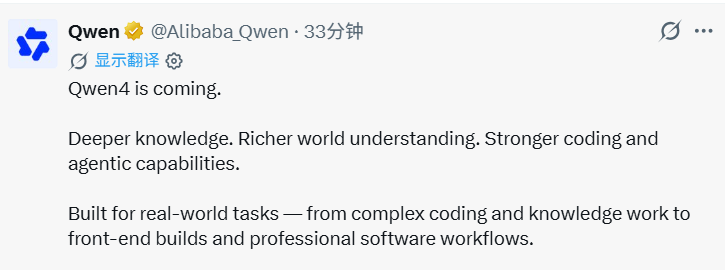
Alibaba's Qwen team announced Qwen 4 on November 11, 2026. The announcement did not ship the full model. What is available now is Qwen 4-Max-Preview, a preview of the Max tier.
Four surfaces have it: QwenWork, Qoder, Qwen App and QwenStudio. The official release date for the complete Qwen 4 family has not been announced.
A preview is not a product launch with a fixed model card, a stable endpoint and published benchmark tables. It is an early build that the team is still changing. The announcement material summarized here does not include an official benchmark table or a model card.
Scroll horizontally to see the full figure.
Where is Qwen 4-Max-Preview live?
The four surfaces are not interchangeable. QwenWork is the office product, which fits the professional office scenario. Qoder is the coding IDE, which fits complex programming and agent workflows. Qwen App is the consumer surface. QwenStudio is the studio surface.
That distribution matters for anyone reading early reviews. Qoder exposes a coding agent with tools, a workspace and a model picker. QwenWork exposes office workflows. QwenStudio is a separate environment. A result from one surface does not automatically transfer to another, because the tools and the context are different.
What is Alibaba claiming about performance?
The announcement makes three qualitative claims: deeper knowledge, richer world understanding, and stronger coding and agentic capabilities. It says the model is built for real-world tasks, from complex coding and knowledge work to front-end builds and professional software workflows.
The official examples concentrate on four kinds of work: complex programming, professional office tasks, frontend design and professional software operation. Each one is harder to measure than a chat answer.
- Complex programming needs multi-file changes, tests, debugging and enough context to keep the codebase coherent.
- Professional office work needs documents, spreadsheets and slides that stay consistent with instructions and with each other.
- Frontend design needs layout, components and visual judgment, plus code that actually runs.
- Professional software operation needs tool use, screen reading, error recovery and multi-step execution.
These are agentic tasks. They depend on the harness, the tools and the feedback loop, not only on the model weights. That is why the surface and the harness matter as much as the model name in the tests below.
Why did Qwen hide the model as QoDuck?
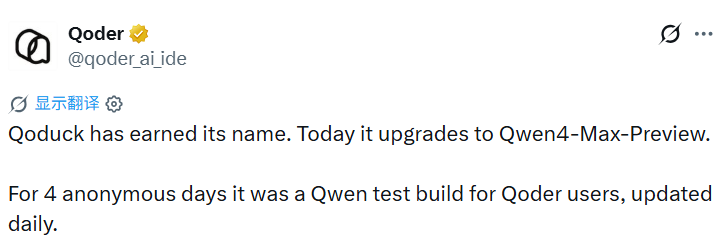
QoDuck was the anonymous model inside Qoder. Users guessed it might be a 27B Qwen 4 variant. Qoder later said the model was Qwen 4-Max-Preview.
The Qoder notice gives a useful timeline: for four anonymous days, the model was a Qwen test build for Qoder users, updated daily. That is a fast iteration loop. It also explains why early reviews disagree. Two testers on different days may have used different models, even if the product label looked the same.
Anonymous testing has a practical effect: users judge the output without a brand prior, and the team can change the build daily. It also makes public comparisons noisy. A score without a build date is a story, not a measurement.
Scroll horizontally to see the full figure.
What did the three public tests show?
The first public test is a pelican on a bicycle. A tester named Leo asked Qwen 4-Max-Preview in Qoder to generate an SVG animation. The result shows a red bicycle moving along a road, with speed and cadence in the corner. He compared it with QoDuck and said it was better, but not by much.
He then published a 31-second version with a green bicycle on a sunset road. His verdict was blunt: "No problem, just not pretty." The motion works. The visual quality is the weak part.
The third test changed both the tool and the prompt. Leo paired Qwen 4-Max-Preview with DeepSeek Harness and spent 19 minutes generating a new SVG animation: Qin Shi Huang holding a sword and riding a polar bear through snow. The motion works. The image quality did not impress him.
The images and videos in this section come from the source article. They mix official announcement material with the tester's output, and they are not an official Qwen benchmark.
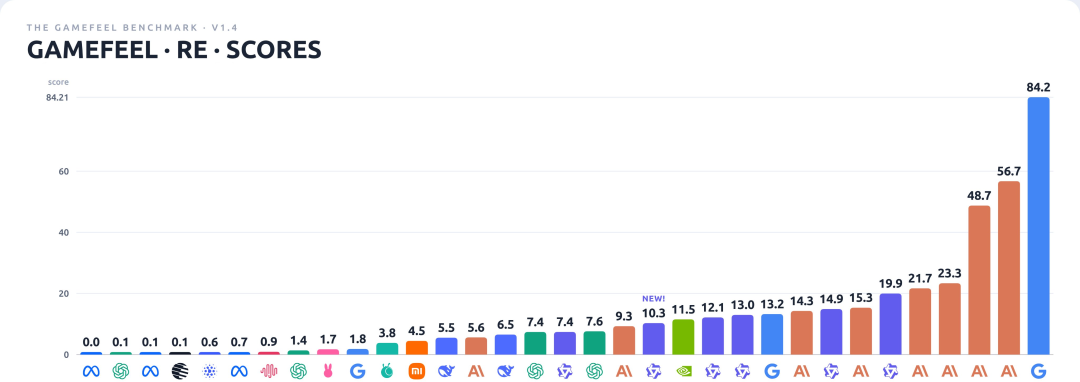
The fourth signal is a leaderboard. A community GameFeel RE chart put Qwen 4-Max-Preview at 10.3, below Qwen3.8 Flash and Max, and below the Qwen 4-27B entry and early Flash builds on the same board.
Scroll horizontally to see the full figure.
Scroll horizontally to see all columns.
| Test | Result | What it can tell you |
|---|---|---|
| Pelican in Qoder | Animation works; visuals are plain | Code generation and motion can work; visual polish lags |
| Polar bear with DeepSeek Harness | Animation works after 19 minutes; visuals are rough | The harness changes the workflow; a running demo is not a polished result |
| GameFeel RE score | 10.3, below Qwen3.8 Flash and Max | On one game-feel task family, the preview is not uniformly better |
These are early public tests, not official benchmarks. Results depend on the build date, the surface, the prompt and the harness.
What does the GameFeel score actually measure?
GameFeel RE is a game-feel and game-design evaluation, not a coding benchmark. A low score says something about how the model handles that task family. It does not say how the model writes an office document, lays out a frontend, or operates a desktop application.
The score is still useful as a warning against a simple story. The preview is not uniformly better than older or sibling Qwen models. Qwen3.8 Flash and Max scored higher on this board, and so did the Qwen 4-27B entry and early Flash builds. That does not make Qwen 4-Max-Preview a bad model. It makes it a preview with an uneven profile.
The board is community-run, and the source does not give the full score table for every entry. Treat the 10.3 as one data point with a known task bias, not as a general ranking.
What the early signals do and do not prove
Three conclusions are reasonable.
- The preview is functional. It can generate code and animation that runs, including inside an agent harness.
- Visual quality is the weak point in the public demos. The testers described the output as correct in motion but unattractive.
- The preview is not a clean upgrade on every axis. A 10.3 on one leaderboard, below Qwen3.8 and other Qwen 4 variants, argues against treating it as the best Qwen model for every task.
What we cannot conclude is whether Qwen 4-Max-Preview is better at complex programming, office work, frontend design or professional software operation. The source gives no official benchmark table and no model card. The public tests are narrow and were run against a moving build.
How should a team evaluate the preview?
If you are evaluating the preview for a team, the useful tests are boring.
- Pin the build. Record the date, the surface, the model label and the harness. If the vendor can give you a build identifier, record that too.
- Use your own repository. A pelican demo does not tell you whether the model can fix a failing test, navigate your codebase or respect your conventions.
- Separate the four scenarios. Run one complex coding task, one office task, one frontend task and one software-operation task. Do not let a good result in one area stand in for the others.
- Measure completion and correction. Count tasks finished, retries, time to completion and human edits. A first output that runs is not the same as work you can ship.
- Test the harness. Run the same task in Qoder and in your own agent. The polar bear test changed when the tester moved from Qoder to DeepSeek Harness; the harness is part of the result.
- Wait for the stable release for production. A preview that updates daily is for exploration, not for a workflow that needs reproducible results or long-lived support.
What should we watch for in the full release?
The full Qwen 4 release will answer questions the preview cannot. The first is the model card: parameter count, context window, supported tools, structured output, latency and any safety limits. The second is the benchmark table, run on a fixed harness with reproducible settings.
Then come the independent tests. The four scenarios Alibaba named need outside evaluation: a multi-file coding task, a real office workflow, a frontend build and a software-operation task. Those tests should report completion and correction rates, not only demo screenshots. The visual quality of generated frontends and animations is another item to watch, because it was the weak point in the public demos.
Finally, watch the release cadence. If the daily updates stop and a stable version appears, the comparison becomes meaningful. Until then, every review is a snapshot of a moving target.
Where does our Multi-Model Coding Plan fit?
Qwen 4 is not in our Multi-Model Coding Plan at the time of writing. The plan's listed Qwen model is Qwen3.8 Max, alongside DeepSeek, GLM, Kimi, MiMo and MiniMax. One gateway key lets you switch between those models inside a coding agent, so you can compare them on the same task instead of rebuilding a separate integration for each one.
That is the useful part for a team evaluating a new model: keep the harness and the task constant, and change one variable. If you want to test Qwen3.8 Max against DeepSeek or another model on your own code, the Multi-Model Coding Plan page lists the models currently in stock and how to connect them. Qwen 4 is a preview from Alibaba today, not a model in our plan.
Frequently asked
Is Qwen 4 released?
No. Alibaba announced Qwen 4 on November 11, 2026, and released Qwen 4-Max-Preview. The company has not announced a date for the full Qwen 4 release.
What is Qwen 4-Max-Preview?
It is a preview of the Max tier, available in QwenWork, Qoder, Qwen App and QwenStudio. In Qoder's anonymous testing, the model behind QoDuck updated daily for four days and was later identified as Qwen 4-Max-Preview.
Where can I use Qwen 4-Max-Preview?
The source names four surfaces: QwenWork for office work, Qoder for coding, Qwen App for the consumer app and QwenStudio for the studio environment. Access and features can differ by surface.
Is Qwen 4-Max-Preview better than Qwen3.8?
Not uniformly in the early tests. It beat QoDuck slightly on one SVG demo, but scored 10.3 on a GameFeel RE leaderboard, below Qwen3.8 Flash and Max. The source does not include official benchmark results.
What is QoDuck?
QoDuck was the anonymous model in Qoder. Qoder later said it had been upgraded to Qwen 4-Max-Preview. The name was a testing label, not a separate product line.
What is GameFeel RE?
It is a community game-feel and game-design evaluation. Qwen 4-Max-Preview scored 10.3 on the chart cited in the source, below several Qwen models. It is one task family, not a general coding or office benchmark.
Is Qwen 4 in the Multi-Model Coding Plan?
No. The plan's listed Qwen model is currently Qwen3.8 Max, alongside DeepSeek, GLM, Kimi, MiMo and MiniMax. The plan page lists the models currently in stock.
Should teams switch to Qwen 4-Max-Preview now?
For exploration, test it on your own tasks and record the build date. For production, wait for the stable release and official benchmarks, because the preview changed daily during anonymous testing.