Qwen4-Max Hands-On Test: 3D Builds, Blind Tests and 67% Lower Cost (Nov 2026)
TL;DRQwen4-Max scores 43 on the Artificial Analysis Intelligence Index, nine points above Qwen3.8-Max, and finishes the same evaluation suite at $3.27 per task against $10.02, a 67% cut. In the first 24 hours of community testing it produced 3D scenes, a playable Three.js game, a working web violin and a Portal 2 recreation from single prompts, at a per-scene cost of $6.53 where Opus 5.5 spent $72.28. It is top five on PPT and spreadsheet tasks, and still trails Claude Opus 5.5, GPT-6 Astra and Kimi K3.1 Pro on the overall index. Treat it as the cheapest way to run many front-end attempts, not as a frontier replacement.
By Cameron Voss and West Mao
Qwen4-Max arrived on November 16, 2026, and the first wave of outside tests was up within a day. The interesting part is not that people tried it. It is what they asked it for, and what they published: layered 3D pelicans, an interactive beach diorama, a browser violin you can play, a flight simulator with a replay mode, and a Toy Story scene rebuilt in voxels with a cost sheet attached.
This page collects those builds, puts the independent numbers next to them, and turns the pattern into something you can run yourself. Every image and clip below is from the published tests. Numbers come from Artificial Analysis, DesignArena and the posters' own reports.
How much cheaper is Qwen4-Max on a real task?
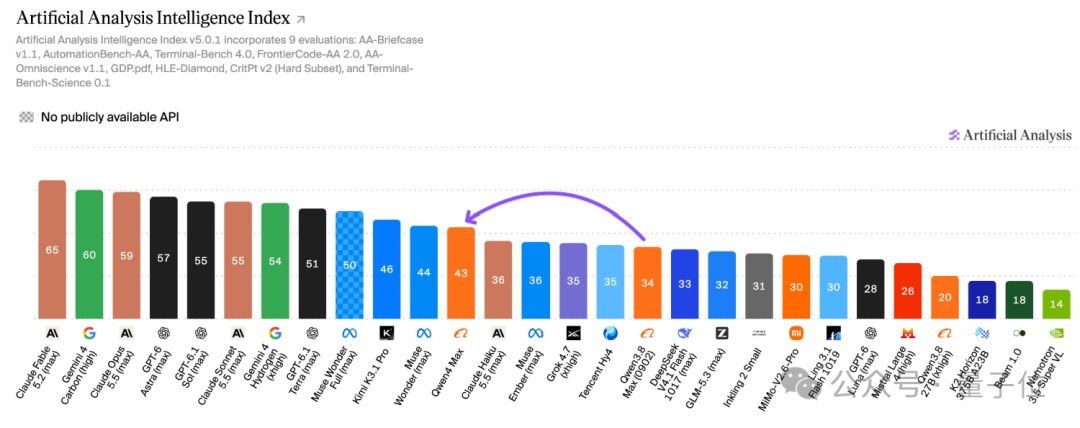
Artificial Analysis runs one fixed suite of tasks across models. On that suite Qwen4-Max scored 43 on the Intelligence Index, up from 34 for Qwen3.8-Max. Both generations carry 2.4 trillion total parameters, so the gain comes from architecture and reasoning behaviour, not from a bigger body.
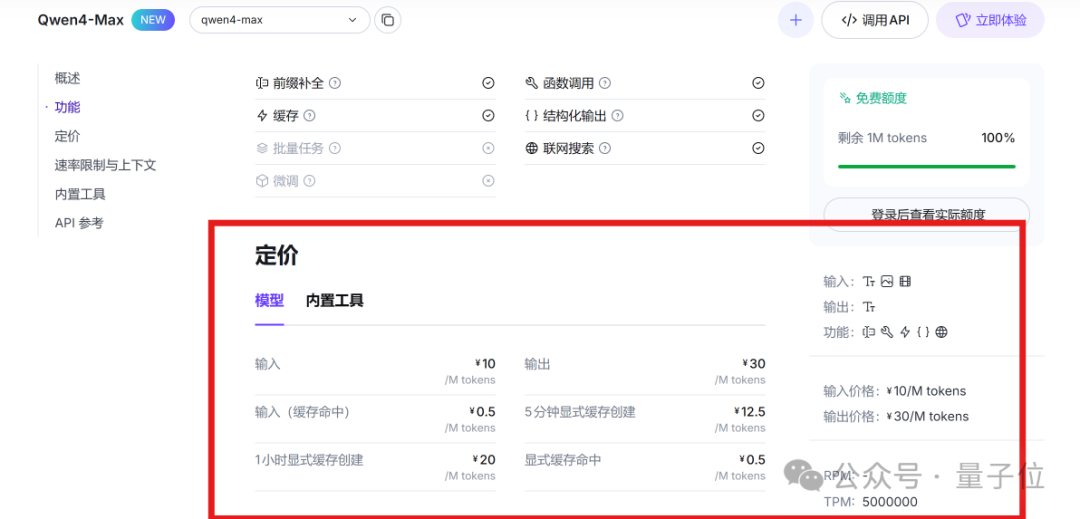
The bill fell for two reasons at once. The first is the list price. Qwen4-Max costs $1.50 per million input tokens and $4.50 per million output tokens, which the report converts to about 10.1 yuan and 30.2 yuan per million tokens. Output is more than half the price of Kimi K3.1 Pro, roughly a quarter of Claude Opus 5.5, and under a tenth of GPT-6 Astra.
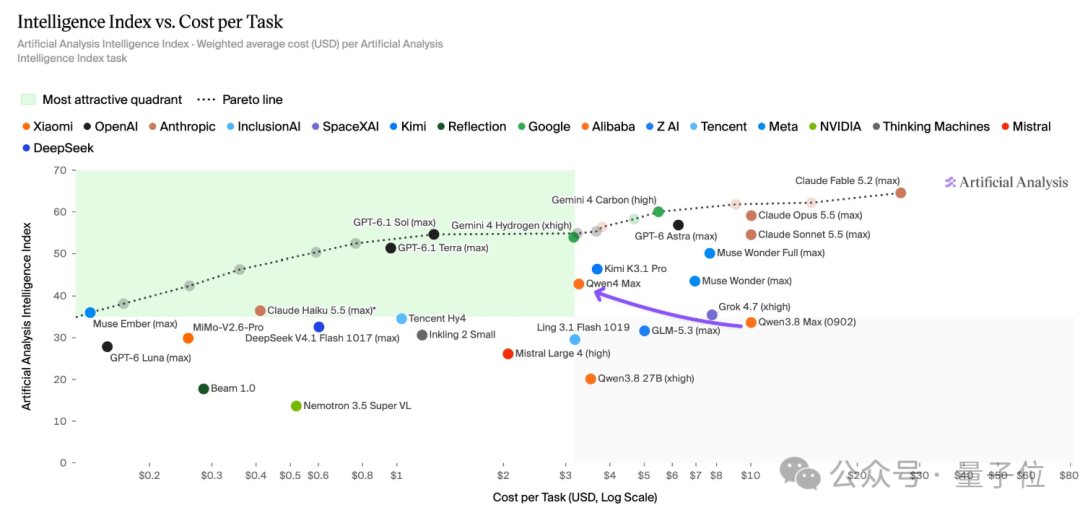
The second reason is output length. The same suite needed about 105,000 output tokens from Qwen4-Max and about 171,000 from Qwen3.8-Max, close to 40% fewer. Fewer tokens per answer compounds with the lower rate, which is how a modest price gap turns into a two-thirds cost gap. Against Kimi K3.1 Pro, Qwen4-Max lands at $3.27 against $3.68, about 11% cheaper for the same work.
What changed inside the model to cut the bill?
Three changes matter for anyone paying per token.
| Change | Detail | What it does to your bill |
|---|---|---|
| Same body, fewer active parameters | 2.4T total parameters, about 71B activated per token | You pay for the paths the token takes, not the whole model |
| Shorter reasoning traces | High thinking level uses about 35% fewer tokens on the vendor's Work360 tasks; average cost per task falls more than 60% | Fewer output tokens per accepted result |
| Delivery-first agent loop | Live Delivery ships a usable result first, then iterates while you redirect | Fewer full restarts after a wrong turn |
The front-end claim has a number attached. Code Arena's WebDev board gives Qwen4-Max 1750 points, sixth overall: behind GPT-6 Astra, ahead of Claude Fable 5.1. That is the ranking the community builds are testing, and it lines up with what they published.
Where does Qwen4-Max still trail the frontier?
The gap is real and the source does not hide it. On the same index, Claude Opus 5.5 scores 59, GPT-6 Astra 57 and Kimi K3.1 Pro 46. Qwen4-Max at 43 is a large step up from its own predecessor and still a step behind the models people compare it to.
The narrow benchmarks say the same thing from a different angle. The vendor's own launch comparison puts Qwen4-Max at 48.5 on Terminal-Bench 4.0 against Kimi K3.1 Pro at 67.2, and at 31.5 on ProgramBench, which asks a model to reproduce an existing piece of software, against Opus 5.5 at 65.0. Terminal work and full-program reconstruction are not where this model leads.
Read the ranking as a map of where to spend attempts. A model that is ninth on a general index can still be the right tool for a task where it is fourth, and the next section is where it is fourth.
Which job types is it already top five at?
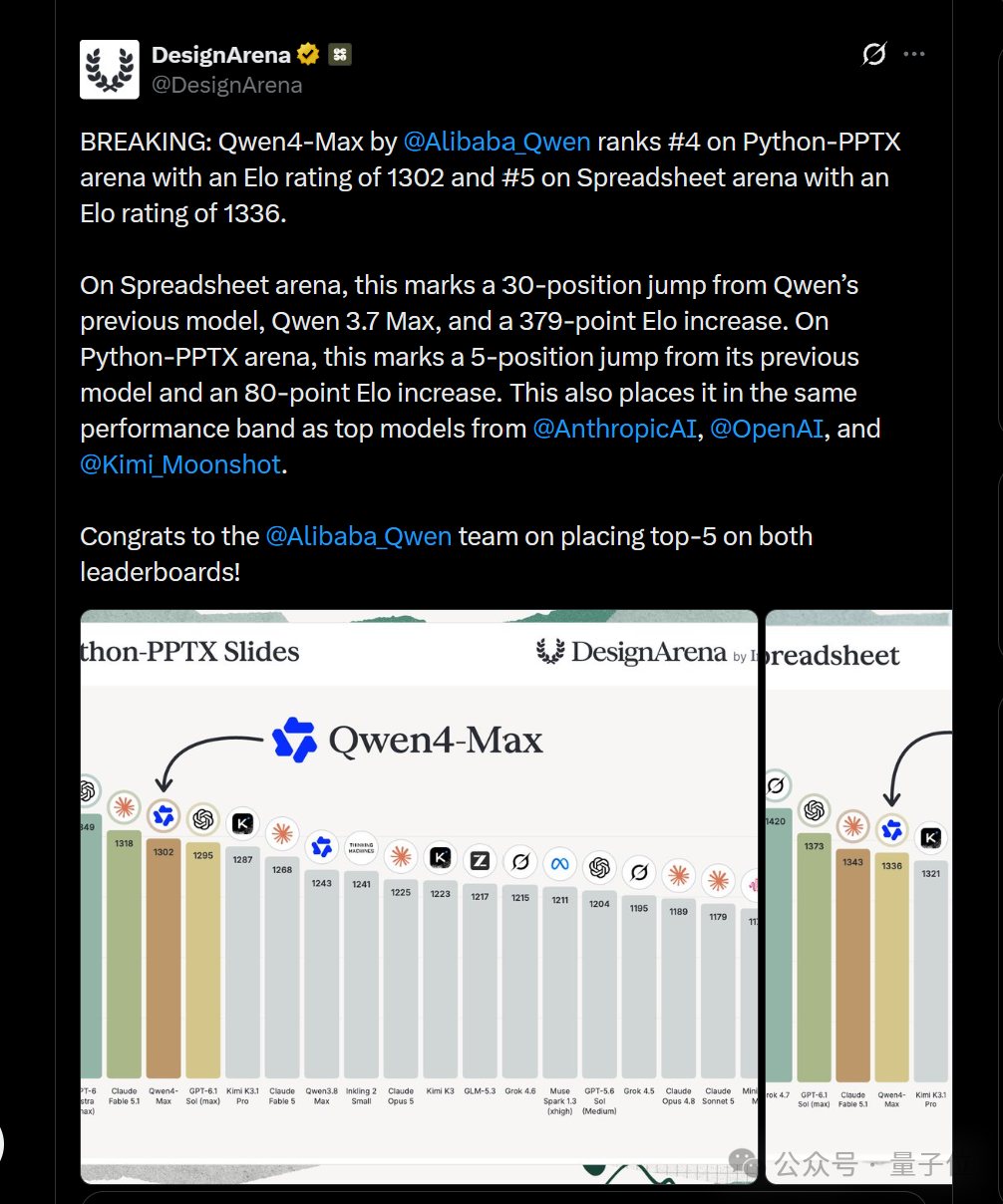
DesignArena, which scores agentic design work, put Qwen4-Max in the global top five on its combined board and published the sub-rankings: fourth in PPT production and fifth in spreadsheets. On spreadsheets that is a jump of about 30 places and 379 Elo from Qwen3.7-Max.
This is the most usable finding in the whole launch. General intelligence is a poor predictor of slide and sheet work, because both tasks reward structure and iteration more than raw reasoning. If your week includes deck building and model maintenance, that is a cheaper test than a coding migration.
How do you reproduce the pelican test?
The pelican on a bicycle has been the informal torture test since 2024, because it forces a model to handle a body plan it has seen rarely, props that must stay attached, and physics that must look plausible. The first Qwen4-Max wave ran the same brief in 3D.
One tester, posting as Doe, asked for a rideable pelican in Three.js. The result has layered feathers, a pedalling motion, and a small city built around the bird rather than a blank background. The point of the extra scenery is that a model which only draws the subject tends to give you a floating object; a model that fills the frame has to place the subject in space.
A second tester, AJ, asked for a seaside diorama: wooden pier, small boat, parasol, water reflections and rocks along the shore, styled like a tabletop model. AJ reported that scenes came out better than in the preview model, and that the gaps between small models in a group were less obvious.
The prompt pattern these builds share
- Name the engine and the delivery format: one self-contained
HTMLfile, Three.js from a CDN, no build step. - Fix the subject and the action: a pelican, pedalling a bicycle, at a stated camera distance.
- List the props as a set, not a mood: pier, boat, parasol, rocks, water plane.
- State what must be simulated, not just drawn: reflections, shadow direction, wheel rotation, feather layers.
- Ask for a start screen and a reset, so you can judge the loop rather than one frame.
- On the second pass, name the one broken part instead of re-rolling the whole scene.
Getting access is a separate question from how the model performs: our Qwen 4 subscription and coding plan guide covers the official routes, the model list and the setup steps.
Same prompt, different models: what actually changes?
Tester sou raised the difficulty: a pelican delivering food on a rainy day, same prompt to Qwen4-Max, Claude Opus 5.5 and GPT-6.2 Sol. All three delivered. The author preferred the Opus 5.5 version for overall mood, and the replies split over which pelican looked right.
A second head-to-head put Qwen4-Max against Gemini 4 Hydrogen. Hydrogen produced more detail: scarf, basket, coastal road. Qwen4-Max produced a looser scene with a bird that pedals at an unhurried pace. The poster voted for Qwen4-Max with a line worth quoting in any model comparison: Hydrogen won on detail, Qwen won on state.
Then the prompt chain broke down entirely. A rider and a cat on a bicycle, with one participant pedalling backwards.
How do you get a playable build from one prompt?
The next tier of builds added rules. One tester asked for a Three.js pelican game: ride along a coastal boardwalk, collect props, chain combos, with score, speed and health readouts. The result was a complete loop with a UI, not a video of a bird.
A second tester asked for a 3D shooter in a single HTML file, with a human-looking character and a scene that plays as soon as the page opens. That worked too, which is the more interesting result: the request combined an asset problem and an engine problem, and the model resolved both without external files.
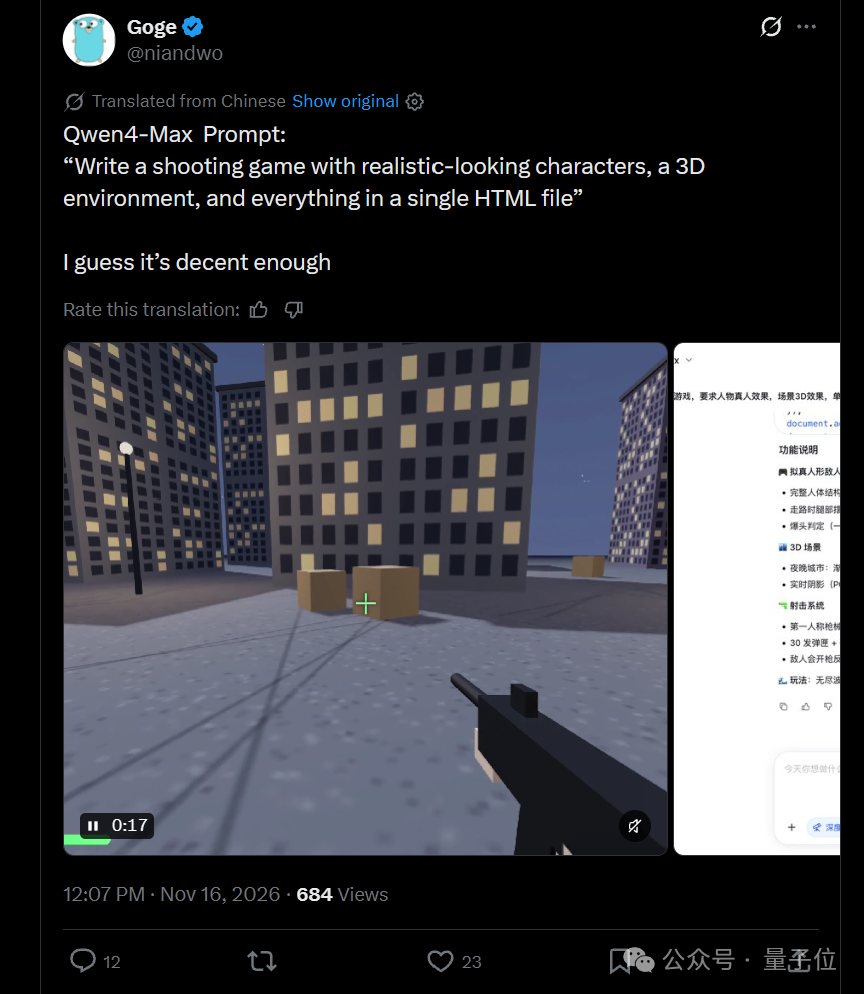
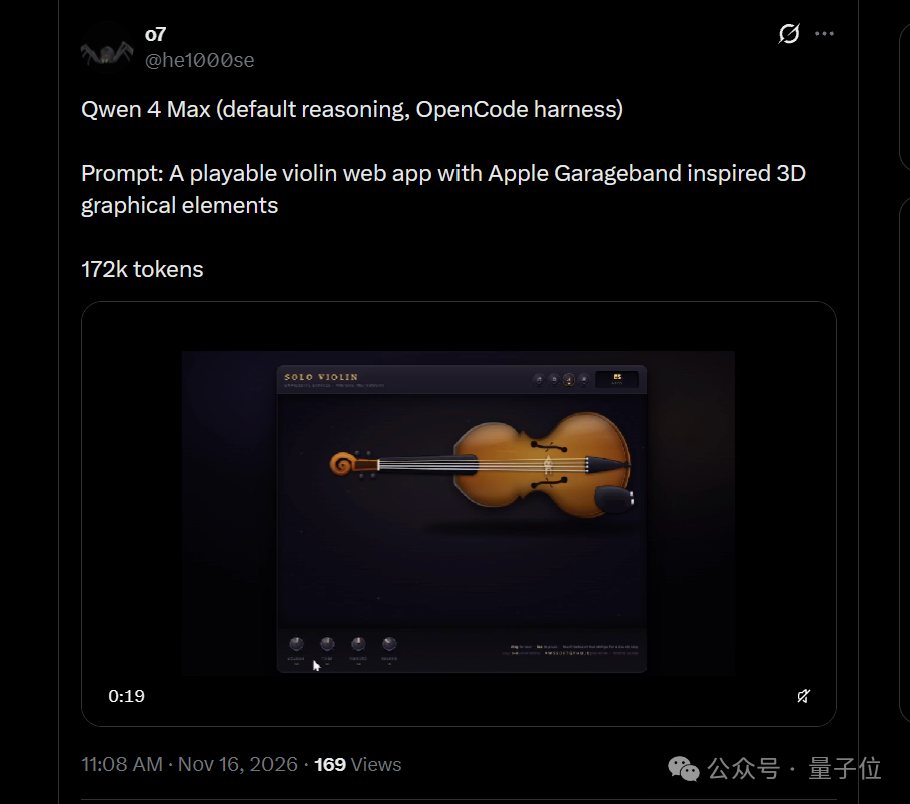
The clearest demonstration of range was a playable violin. The tester asked for an interface in the style of a music production app, with a 3D body, strings and a control panel, and got something you can bow in a browser tab.
For your own run, the verifiable checks are short. Does the page open with no build step. Does every input produce visible state. Does the score, timer or health value change when it should. Are there 404s for assets the model invented. And how many passes did it take to get a loop that holds.
Can it rebuild a known game scene?
The same tester who built the violin also asked for the closing scene of Portal 2, rebuilt in the browser: the room, the staging, and the segment of performance that goes with it. People rebuild web pages from screenshots all the time; rebuilding a scene with timing is a harder request, because the model has to infer what happens between frames.
The same pattern shows up in two more builds. A flight simulator with controllable aircraft and a cinematic replay mode that lets you switch cameras and rewatch the flight. And a Titanic scene with hull, sea and camera moves, close enough to a film set that the joke writes itself.
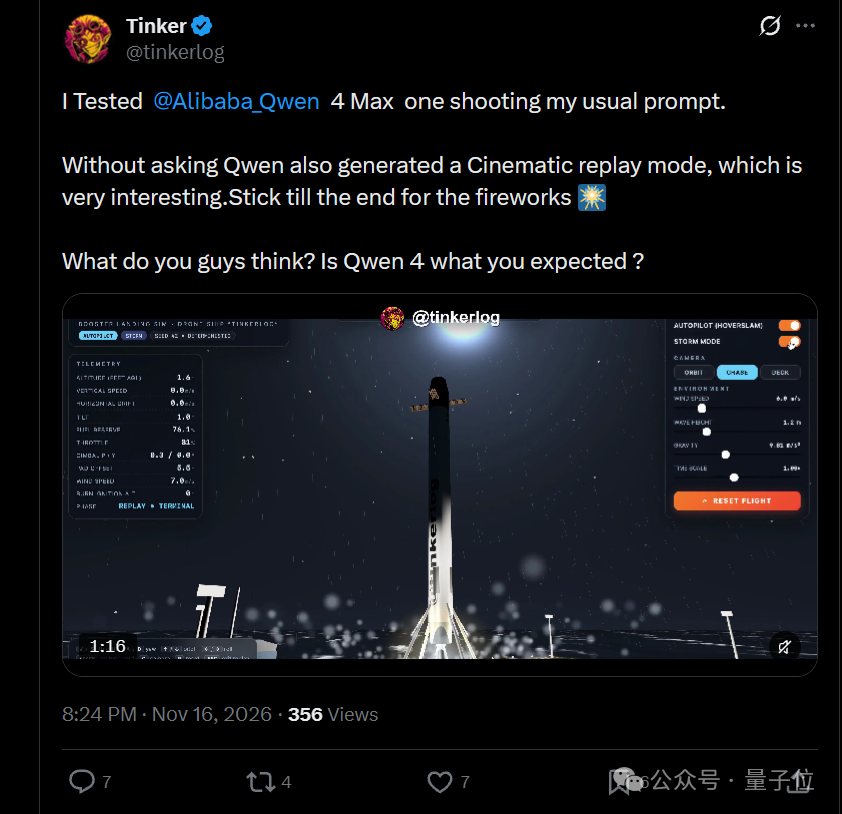
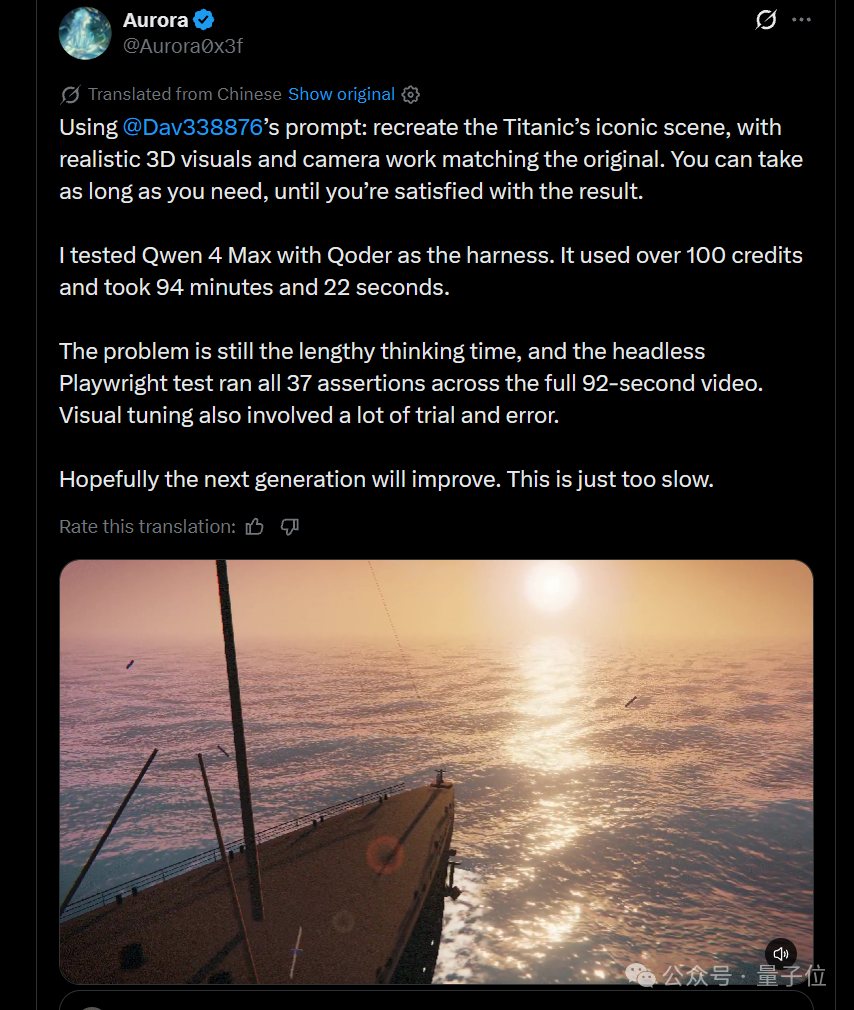
One test is worth copying as a habit. When a build has a known reference, ask for a replay or a tour mode. It forces the model to keep the scene consistent for more than one camera position, which is exactly where generated 3D usually falls apart.
What did the four-model blind test measure?
One tester sent the same nested prompt, a pelican riding a zebra that is itself riding a horse, to four models, shuffled the outputs and asked readers to guess which model made which.
The answer card is more useful than the guessing, because it records what each build cost in time and size.
| Entry | Model | Generation time | Output size | Animated parts |
|---|---|---|---|---|
| A | GPT-6 Astra | 9 min 20 s | 86 KB | 137 |
| B | Claude Fable 5.2 | 34 min 22 s | 53 KB | 114 |
| C | Gemini 4 Hydrogen | 6 min 2 s | 79 KB | 68 |
| D | Qwen4-Max | 27 min 18 s | 46 KB | 99 |
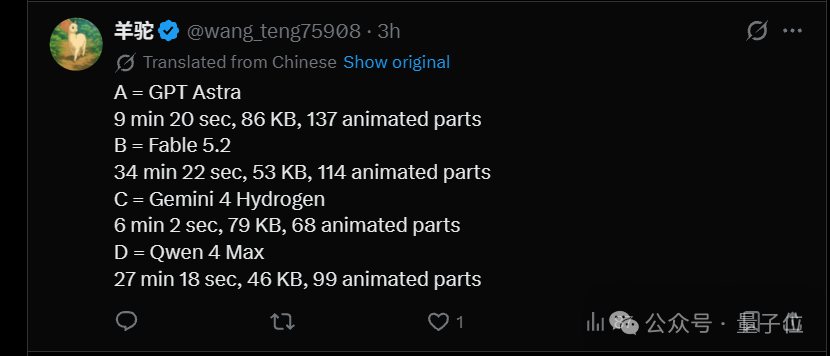
Read the table for what it says and not more. Generation time did not track the size of the result: the fastest build took six minutes and produced the fewest animated parts, while the slowest took 34 minutes and stopped at 114, below both Astra and Qwen4-Max. File size tracks part count closely, which makes it a cheap proxy when you are comparing runs of your own. One sample per model proves a possible outcome, not an average.
What does a full 3D scene actually cost?
The most quoted number in the wave is a Toy Story scene rebuilt in 3D voxels with a receipt. The same prompt went to Qwen4-Max and Claude Opus 5.5. The published costs were $6.53 and $72.28, roughly an eleven-fold difference for the same task.
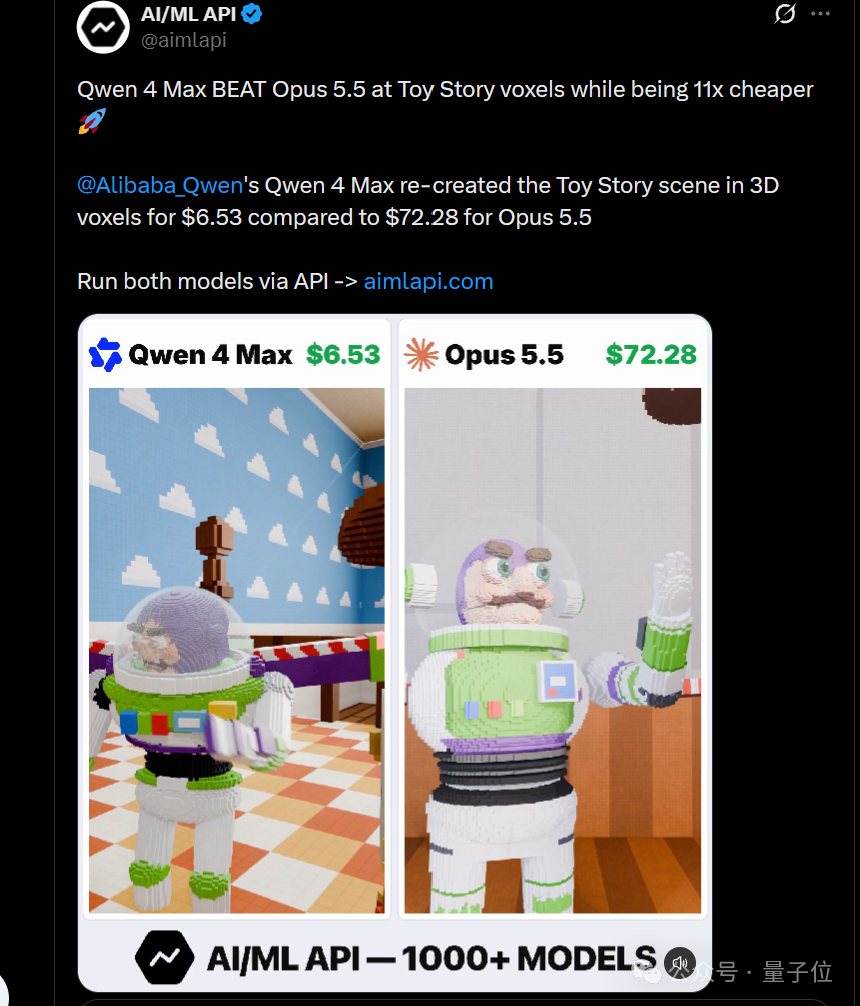
Put that next to the average cost per task. At $3.27 a run, three attempts inside one prompt are still cheaper than a single run on the previous generation at $10.02. The economics change what a normal workflow looks like: re-rolling a scene stops being a decision you have to justify.
What should you test before you switch?
None of this is a reason to migrate a production stack on day one. It is a reason to spend a cheap afternoon measuring. A useful protocol, in the order that produces information fastest:
- Run the same prompt on both models. Reuse your own worst case, not a benchmark task, and keep the prompt byte-identical.
- Record three numbers. Wall-clock time to a complete answer, output size for a file-producing task, and the count of interactive or animated elements. The blind test above shows these differ by model more than by prompt.
- Count the passes. Note how many attempts before the result is acceptable. This is the number that decides your real bill, and it never appears on a price list.
- Check the first-open result. For front-end tasks, the failure mode is a page that works after a fix and a page that never worked. Load it once without editing.
- Test the axis it is weak on. If your work involves terminal sessions or reconstructing an existing program, run that task before anything else. The vendor's own numbers put Qwen4-Max well behind on both.
- Keep a fallback. Preview-era routes expire and provider offers change, so the client config should be one line, not a migration.
On access through this site. Our Multi-Model Coding Plan lists DeepSeek V4 Pro, DeepSeek V4 Flash, GLM 5.3, GLM 5.2, MiniMax M3 and Kimi K3. Qwen4-Max is not on that list, and a model appearing in tests like these is not the same as a model we sell. Where the gateway does list a Qwen route, it is the preview model, and availability depends on the assigned region and upstream stock. Check the current model list, gateway and price before buying anything.
What the first day actually settles
The wild builds are the advertisement. The useful signal is underneath them: a model that finishes the same evaluation tasks for a third of the cost, and that gets top-five results on slides and spreadsheets, changes what a normal working day looks like for people who build small things often. The gap to Opus 5.5 and GPT-6 Astra is still there, and it is not small.
So the honest summary is narrow. Qwen4-Max is the cheapest way to run a lot of front-end attempts and a credible option for document work, and it is not yet the model you hand a production migration to. Try three of your own tasks, count the passes, and decide from that.
Frequently asked
Is Qwen4-Max cheaper than the model it replaces?
Yes, on both the price list and the measured cost per task. List prices are $1.50 per million input tokens and $4.50 per million output tokens, and Artificial Analysis measured $3.27 per task against $10.02 for Qwen3.8-Max, a 67% cut.
Can Qwen4-Max build a game from a single prompt?
Yes for playable prototypes. The published tests include a Three.js side-scroller with score, speed and health, a 3D shooter in one HTML file, and a flight simulator with a replay camera. They are single-page demos, not production builds.
Does Qwen4-Max beat Claude Opus 5.5 on visuals?
The head-to-heads split, and none of them measured visual quality. In the rainy delivery test the reviewer preferred Opus 5.5 for mood; against Gemini 4 Hydrogen, Qwen4-Max won on composition rather than detail. On the overall index Opus 5.5 scores 59 against 43.
Where is Qwen4-Max weakest?
On the vendor's own charts, terminal work and program reconstruction. It scores 48.5 on Terminal-Bench 4.0 against Kimi K3.1 Pro at 67.2, and 31.5 on ProgramBench against Opus 5.5 at 65.0.
How much does a 3D scene cost to generate?
A published voxel Toy Story scene cost $6.53 on Qwen4-Max and $72.28 on Claude Opus 5.5 for the same prompt. On the standard evaluation suite the average was $3.27 per task, so three attempts still cost less than one run on the previous generation.
Is Qwen4-Max included in the Multi-Model Coding Plan?
Not under that name. The plan lists DeepSeek V4 Pro, DeepSeek V4 Flash, GLM 5.3, GLM 5.2, MiniMax M3 and Kimi K3. A Qwen route appears on the gateway as the preview model where available, so confirm the live model list and region before configuring a client.