Qwen4-Max Launches: 2.4T Parameters, $1.5 Input and Six Industry Demos
TL;DRAlibaba released Qwen4-Max on November 16, 2026, the first model in the Qwen 4 family. It is a sparse MoE model with 2.4T total parameters, 71B activated per token, native vision input and a 1M-token context window. Pricing is $1.50 per million input tokens, $4.50 per million output tokens and $0.075 for implicit cache, which is cheaper than Qwen3.8-Max. The official comparison shows first places on DeepSWE v1.1, Agents' Last Exam v1.1, BioMysteryBench and a legal-agent benchmark, and clear losses on Terminal-Bench 4.0 and ProgramBench. The API is live on QwenCloud with pay-as-you-go and Token Plan billing, and the model is not open source.
By Cameron Voss and West Mao
What launched, and where you can use it
Alibaba released Qwen4-Max on November 16, 2026. It is the first model in the Qwen 4 family: a new sparse mixture-of-experts architecture with 2.4 trillion total parameters and 71 billion activated per token, native vision input, and a one-million-token context window. The official positioning is an "AI teammate" for long-horizon execution on real work rather than a chat model.
The API is live on QwenCloud, where it can be called with pay-as-you-go billing or through the Token Plan. There is also direct access in Qwen Studio, QwenWork and Qoder. Qwen4-Max itself is not open source; Alibaba says smaller Qwen 4 models will be released later with open weights from the same generation.
Price: cheaper than the model it replaces
Qwen4-Max costs $1.50 per million input tokens and $4.50 per million output tokens. Implicit cache is $0.075 per million tokens, roughly a 70% cut to the cache price and 5% of the fresh-input rate. Alibaba presents this as a price cut against Qwen3.8-Max, not a premium tier.
| Qwen4-Max list price | USD per 1M tokens |
|---|---|
| Input | $1.50 |
| Output | $4.50 |
| Implicit cache | $0.075 |
Prices from the November 16 announcement. Check the provider's live pricing page before budgeting.
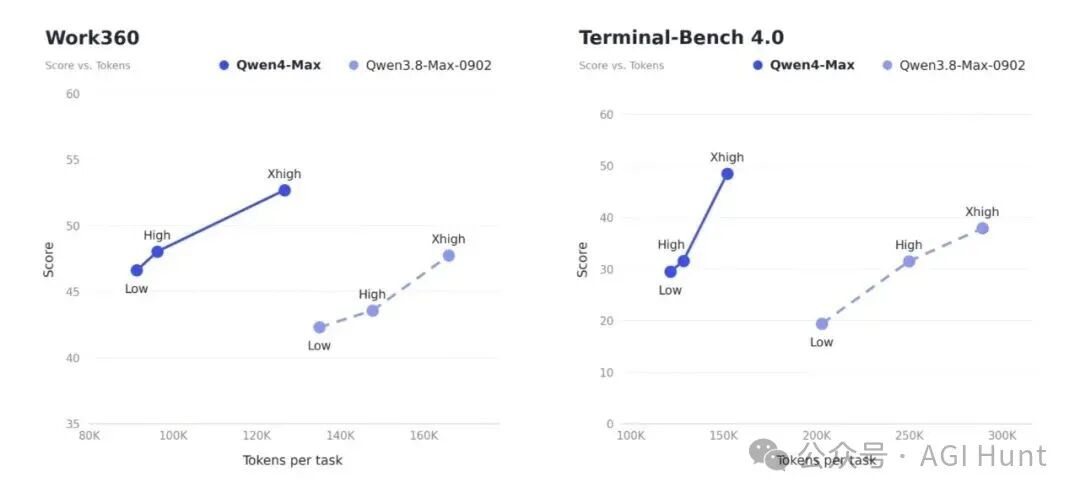
Token efficiency matters as much as the rate. On Work360, the vendor says XHigh and High thinking levels use about 24% and 35% fewer tokens than the previous generation; on Terminal-Bench 4.0 the reduction is about 48% and 49%. Combined with the lower rates, the average cost of a Work360 task falls from $4.43 to $1.67, a 62% drop.
Benchmarks: first place on four tests, last place on two
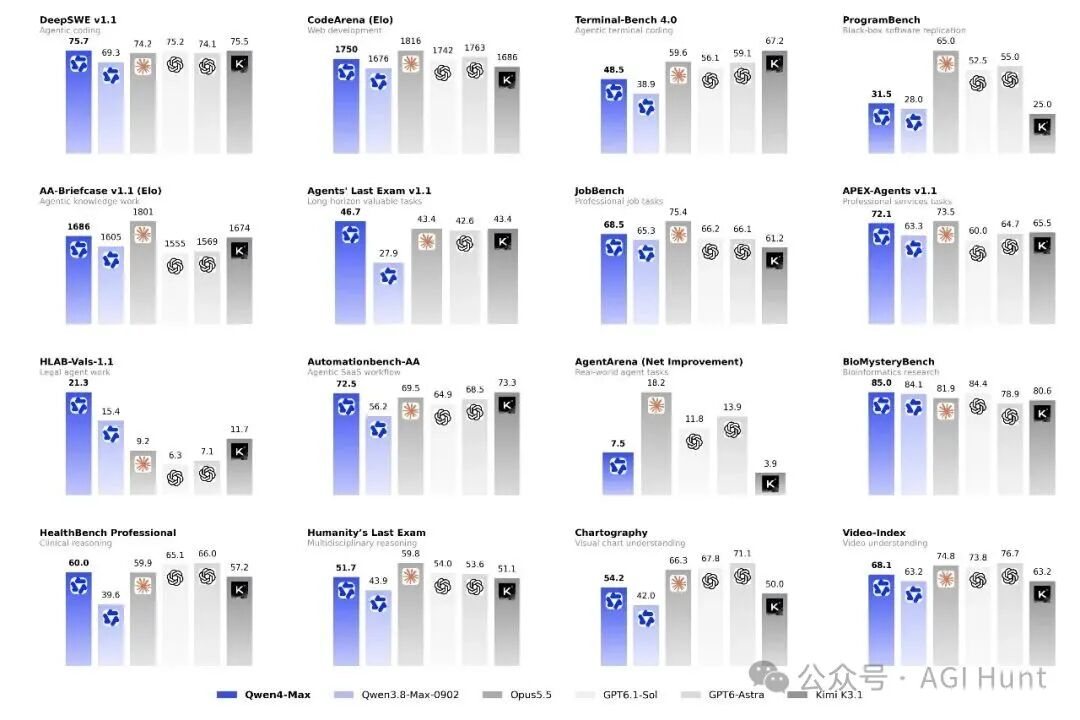
Alibaba compared Qwen4-Max with Opus 5.5, GPT-6.1 Sol, GPT-6 Astra and Kimi K3.1. It takes first place on DeepSWE v1.1 at 75.7, Agents' Last Exam v1.1 at 46.7, BioMysteryBench at 85.0, and the legal-agent benchmark HLAB-Vals-1.1 at 21.3, which is more than twice the Opus 5.5 score of 9.2.
The same table also shows where it loses. On Terminal-Bench 4.0 it scores 48.5 against Kimi K3.1 at 67.2. On ProgramBench, which asks a model to reproduce an existing piece of software, it scores 31.5 against Opus 5.5 at 65.0. Chart understanding and AgentArena place it near the back of the group.
| Benchmark | Qwen4-Max | Comparison | Reading |
|---|---|---|---|
| DeepSWE v1.1 | 75.7 | Leads the set | Software engineering tasks |
| Agents' Last Exam v1.1 | 46.7 | Leads the set | Long-horizon agent work |
| BioMysteryBench | 85.0 | Leads the set | Biology research tasks |
| HLAB-Vals-1.1 | 21.3 | Opus 5.5 at 9.2 | Legal agent work |
| Terminal-Bench 4.0 | 48.5 | Kimi K3.1 at 67.2 | Terminal and shell tasks |
| ProgramBench | 31.5 | Opus 5.5 at 65.0 | Reproducing existing software |
Vendor-reported comparison from the launch announcement. No independent replication has been published.
Work360: a 52.69 score on a benchmark Alibaba built
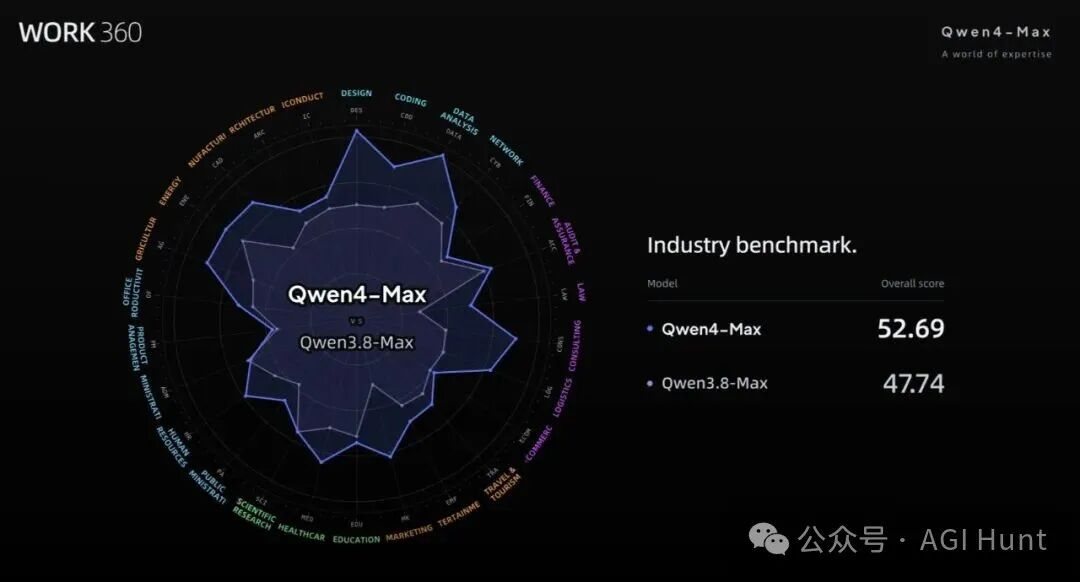
To measure work rather than exam answers, the Qwen team built its own tiered work benchmark, Work360, with 26 first-level domains, 182 sub-domains and 721 specialist areas covering design, coding, finance, law, medicine, education, logistics and energy. Qwen4-Max scores 52.69, up from 47.74 for the previous generation, about a 10% gain.
A vendor-designed benchmark is useful context and weak evidence at the same time. It is the only public measurement that spans this many job types, and it is also the benchmark the vendor chose and can revise. Read the ranking, then run your own tasks.
Choosing between official access and a gateway? Read the Qwen 4 subscription guide for the current routes, model list and setup steps.
Architecture: sparse attention, gated residuals, a bigger embedding
Three parts of the model changed. Attention mixes Gated DeltaNet with Qwen Sparse Attention, in a pattern of three GDN layers to one QSA layer: GDN compresses history into a fixed-size state, and QSA uses a lightweight indexer to pick relevant micro-blocks, which is how long sequences get cheaper. Residual connections became four parallel gated paths with dynamic read and write gates per layer, aimed at training stability. Layer two adds an N-gram embedding with 328 billion extra parameters that barely adds compute.
Alibaba says the 2.4T-parameter training run had no loss spikes, and that the base model uses 25% fewer active parameters than Qwen3.8-Max-Base with 5% to 13% lower bits-per-byte across domains. Those are training-side claims; they tell you what to test, not what your workload will see.
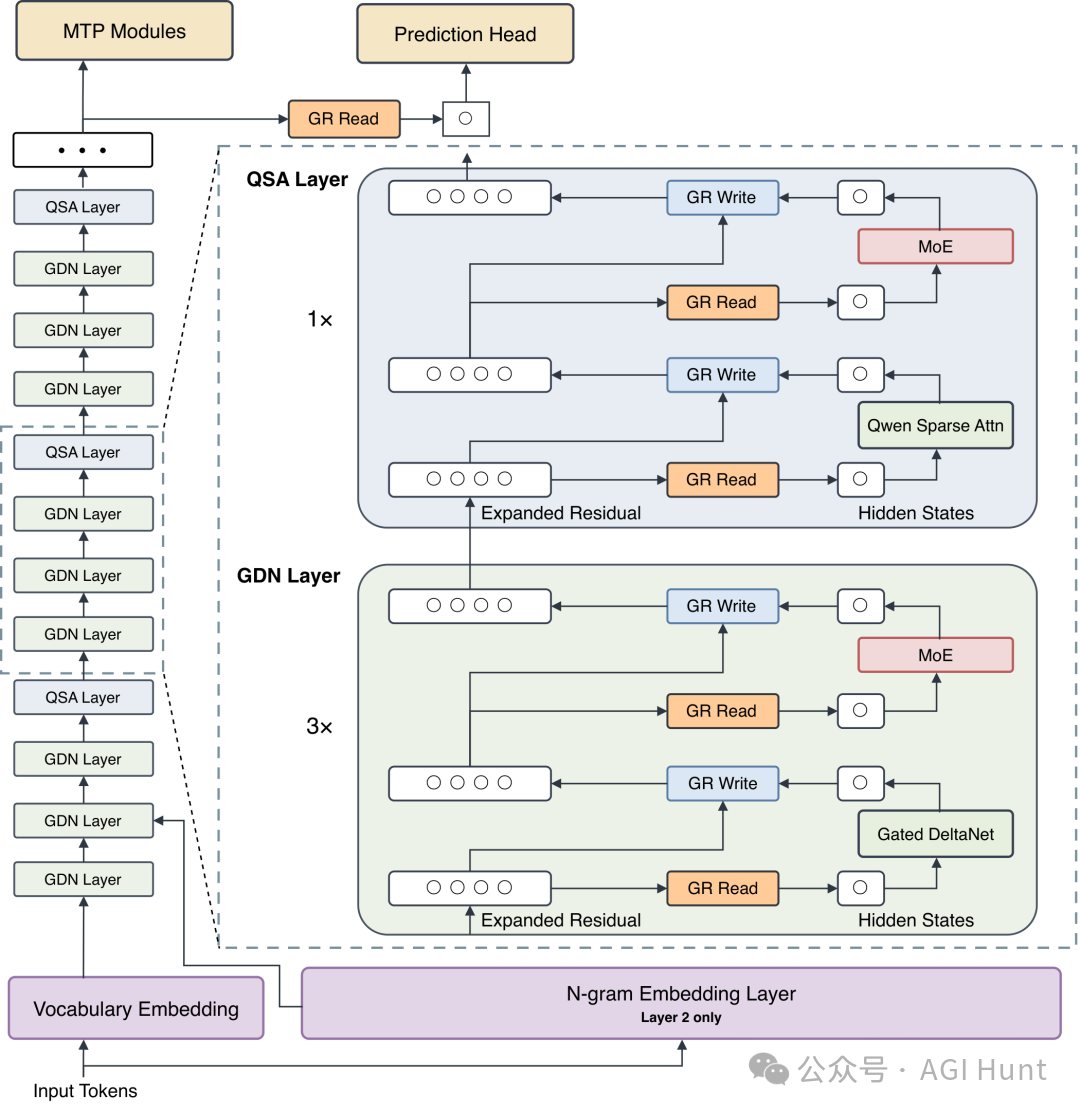
Six industry demos in the launch
The demos are the part of a launch that a benchmark cannot replace. Alibaba ran the model in six settings and reported outcomes for each. Treat them as demonstrations the vendor chose, then decide which ones resemble your work.
3D and games. The model operates Blender directly for modelling, scene setup, materials, lighting and rendering, moving from a rough white model to a cinematic shot. It also builds games in Unity, Unreal Engine and Godot, runs them to test itself, and adjusts camera work, animation and hit feedback from what it sees. The examples are a Unreal Engine xianxia game, Yunguanxing, with a boss fight against a panda, and a Unity 6 West Lake racing game that was packaged as an installable Android build.
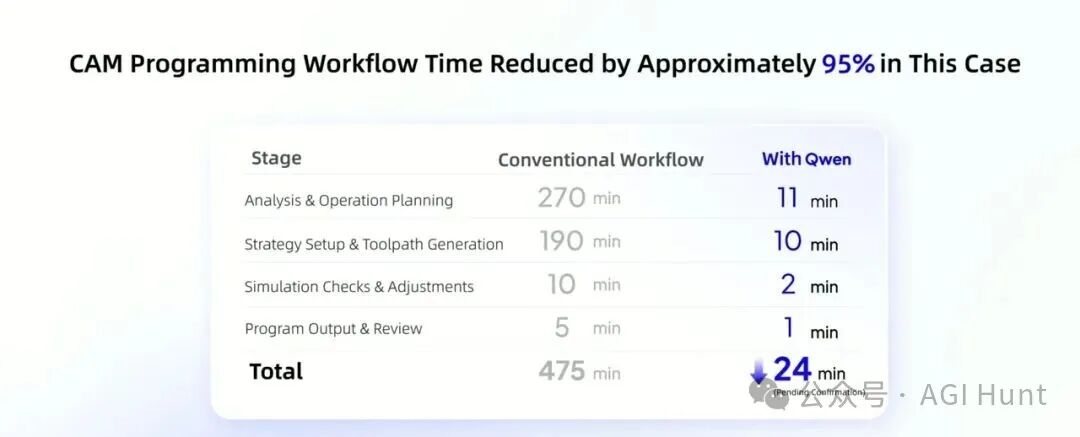
Manufacturing. At SANF and Pacific Union, the model worked inside real production environments. It built a 3D production line from a 2D layout and process parameters using an existing equipment library, simulated cycle times, and did PLC virtual commissioning. At the part level it designed door assemblies and friction wheels, planned machining sequences, generated toolpaths, and used simulation to find over-cutting and under-cutting before machining. The reported result: programming time for a single workpiece fell from about 475 minutes to 24 minutes, a 95% reduction.
Scientific discovery. The model designed and synthesised a new coolant molecule for next-generation high-power chip cooling. Connected to Deep Principle's Mira wet-and-dry lab platform, it ran autonomously for 48 hours: surveyed the technical route, built a candidate space of 2.7 million molecules, then filtered structures, predicted properties, ran first-principles calculations and retrosynthesis analysis, and directed an automated wet lab to prepare reagents, synthesise, separate, purify and test. After four rounds of design, synthesis, testing and active learning, it produced a physically verified sample.
Drug design. On Deep Principle's PharmMaster platform, the model worked on the NLRP3 target linked to Alzheimer's disease. It made 454 tool calls, completed 3,239 computational evaluations and designed and refined 24 candidate molecules; the final pick has a predicted binding affinity about 3.6 times the reference molecule.
Finance. In equity research, one call pulled 90 MCP tools to collect A-share, Hong Kong, US, bond, fund and derivative data, then delivered an Excel workbook and an editable slide deck, with every chart traceable to the workbook and cell hyperlinks pointing back to source data.
Legal. In pre-IPO due diligence, 198 source documents arrived with inconsistent formats and file names. The model renamed them by content, filed them into 14 folders, cross-checked business registration, intellectual property, litigation and credit records, and produced an 86-page report of more than 60,000 characters with a source citation for every conclusion.
Medical. In one conversation it read six days of ICU records, including dozens of lab sheets, more than 10,000 characters of progress notes and 1,433 raw images. It dispatched sub-agents to review hundreds of CT slices in parallel, and its four recommendations matched the doctor's actual orders on the same day, item for item.
| Domain | Task | Claimed outcome |
|---|---|---|
| 3D and games | Blender modelling and rendering; Unreal Engine and Unity games | Finished scenes, a playable Android build |
| Manufacturing | 3D production line, PLC virtual commissioning, toolpaths | 475 to 24 minutes per workpiece |
| Materials | Coolant molecule design on a wet-and-dry lab platform | Synthesised sample after four loops |
| Drug design | NLRP3 candidates on PharmMaster | 24 candidates, 3.6x predicted affinity |
| Finance | 90 MCP tools, Excel and deck delivery | Charts traceable to source cells |
| Legal | 198-document due diligence | 86 pages with per-claim citations |
| Medical | Six days of ICU records and CT review | Four recommendations matching orders |
All outcomes are the vendor's account of demonstration runs. They are not matched tests and they were not independently audited.
The 24-hour agent and the Live Delivery plugin
Qwen4-Max is pitched at long-running agents. The launch adds Live Delivery: instead of waiting until a long task finishes, the agent ships a usable first version early and then iterates, so a user can step in and correct course. The companion Qwen-Live-Delivery-Plugin is open source.
Alibaba Cloud also reports using the model internally to tune its own compute scheduling: annotation model-call cost down 10.42% on average, and offline CPU rescheduling solved more than 14.61 times faster. Internal numbers of this kind are hard to check from outside, and they measure the vendor's own workloads.
Safety claims
Code training added security checks alongside functional ones. On Last Secure Code Bench, the function-level pass rate for correctness and security together rose from 22.0% to 31.8%, and the share passing at function, file and repository level rose from 8% to 14.7%, close to a doubling. Alibaba also says training data that strengthens attack capability was removed.
What this launch does not settle
Four things stay open. The benchmark table is vendor-run, with no independent replication of the Terminal-Bench or ProgramBench gaps. The demos are selected runs, and none of them reports a failure rate. The 24% to 49% token savings depend on the thinking level and the task, so they are not a blanket discount. And the model is closed: if you need weights, this is not the Qwen release for you, though smaller open models are promised.