DeepSeek V4.1 Flash vs Gemini 4 Neon: You're Paying for How Often Your Agent Can Fail.
TL;DR
By Cameron Voss
What each model is
DeepSeek V4.1 Flash uses the model ID deepseek-flash. The current release is V4.1 Flash-1017, an October 17, 2026 update that kept the same API ID and token prices. It takes text and images, supports thinking and non-thinking modes, returns JSON, and handles tool calls. The context window is 1M tokens, with a 384K maximum output. The API is OpenAI-compatible, so most existing clients need a base URL and key change rather than a rewrite.
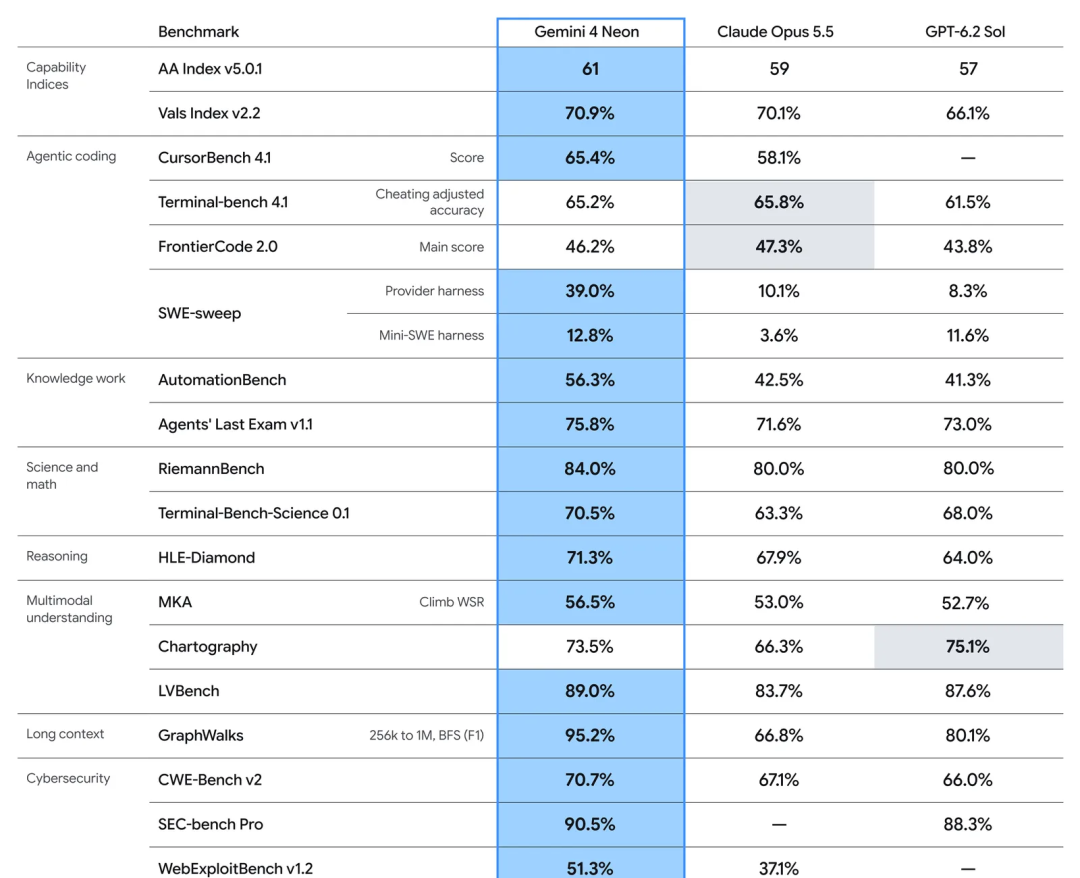
Gemini 4 Neon sits in the middle of Google's Gemini 4 family. Carbon takes the hardest, longest projects. Hydrogen handles fast everyday execution. Neon is the balanced tier: frontier-level reasoning at higher speed and lower cost than Carbon. It has a 1M-token context window and four thinking levels, including the default high setting and an xhigh setting for harder work. Google reports 61 on the Artificial Analysis Intelligence Index at xhigh and 60 at the default high setting.
| Item | DeepSeek V4.1 Flash | Gemini 4 Neon |
|---|---|---|
| API model ID | deepseek-flash | gemini-4-neon |
| Context | 1M tokens | 1M tokens |
| Max output | 384K tokens | Not stated in the announcement |
| Input price | $0.30 peak / $0.15 off-peak per 1M | $3.00 per 1M |
| Cached input | $0.006 peak / $0.003 off-peak per 1M | $0.15 per 1M |
| Output price | $1.20 peak / $0.60 off-peak per 1M | $15.00 per 1M |
| Tool use | OpenAI-style function calling | Function calling, Search grounding, code execution |
| Managed orchestration | None. Build your own. | Antigravity /swarm with Hydrogen workers |
Pricing changes the shape of the workload
The token gap is large. At peak, DeepSeek Flash charges $0.30 per million input tokens and $1.20 per million output tokens. Off-peak, those fall to $0.15 and $0.60. Gemini 4 Neon charges $3.00 and $15.00, with cached input at $0.15. Output is 12.5 times more expensive on Neon at DeepSeek peak rates, and 25 times more expensive against DeepSeek off-peak rates.
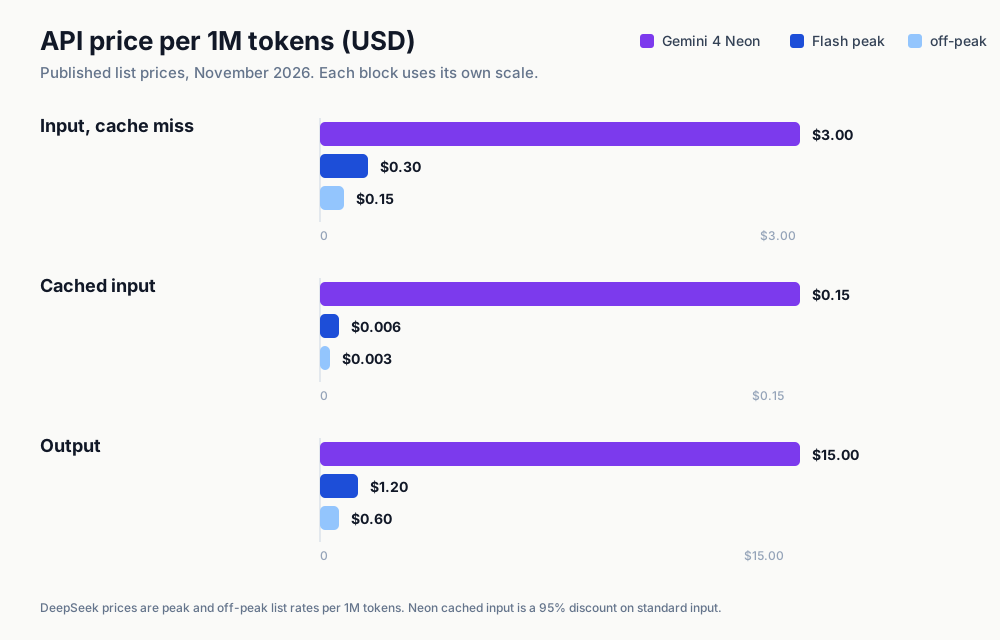
This changes how much trial and error a workload can afford. At Flash prices, a loop can retry, re-read files, and fan out to several workers without the bill moving much. At Neon prices, every long run has a higher floor, so context compaction and a tight plan matter more. Google says Neon at its default high setting costs 32% less per task than Carbon, and roughly 50% to 80% less than top frontier models. Those figures compare Neon with larger models, not with Flash.
Thinking levels are the other cost control. Neon's four levels let a team set depth per request. Flash exposes thinking and non-thinking modes instead. Both approaches let you spend more on hard steps and less on routine ones, but Neon gives you more stops between the two ends.
Tool calls and web access
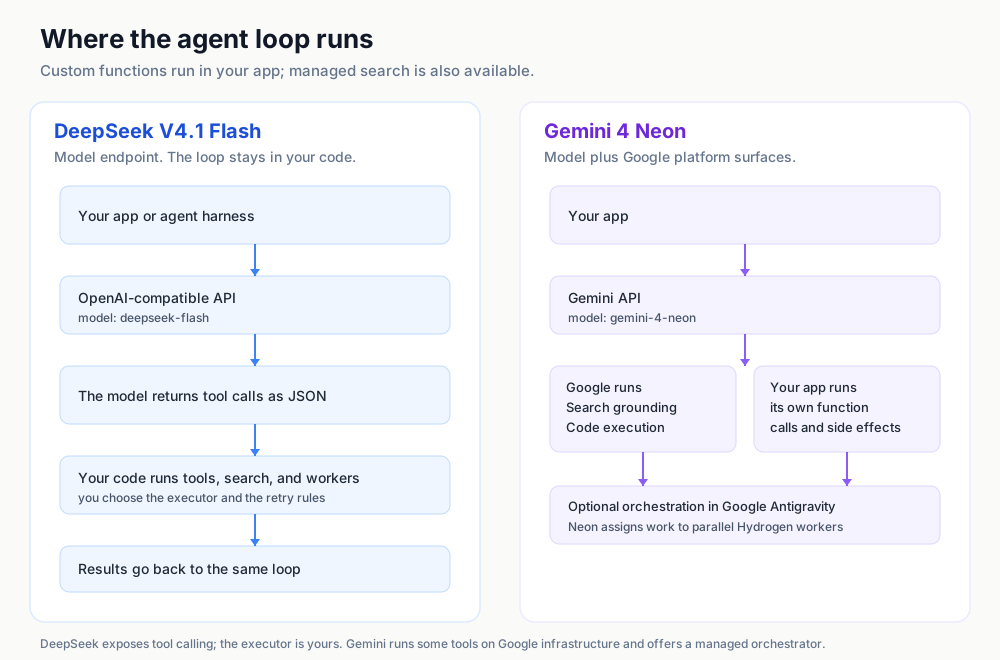
DeepSeek supports OpenAI-style function calling: your application executes its own custom tools. Its app APIs also offer managed web search and URL reading on deepseek-flash, where DeepSeek performs the search or fetch and assembles the context. Tool calls are billed separately from standard token charges. For custom tools, your application still owns permissions, timeouts, and access to production systems.
Gemini 4 Neon splits tool execution across two places. Google Search grounding and code execution run on Google's infrastructure. Your own functions still run in your app. The Gemini app can also pull details from Gmail and Docs when a user connects those accounts. That removes a layer of glue code, at the cost of putting more of the path inside Google's platform.
Long-running agents and orchestration
Google built Neon for long agent sessions. In Antigravity, it can act as an orchestrator and send parts of a task to parallel Hydrogen workers through /swarm. Neon plans, assigns, checks the results, and reassigns work when something fails. Google also points to context compaction and fewer redundant file reads as part of the design.
The harness effect is visible in Google's own numbers. Neon scores 12.8% on SWE-sweep with a mini harness and 39.0% inside Antigravity. The model is the same. The surrounding system does the rest.
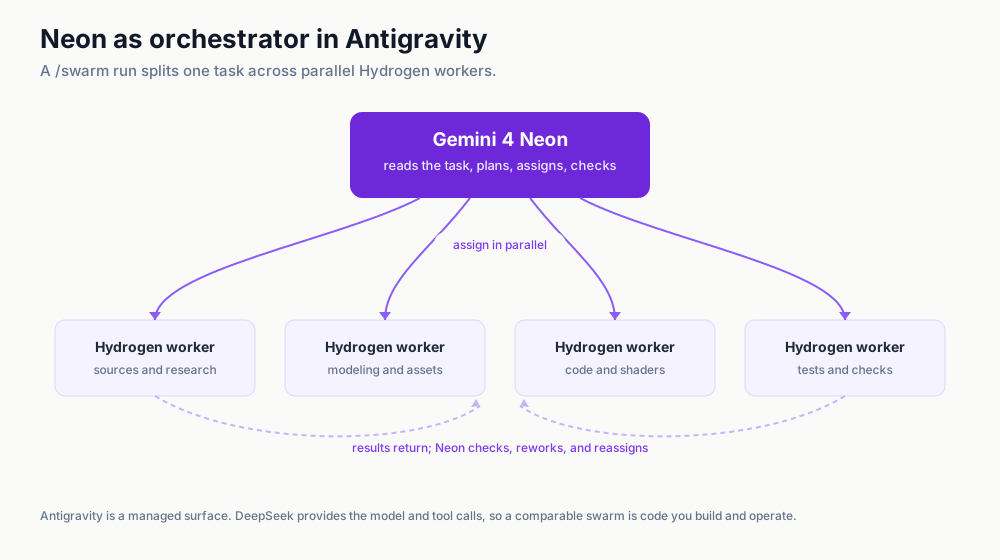
Google's own demo puts the design on screen. In one /swarm run, Neon spent 12 hours rebuilding Alan Turing's 1936 study at King's College, Cambridge from archival photos, down to a working Universal Turing Machine on the desk. The task combined research, modeling, materials, and rendering. That is a long chain with many handoffs, which is the case a managed orchestrator is built for.
DeepSeek does not ship a managed orchestrator. Flash is the worker. You write the planner, the queue, the retry rules, and the review step. That is more work up front, and it also means the orchestration can match your existing job system, permissions, and logging. A team that already runs its own agent harness gets a cheap worker without adopting a new platform.
Neon's Antigravity score and Flash's API score come from different harnesses, so the numbers are not directly interchangeable. Where you want the orchestration to live matters more than any single benchmark line.
Multimodal and document work
Both models accept images. Neon goes further in the Gemini app and Antigravity: spreadsheets, PDFs, charts, audio, and video can sit in the same 1M-token context. Google's demos include a 3D recreation of Alan Turing's 1936 study and a WebGL2 ski simulator written from scratch. These are showcase runs. They point at the kind of long, multi-step task Neon is tuned for.

DeepSeek V4.1 Flash handles text and images natively. That covers screenshots, diagrams, and document pages. Audio and video need an extraction step before the model sees them. For teams that mostly send code, logs, and screenshots, the narrower input set is enough.
Which workload fits which design
The choice comes down to where the loop and the tools should live. This table maps common workloads to the design that fits them. It is a routing guide, not a ranking.
| Workload | Better fit | Why |
|---|---|---|
| High-volume coding loops | DeepSeek V4.1 Flash | Low output price makes retries and repeated tool turns cheap. |
| Existing OpenAI-compatible stack | DeepSeek V4.1 Flash | Base URL and key change, no new platform. |
| Custom orchestration and permissions | DeepSeek V4.1 Flash | You already own the planner and executor. |
| Long research and browser tasks | Gemini 4 Neon | Search grounding and code execution are built in. |
| Google Cloud and Antigravity teams | Gemini 4 Neon | /swarm and Hydrogen workers are part of the surface. |
| Spreadsheet, PDF, and media analysis | Gemini 4 Neon | Wider native input set in one context window. |
| Hardest single-shot reasoning | Neither | Use a larger model such as DeepSeek V4 Pro, Carbon, or Opus 5.5. |