GLM-5.4 Goes Live: KingBench 4's Highest-Ranked Open Model
TL;DRGLM-5.4 went live for all GLM Coding Plan users on November 23, 2026. An overseas KingBench 4 board that circulated during launch day ranks it seventh of 19 at 33.2 out of 60, the highest open model on that list, ahead of Kimi K3.1 Pro and DeepSeek V4.1 Flash. Early users report it finds bugs and security issues other models missed. It is Zhipu's first Loop Transformer flagship, with native vision, 1M context and broader general Coding. API access and downloadable weights are still pending.
By Cameron Voss and West Mao
What happened at the GLM-5.4 launch?
The model appeared without a countdown. On the afternoon of November 23, 2026, Chinese AI outlet Jiqizhixin (Machine Heart) reported that GLM-5.4 had gone live quietly, and that it was already open to every GLM Coding Plan user.
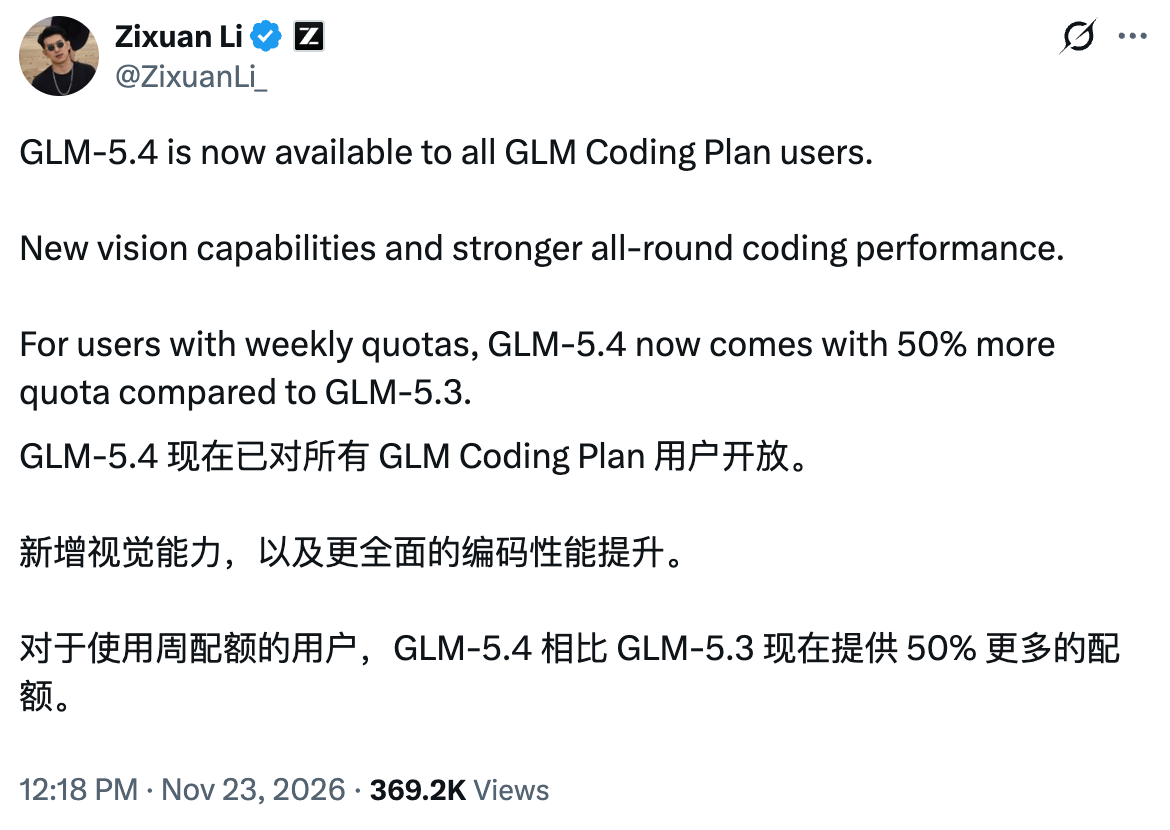
Zhipu's confirmation came shortly after. Zixuan Li posted on X at 12:18 PM that day: GLM-5.4 is available to all GLM Coding Plan users, with new vision capabilities and stronger all-round coding performance. For users on weekly quotas, the post says GLM-5.4 comes with 50% more quota than GLM-5.3. The post had drawn 369.2K views by the time launch coverage compiled it.
The company's full announcement followed the same evening. It names GLM-5.4 as Zhipu's first Loop Transformer flagship, says its intelligence reaches a 2 to 3T-level model, and opens what Zhipu calls general Coding. Zhipu's own engineering breakdown is covered in detail in our Loop Transformer article, listed under the GLM 5.5 tab below.
Where does GLM-5.4 rank on KingBench 4?
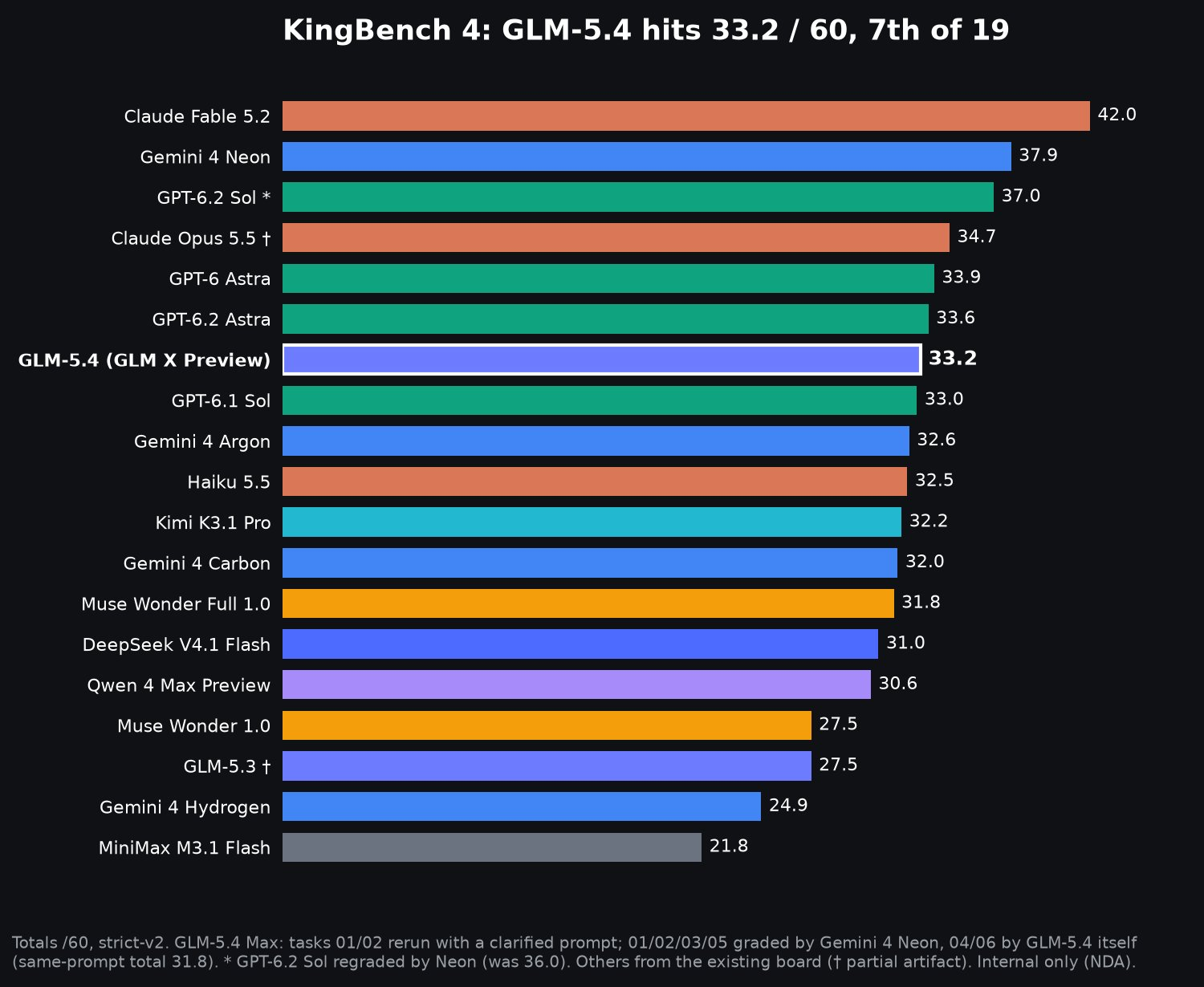
Z.ai has not published an official leaderboard for the model. The ranking that spread during launch day comes from an overseas evaluation board cited by Chinese coverage: on KingBench 4, GLM-5.4 scores 33.2 out of 60, seventh of 19 models, and the highest-ranked open model on that list.
| Rank | Model | Score |
|---|---|---|
| 1 | Claude Fable 5.2 | 42.0 |
| 2 | Gemini 4 Neon | 37.9 |
| 3 | GPT-6.2 Sol | 37.0 |
| 4 | Claude Opus 5.5 | 34.7 |
| 5 | GPT-6 Astra | 33.9 |
| 6 | GPT-6.2 Astra | 33.6 |
| 7 | GLM-5.4 (listed as GLM X Preview) | 33.2 |
| 8 | GPT-6.1 Sol | 33.0 |
| 9 | Gemini 4 Argon | 32.6 |
| 10 | Haiku 5.5 | 32.5 |
| 11 | Kimi K3.1 Pro | 32.2 |
| 12 | Gemini 4 Carbon | 32.0 |
| 13 | Muse Wonder Full 1.0 | 31.8 |
| 14 | DeepSeek V4.1 Flash | 31.0 |
| 15 | Qwen 4 Max Preview | 30.6 |
| 16 | Muse Wonder 1.0 | 27.5 |
| 17 | GLM-5.3 | 27.5 |
| 18 | Gemini 4 Hydrogen | 24.9 |
| 19 | MiniMax M3.1 Flash | 21.8 |
Against its own predecessor on the same board, GLM-5.4 at 33.2 sits 5.7 points above GLM-5.3 at 27.5. Treat the comparison as indicative: this is a third-party board, not an official Z.ai benchmark.
The board's own footnote deserves attention. Totals are strict-v2 out of 60. GLM-5.4's tasks 01 and 02 were rerun with a clarified prompt, tasks 01, 02, 03 and 05 were graded by Gemini 4 Neon, and task 04 and 06 were graded by GLM-5.4 itself; its same-prompt total is given as 31.8. GPT-6.2 Sol was regraded by Neon from an earlier 36.0. The board is marked internal only, under NDA. Read the placement as a useful signal, not a settled verdict.
What are early users finding?
The most quoted early report comes from an overseas tester, relayed through Chinese coverage: the model "may be the most careful model I have used." In their application, they found bugs and security vulnerabilities that other models, including Fable, Claude's flagship, had not surfaced.
"Possibly the most careful model I have used."
That is one user's experience with one application, not a benchmark result, and we have not reproduced it. It does line up with what the architecture is supposed to favor: longer, more careful reasoning chains rather than quick pattern matches.
What do the launch demos show?
Two demonstration clips circulated with the launch, both produced with GLM-5.4 and both also featured in Zhipu's own announcement.
How does Loop Transformer work, in brief?
Launch coverage restated the architectural rule behind the model: memory-heavy tasks gain from more parameters, reasoning-heavy tasks gain from more effective computation. Writing code, doing math and building 3D scenes are all long-chain reasoning problems, where the model has to keep a multi-step causal chain consistent from end to end. More parameters alone do not buy that.
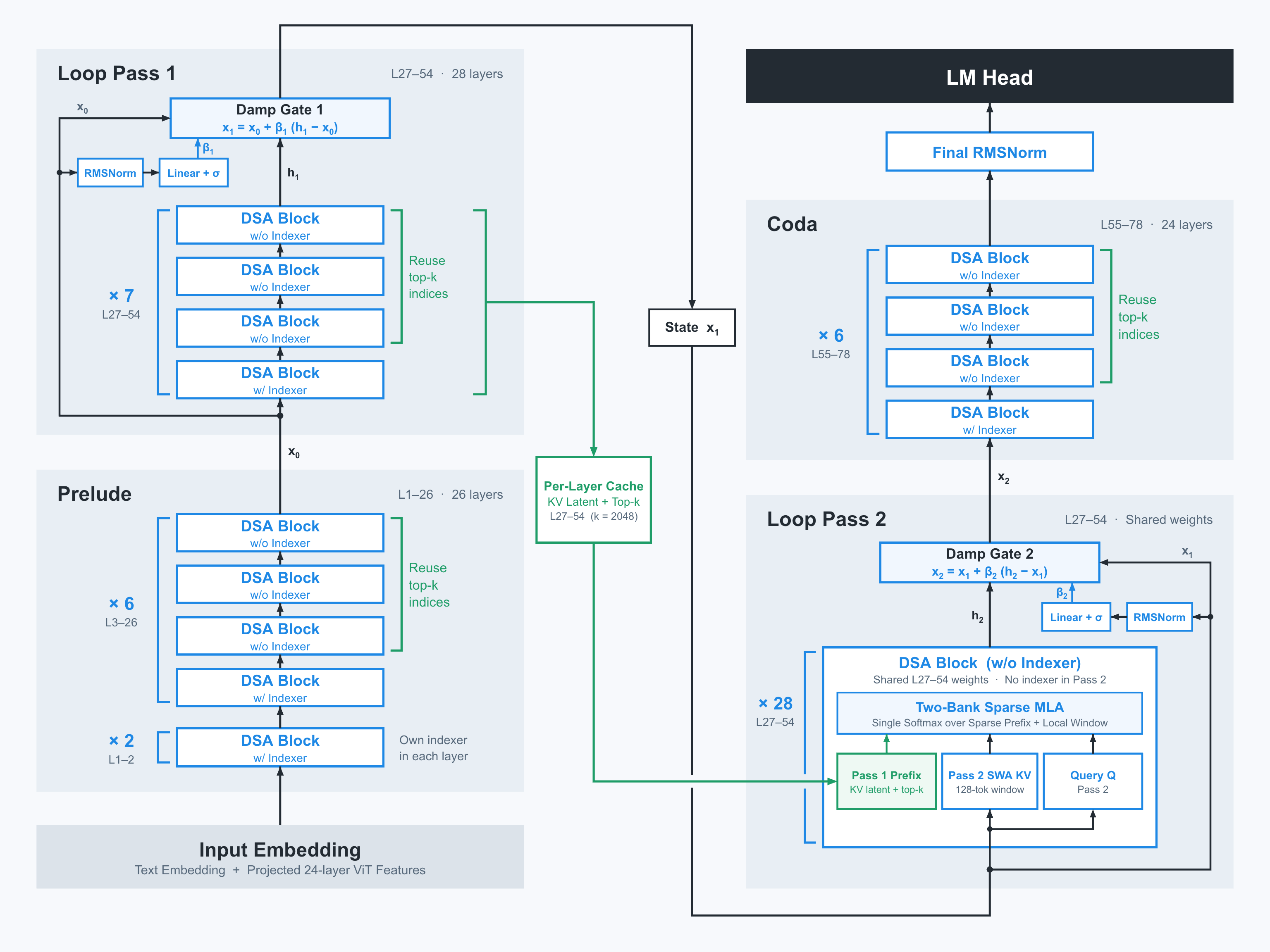
Loop Transformer is Zhipu's answer. A group of shared-weight layers runs for multiple rounds, each round refining the hidden state left by the last one. The computation gets deeper without the parameter count growing, which is how a 750B model is positioned against 2 to 3T-class models.
The lineage matters for reading the result. Google's Universal Transformer proposed shared-weight loops back in 2018, but trained from scratch, shared-weight models lost to standard ones at equal compute. Zhipu sidestepped that by retrofitting a pretrained 750B standard base: the loop is introduced in post-training, so the pretrained knowledge survives and the extra compute stays modest.
Concretely, 28 of the base model's layers run twice, supported by three engineering changes:
- Gated progressive updates. Each round has its own token-level gate that writes a fraction of the candidate change back into the residual stream. Pass one builds global context with cautious writes; pass two reuses that state and writes more fully. Harder-to-predict positions get a larger first-pass write.
- KV cache split by distance. Within the sliding window, each round keeps its own KV, because nearby context is where the rounds differ most. Beyond the window, all rounds share one KV set. Another round costs one window of KV, which keeps deployment cost controlled at 1M context.
- Reused sparse-attention indices. The second round reuses the indices from the first round's indexer at no extra cost, and Z.ai reports results nearly equal to recomputing them.
All three changes serve the same goal: make the cost of thinking one more round as small as possible.
Why does GLM-5.4 pair vision with coding?
The launch coverage also laid out the logic behind general Coding better than a spec sheet would. Modern creative tools already expose code interfaces: video engines have script APIs, 3D suites have Python bindings, game engines ship full programming frameworks, and engineering software speaks parametric modeling languages. Those interfaces used to belong to professional developers.
A model with strong enough code ability can drive them directly. That is how one model chains together work that used to need separate toolchains: generating video, building a game, completing a 3D model, operating professional engineering software.
It also explains the vision investment. Vision lets the model read design intent and check rendered output; code lets it drive the tools. Together they form a chain from understanding a requirement to delivering a finished result, without a person hauling files between tools in the middle.
The framing that launch coverage settled on: code is becoming the interface through which AI operates the digital world, so a model that writes code well is also a model that makes video, builds games and produces engineering prototypes.
Where can you use GLM-5.4 today?
The model is open to all GLM Coding Plan users as of November 23. Launch coverage lists ZCode, Trae, WorkBuddy, Qoder, CatPaw and OpenCode among the coding platforms carrying it at launch. Coding Plan V2, V3 and Team users get their GLM-5.4 allowance raised to 1.5 times; the launch post expresses the same change as 50% more quota for weekly-quota users compared with GLM-5.3.
Two things are still pending: API access opens after the safety review, and Z.ai plans to release the model weights in a responsible way. On speed, Z.ai's figures top out at 200 tokens per second off-peak and hold 70 to 80 tokens per second at peak.
Zhipu's announcement closes by saying the next model will be significantly larger. The KingBench placement and the early user reports make GLM-5.4 worth evaluating now on work you understand well; the official leaderboard, when it arrives, is what will settle the ranking question.
GLM-5.4 launch FAQ
Is GLM-5.4 available now?
Yes. It has been open to all GLM Coding Plan users since November 23, 2026, and launched on coding platforms including ZCode, Trae, WorkBuddy, Qoder, CatPaw and OpenCode. API access and downloadable weights are still pending.
What is GLM-5.4's KingBench 4 score?
A third-party board circulated on launch day scores it 33.2 out of 60, seventh of 19 models and the highest open model on that list, under the label GLM X Preview. The board is marked internal only with mixed grading, so treat the placement as indicative rather than official.
What is Loop Transformer in GLM-5.4?
It runs 28 shared-weight layers twice, adding computational depth without increasing the parameter count of that block. Z.ai positions the 750B model against 2 to 3T-class models, with gated updates, a distance-split KV cache and reused sparse-attention indices keeping the loop cheap.
How much more quota do Coding Plan users get?
Coding Plan V2, V3 and Team users get their GLM-5.4 allowance raised to 1.5 times. Zhipu's launch post states the same change as 50% more quota for weekly-quota users compared with GLM-5.3.
Frequently asked
Is GLM-5.4 available now?
Yes. It has been open to all GLM Coding Plan users since November 23, 2026, and launched on coding platforms including ZCode, Trae, WorkBuddy, Qoder, CatPaw and OpenCode. API access and downloadable weights are still pending.
What is GLM-5.4's KingBench 4 score?
A third-party board circulated on launch day scores it 33.2 out of 60, seventh of 19 models and the highest open model on that list, under the label GLM X Preview. The board is marked internal only with mixed grading, so treat the placement as indicative rather than official.
What is Loop Transformer in GLM-5.4?
It runs 28 shared-weight layers twice, adding computational depth without increasing the parameter count of that block. Z.ai positions the 750B model against 2 to 3T-class models, with gated updates, a distance-split KV cache and reused sparse-attention indices keeping the loop cheap.
How much more quota do Coding Plan users get?
Coding Plan V2, V3 and Team users get their GLM-5.4 allowance raised to 1.5 times. Zhipu's launch post states the same change as 50% more quota for weekly-quota users compared with GLM-5.3.