Kimi K3.1 Pro vs Claude Opus 5.5: Two Routes to Fast Agent Work
By Cameron Voss
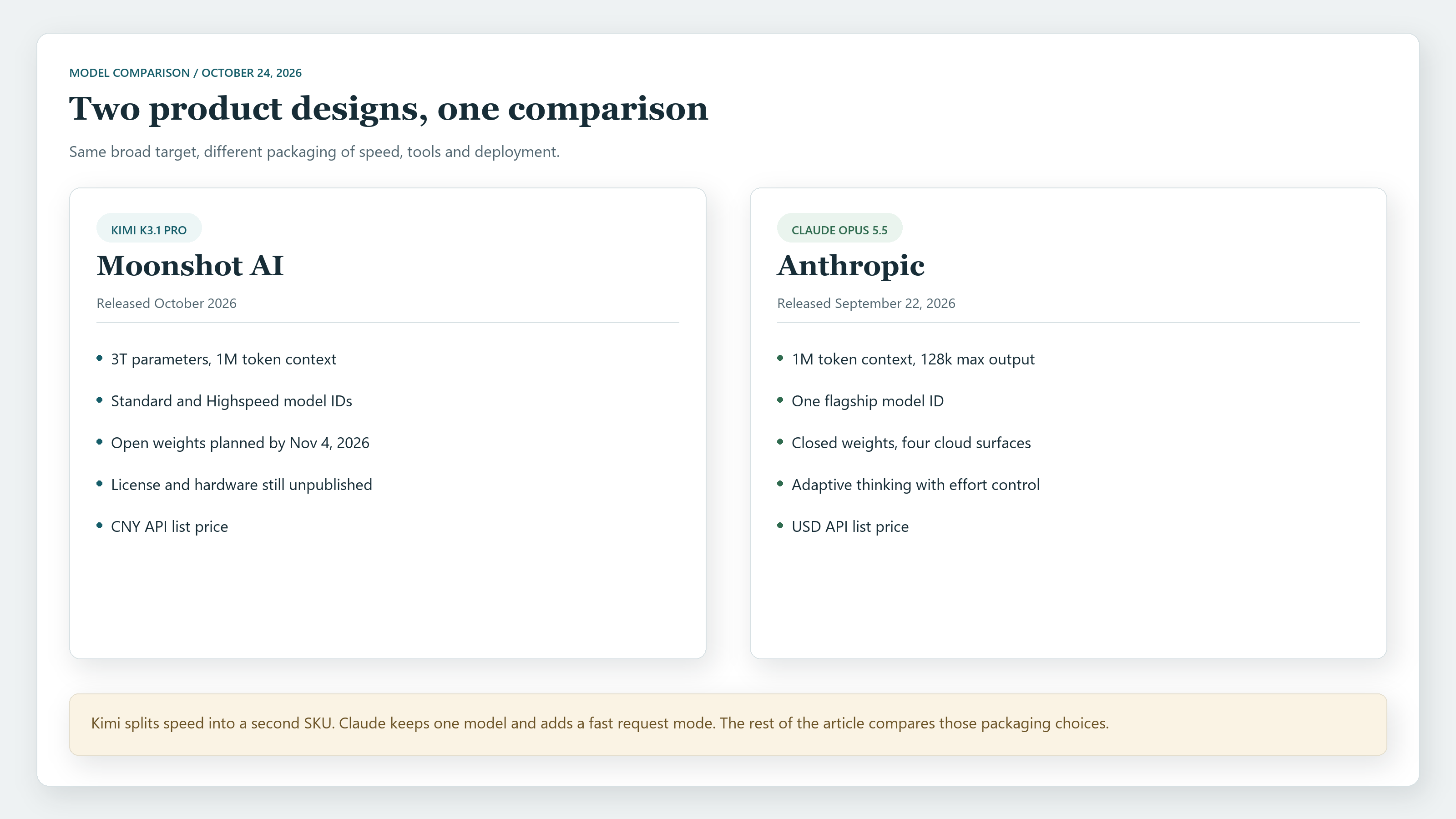
TL;DRKimi K3.1 Pro and Claude Opus 5.5 both target long-running coding and Agent workflows with a 1M-token context. The key difference is packaging. Kimi is a 3T model on an open-weight roadmap, offered via a standard ID plus a separate Highspeed ID at double the token price. Claude Opus 5.5 is a closed flagship priced at $4 input / $20 output per million tokens; its fast mode lives as a request parameter on the same model. Kimi offers a planned self-hosting path and developer-controlled search endpoints. Claude delivers a consistent cross-cloud model and model-triggered cited search.
- Kimi context1M tokens, 3T parameters
- Kimi speedSeparate model ID, 2 to 3x output speed, 2x price
- Claude context1M tokens, 128k max output
- Claude speedSame model,
speed: "fast", $8 input and $40 output
Both arrived in the second half of 2026 and target the same work. The useful comparison is how each vendor packages speed, retrieval and deployment.
On this page
What each model is
Kimi K3.1 Pro is Moonshot AI's 3T-parameter flagship, with a 1M-token context and text plus image input. Moonshot calls it an open-weight release and says full weights will be published by November 4, 2026; on October 24, the license and hardware requirements were not published. It ships as kimi-k3.1-pro and kimi-k3.1-pro-highspeed.
Claude Opus 5.5 is Anthropic's flagship release for the 5.5 generation. It launched on September 22, 2026 with a 1M-token context, 128k max output and text plus image input. It is closed-weight and available through the Claude API, Amazon Bedrock, Google Cloud and Microsoft Foundry. Fast mode is a setting on the same model, not a second model.
| Specification | Kimi K3.1 Pro | Claude Opus 5.5 |
|---|---|---|
| Provider | Moonshot AI | Anthropic |
| Model IDs | kimi-k3.1-prokimi-k3.1-pro-highspeed | claude-opus-5-5 |
| Release | October 2026 | September 22, 2026 |
| Parameters | 3T | Not stated in the checked docs |
| Context | 1M tokens | 1M tokens |
| Max output | 128k default, up to 1M | 128k, 300k on Batch API beta |
| Reasoning | Always on, low / high / max, default max | Adaptive, always on, effort parameter, default medium |
| Speed option | Separate Highspeed model ID | Fast mode on the same model |
| Weights | Open-weight release planned by November 4, 2026 | Closed |
| API list price | CNY 13 input / CNY 68 output per MTok | USD 4 input / USD 20 output per MTok |
| Availability | Kimi API, Kimi Code, Kimi apps | Claude API, Bedrock, Google Cloud, Microsoft Foundry |
Both models keep thinking on. Kimi defaults to max effort, Claude to medium.
How speed is packaged
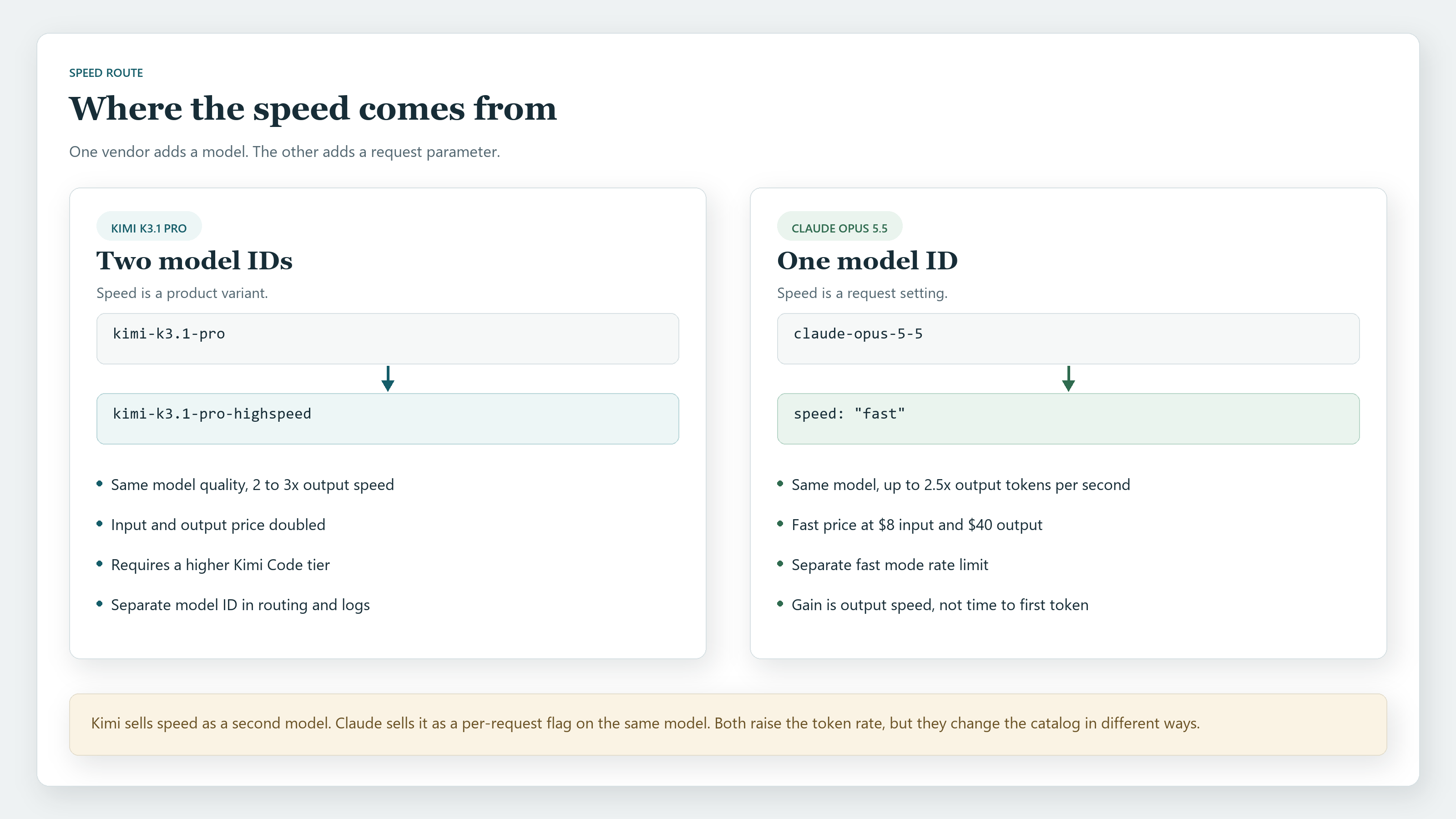
Kimi sells speed as a second model. kimi-k3.1-pro-highspeed keeps the same model quality, runs about 2 to 3 times faster on output, and costs twice as much per input and output token. It also needs a higher Kimi Code tier. Routing and logs see a different model ID.
Claude keeps one model ID. A request sets speed: "fast" and gets up to 2.5 times the output tokens per second at $8 input and $40 output per million tokens. Anthropic says the intelligence is unchanged, and the gain is output speed rather than time to first token. Fast mode has its own rate limit.
Kimi's split doubles the model matrix but is easy to price. Claude's flag keeps the catalog small but makes speed a per-request decision.
How search and tools are packaged
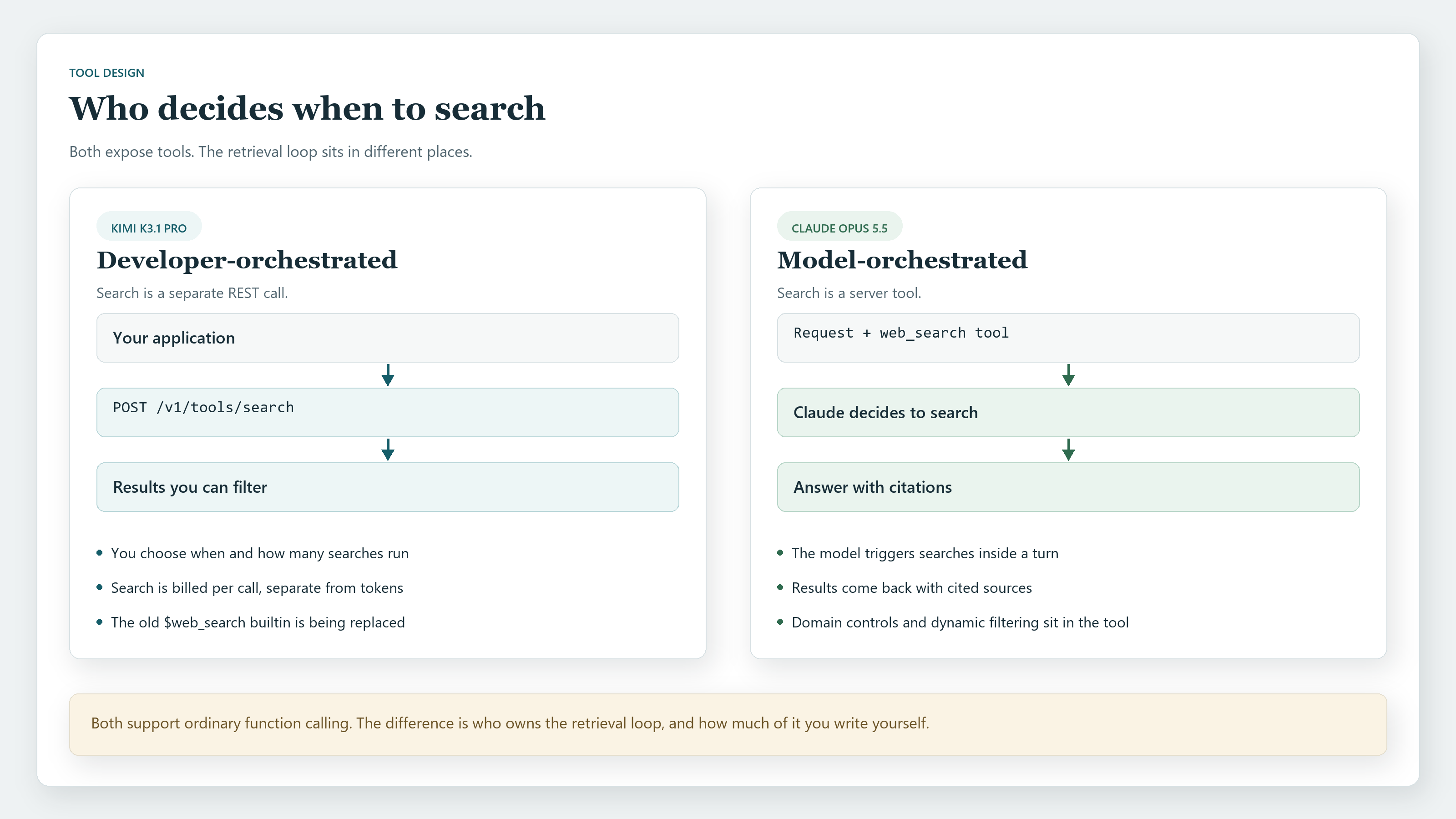
Kimi keeps retrieval in your application. The old $web_search builtin is being replaced by REST endpoints for search, search_pro and fetch. Your code decides when to search, how many results to pull, and what enters the prompt. Search is billed per call, outside token billing. Kimi also supports ordinary function calling, dynamic tool loading and tool_choice.
Claude puts retrieval inside the model turn. You add the web_search server tool; Claude decides whether to search, the API runs the searches, and the answer comes back with citations. Domain controls and dynamic filtering are part of the tool. Claude also has web fetch, code execution, computer use and MCP tools.
Kimi gives the developer the loop. Claude gives the model the loop. The first is easier to audit; the second needs less code.
How the costs are packaged
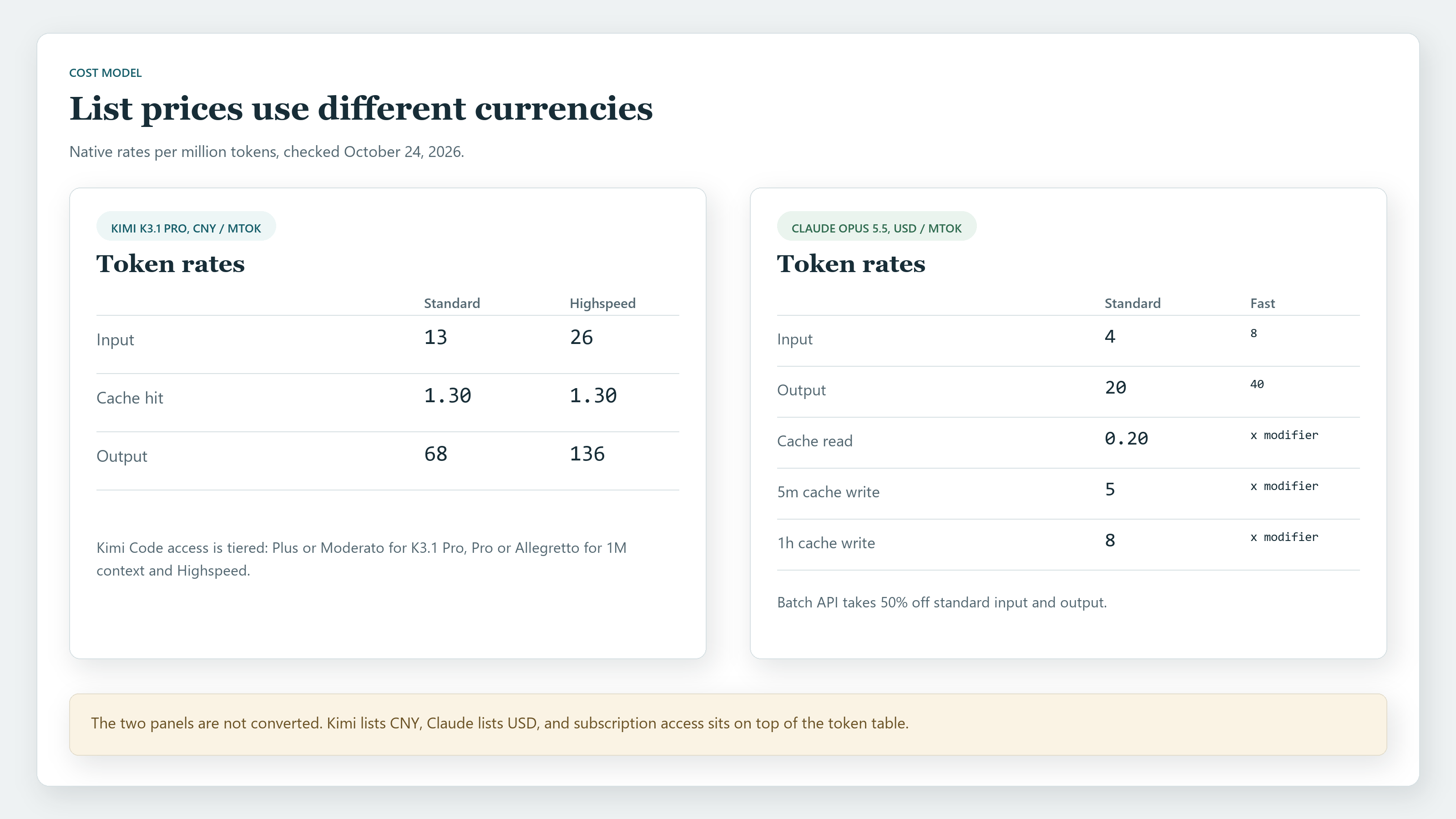
Kimi lists CNY 13 input and CNY 68 output per million tokens, with a CNY 1.30 cache hit. Highspeed doubles input and output to CNY 26 and CNY 136. Kimi Code access is tiered: Plus or Moderato for K3.1 Pro, Pro or Allegretto for 1M context and Highspeed. The API needs a minimum CNY 10 recharge, and the CNY 15 new-user voucher does not apply.
Claude lists USD 4 input and USD 20 output per million tokens. Cache reads are USD 0.20, a 5-minute cache write is USD 5, and a 1-hour cache write is USD 8. Batch API takes 50% off input and output. Fast mode is USD 8 input and USD 40 output.
The currencies and packaging differ. Kimi mixes token rates with membership tiers; Claude mixes token rates with batch discounts and a fast premium. The table stops at list prices.
If you want to see how Kimi K3.1 Pro fits a coding workflow, the Kimi coding plan guide explains what each membership tier unlocks and which model limits apply.
Which design fits which team
Need weights or a self-host path: Kimi's planned release is the only one of the two that offers it. The two IDs also separate deep work from interactive loops.
Need one model across clouds and model-triggered search with citations: Claude's hosted, single-ID design covers that.
Need both: route by task. Standard tier for long analysis, fast tier for short turns. That is a packaging choice, not a claim about coding quality.
What to watch
Kimi: weights are not out yet, so the license and hardware story is incomplete. Thinking is always on and defaults to max. Highspeed doubles the token price and needs a higher tier. A 3T model will be heavy to self-host.
Claude: weights are closed, so there is no self-host path. Thinking cannot be disabled. Forced tool use returns an error. Fast mode doubles the token price and improves output speed, not time to first token. Text between tool calls can come back empty at the default display setting.
FAQ
- Does Kimi K3.1 Pro have a Highspeed model?
- Yes.
kimi-k3.1-pro-highspeedis a separate model ID with the same model quality, about 2 to 3 times the output speed, and twice the input and output price. - Does Claude Opus 5.5 have a separate Highspeed model?
- No. Fast mode is a request-level setting on
claude-opus-5-5. The model ID does not change. - Can I compare the API prices directly?
- Not from the list prices alone. Kimi lists CNY per million tokens and Claude lists USD per million tokens. A comparison needs an exchange rate and a usage profile.
- Can either model turn thinking off?
- No. Kimi returns a 400 when thinking is disabled. Claude's adaptive thinking is always on.