Kimi K3.1 Pro vs GPT-6.1 Sol: Two Paths for Faster Agent LLMs
By Cameron Voss
TL;DRKimi K3.1 Pro and GPT-6.1 Sol both target cheaper Agent workloads, but take opposite approaches. Moonshot maintains one 3T-class model with up to 1M-token context on premium tiers, selling speed as an extra serving tier. OpenAI releases Sol as a lighter, independently tuned model, priced at $2 input / $10 output per million tokens. Long, context-heavy sessions suit Kimi; short, high-volume loops suit Sol.
On this page
Kimi K3.1 Pro reached Kimi Code on October 23, 2026. GPT-6.1 Sol shipped in OpenAI's September 29 update. Both are sold for coding agents and long-running tool use. The difference worth tracking is where each company does the work of making an agent cheaper.
What each product actually is
K3.1 Pro is the first model in Moonshot's K3.1 series. It is a 3T-class model post-trained from Kimi K3, with coding, 3D work, financial research and long agent tasks as the stated focus. Access runs through the Kimi app, the Kimi Code clients and the API. Full weights are promised by November 4, 2026, and the license is not published yet.
Sol is a lighter model in OpenAI's GPT-6 line, positioned below Astra. OpenAI's launch copy puts it on agentic coding, computer use and professional work. At launch it was available in the API, ChatGPT Work and Codex on named paid plans, not in Chat. An Ultrafast option was described as coming later.
| Feature | Kimi K3.1 Pro | GPT-6.1 Sol |
|---|---|---|
| Provider | Moonshot AI | OpenAI |
| Shipped | October 23, 2026, in Kimi Code | September 29, 2026 |
| Position | Flagship of the K3.1 series | Lighter tier under Astra |
| Speed route | Second serving tier, 2 to 3x output speed at 2x price | Smaller, separately tuned model |
| Context | Up to 1M tokens on higher tiers | Not stated in the launch material checked |
| Thinking | Always on, low, high or max, default max | Set per request, not always on |
| Weights | Promised by November 4, 2026, license pending | Proprietary |
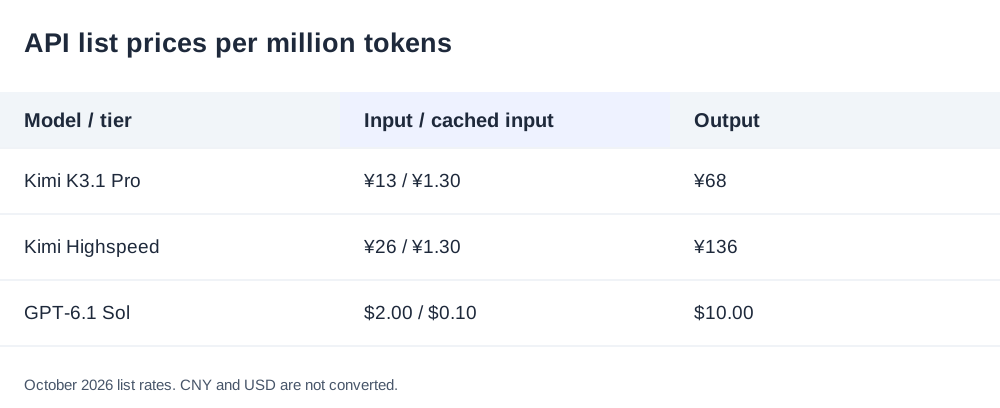
| API price, per 1M tokens | ¥13 input, ¥1.30 cached, ¥68 output | $2.00 input, $0.10 cached, $10.00 output |
Prices are published list rates: Moonshot AI, October 2026; OpenAI, September 29, 2026. Currencies are not converted.
Where does the speed come from?
Kimi K3.1 Pro: keep the model, split the serving
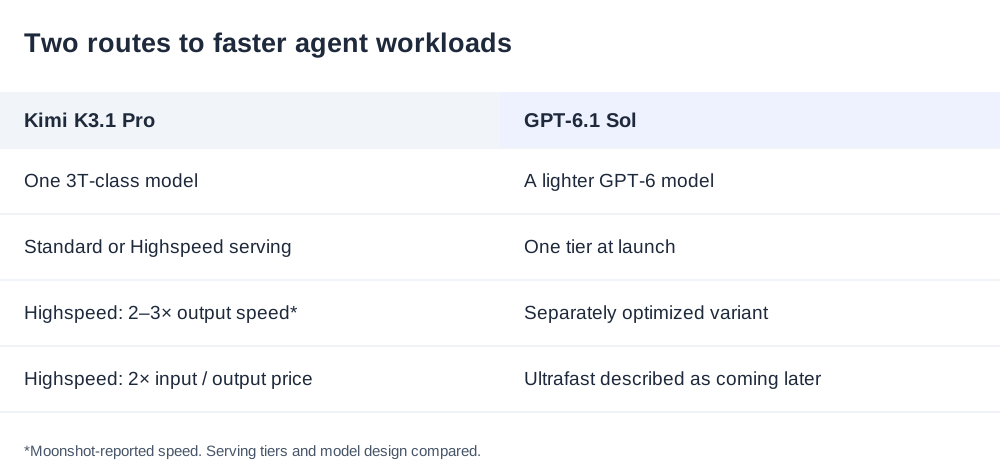
Moonshot kept the model large and made speed a routing decision. K3.1 Pro ships under two API IDs. kimi-k3.1-pro lists at ¥13 input and ¥68 output per million tokens. kimi-k3.1-pro-highspeed lists at ¥26 and ¥136, with output about 2 to 3 times faster by Moonshot's account. Cache reads stay at ¥1.30 on both.
The upside is granularity. A team can send an interactive edit to Highspeed and a nightly batch to the standard tier, using the same model in both cases. The cost is that speed carries a 2x token price, and someone has to own the routing logic.
Thinking is always on. The API accepts reasoning_effort at low, high or max, defaults to max, and returns a 400 if thinking is disabled. That puts a token floor under every call, including simple ones.
GPT-6.1 Sol: trim the model instead
OpenAI moved the work into the model. Sol is a smaller, separately optimized variant rather than a speed mode of Astra, so the savings show up before the request is sent: a lower list price and faster responses, with a capability ceiling below the flagship.
There is no Highspeed switch. Within OpenAI's lineup, going cheaper or faster means choosing a different model. That makes the decision a one-time choice for a workload instead of a per-request setting, and it keeps the runtime consistent once the choice is made.
Where does the agent loop run?
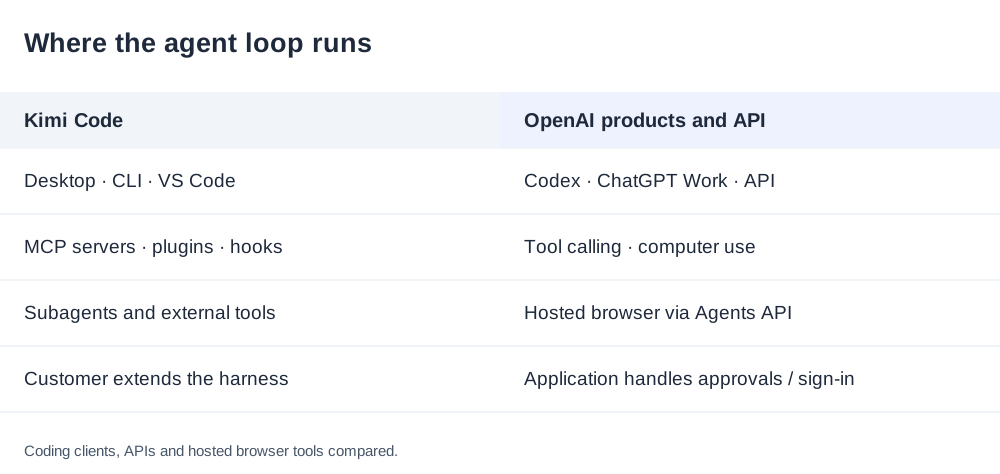
K3.1 Pro comes with a runtime the customer can extend. Kimi Code ships as a desktop app, a CLI and a VS Code extension, with MCP servers, plugins, hooks and subagents available to shape the loop. Moonshot recommends its native Responses, chat completion and message protocols and warns that proxy translation can shift results. The model is also aimed at driving external tools such as Blender, CAD and game engines.
OpenAI keeps more of the loop inside its own runtime. Tool calling and computer use are exposed through the API, and Sol launched inside Codex and ChatGPT Work. The September 29 API changelog added hosted browser computer use to the Agents API, with the integrating application handling site approvals and sign-in. A team on this path gets a managed surface and less wiring, inside OpenAI's product boundaries.
Where does the money go?
Both vendors discount cached input, by different amounts. A cached token costs about 10% of a fresh input token on K3.1 Pro and 5% on Sol. That matters for agents that resend a long prefix at every step, which is most of them.
Kimi Code adds a second pricing shape. K3.1 Pro needs Plus or Moderato and above, while the 1M context window and Highspeed need Pro or Allegretto and above. For an individual developer, the effective cost becomes a subscription decision rather than a token multiplication. The API stays metered.
If you want to try K3.1 Pro, our Kimi coding plan is one way to start. The Kimi coding plan guide covers the model IDs, the tier limits and the config steps for getting a real task running.
Which workload points to which design?
- Long refactors and repo-scale work: K3.1 Pro's 1M context and always-on thinking fit sessions that stay open across many files. Highspeed helps when a developer is waiting on an edit.
- Bulk jobs with short turns: Sol's single tier and lower list price simplify estimates, since there is nothing to route per request.
- 3D, CAD and game engine work: Moonshot's release notes put K3.1 Pro on it.
- Computer use with approvals: Sol's hosted browser runs inside OpenAI's infrastructure, while the integrating app still handles approvals and sign-in.
- Teams already paying for OpenAI plans: Sol shows up inside products they already use. Kimi Code buyers get K3.1 Pro through a membership tier instead.
Both designs allow a mixed setup. Long, expensive sessions can go to K3.1 Pro while short, repeated work goes to Sol, with each model evaluated once for the job it handles.
What does each design give up?
K3.1 Pro pays for its flexibility in a few places. Always-on thinking raises the token floor on simple prompts. Highspeed doubles the input and output price, though not the cache price. The 1M window and Highspeed sit behind higher membership tiers. The weights are late and heavy, with the license unpublished and a 3T-class model well beyond a laptop. Moonshot also flags proxy protocol translation as a stability risk, which adds a constraint on how the harness is built.
Sol pays in ceiling and flexibility. There is no speed switch at flagship capability, so faster means smaller. OpenAI's launch post does not state Sol's context window, so capacity has to come from current docs rather than the announcement. Chat access was absent at launch, and Ultrafast was described as coming later. The managed runtime also sets where tools and approvals can live.
FAQ
Is Kimi K3.1 Pro open source?
Not yet. Moonshot says full model weights will be published by November 4, 2026, and the license has not been published. Until then the model is available through Kimi products and the API.
Can I turn off thinking mode on Kimi K3.1 Pro?
No. The API returns 400 when thinking is disabled. reasoning_effort accepts low, high or max, and max is the default.
Does GPT-6.1 Sol have a faster tier like Kimi Highspeed?
No. At launch Sol has one price tier. OpenAI described an Ultrafast option for the model as coming later.
Which model is cheaper per token?
There is no single number, because the vendors price in different currencies. Kimi lists ¥13 input and ¥68 output per million tokens for the standard tier. Sol lists $2 input and $10 output. Cached input runs about 10% of the input rate on K3.1 Pro and 5% on Sol.
Sources: Moonshot AI, Kimi K3.1 Pro release notes and API price list, October 2026.