Kimi K3.1 Pro vs DeepSeek V4.1 Flash: Two Different Ways to Purchase Speed
TL;DRKimi K3.1 Pro and DeepSeek V4.1 Flash both target agent workloads, and they lower the cost per step in different ways. Kimi keeps one flagship model and sells a Highspeed tier that Moonshot says runs 2 to 3 times faster at twice the token price. DeepSeek builds a separate lightweight variant with a small active path, a $0.006 cached-input rate and half-price off-peak hours. Long, multimodal runs fit Kimi; high-volume loops with repeated prefixes fit DeepSeek.
By Cameron Voss
On this page
Two products, two speed strategies
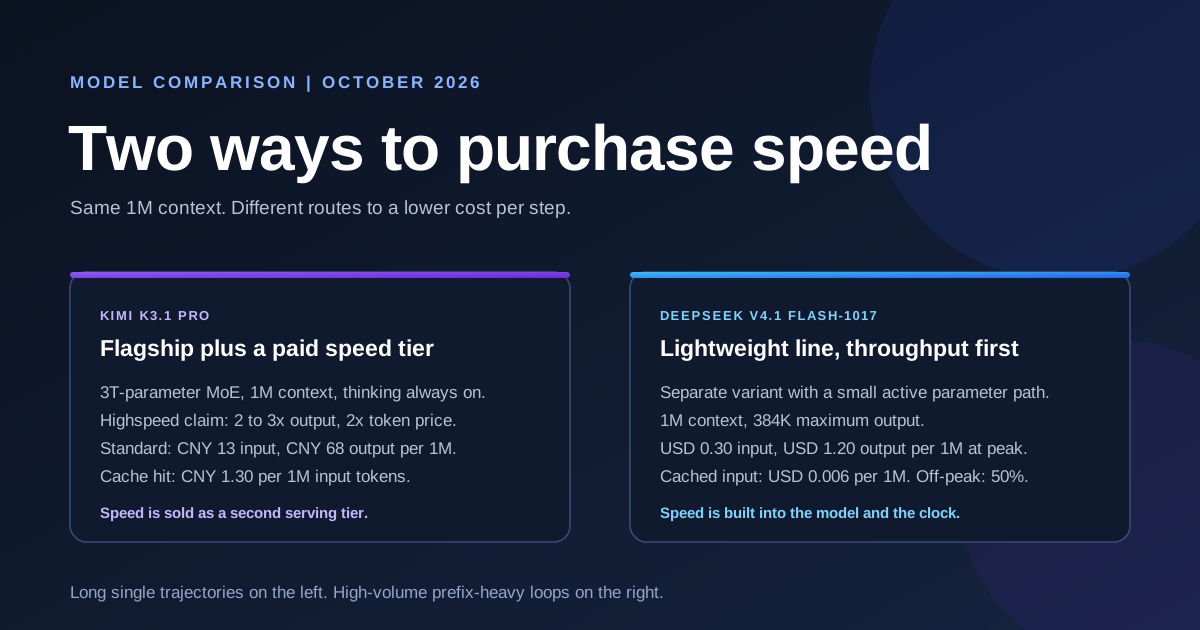
Kimi K3.1 Pro launched on October 23, 2026. It is a 3T-parameter multimodal model with a 1M-token context, thinking always on, and a paid Highspeed tier. DeepSeek V4.1 Flash-1017 launched on October 17 and is served through deepseek-flash. It is a separate lightweight variant with the same 1M context and a 384K output ceiling.
The context windows match. The design targets do not. Kimi sells lower latency as a second service tier. DeepSeek builds a cheaper model and prices by cache and time of day.
At a glance
| Item | Kimi K3.1 Pro | DeepSeek V4.1 Flash-1017 |
|---|---|---|
| Provider | Moonshot AI | DeepSeek |
| Model ID | kimi-k3.1-prokimi-k3.1-pro-highspeed | deepseek-flash |
| Released | October 23, 2026 | October 17, 2026 |
| Design | 3T-parameter MoE, multimodal | Sparse MoE, lightweight variant |
| Context | 1M tokens | 1M tokens |
| Maximum output | 131,072 by default; up to 1,048,576 via max_completion_tokens | 384K tokens |
| Thinking mode | Always on. reasoning_effort: low, high or max; default max | thinking and reasoning_effort parameters |
| API price per 1M tokens | Standard: CNY 13 input, CNY 1.30 cached, CNY 68 output Highspeed: CNY 26, CNY 1.30, CNY 136 | Peak: USD 0.30 input, USD 0.006 cached, USD 1.20 output Off-peak: 50% |
| Speed posture | Highspeed runs 2 to 3 times the standard output speed, per Moonshot | Throughput-first design |
| Design target | Long, multimodal, single-trajectory work | High-volume, prefix-heavy loops |
Active parameters describe computation per token, not the memory needed to load a model. Kimi's weights are planned before November 4; DeepSeek V4.1 Flash-1017 already has MIT-licensed weights.
If you want to try Kimi K3.1 Pro through a coding plan, our Kimi coding plan guide walks through model selection and the account requirements.
How each model gets its speed
Kimi K3.1 Pro
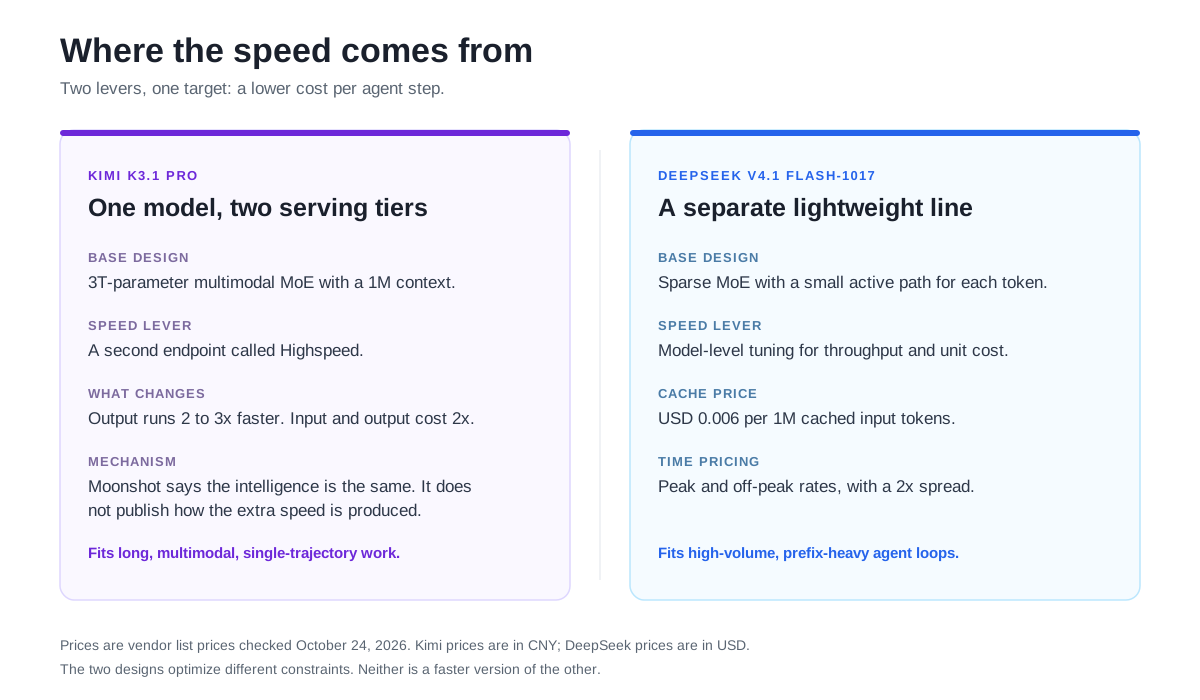
Kimi does not shrink the model to go faster. It keeps the same 3T-parameter model and sells a second endpoint. Moonshot says Highspeed has the same intelligence and runs 2 to 3 times faster, at exactly double the input and output price. Cache hits stay at CNY 1.30. The serving mechanism is not published, so treat Highspeed as a service level, not a different model.
Operations stay simple: one model, two speeds, one cache price. The trade is that the faster tier is a premium product, Kimi Code membership and pay-as-you-go API access have separate terms.
DeepSeek V4.1 Flash
Flash is not a faster endpoint of an existing model. It is a separate lightweight variant, tuned at the model level for throughput and unit cost. Its sparse mixture-of-experts design activates only part of the model per token. Active parameter counts alone do not establish latency or the cost of completing a task.
The pricing uses the same logic. Cached input is USD 0.006 per 1M, 2% of the peak input rate. Peak hours are 01:00 to 04:00 and 06:00 to 10:00 UTC, Monday through Friday, excluding Chinese public holidays; all other hours are half price. A long context window alone does not establish reliable performance across a long agent run.
What a month costs
Kimi's lever is latency. DeepSeek's lever is timing and cache. The table uses 1B input and 100M output tokens with the October 24 rate snapshot supplied for this article. It estimates token charges, not measured cost per task or a complete invoice.
| Scenario | Input | Output | Token subtotal |
|---|---|---|---|
| Kimi standard, no cache | CNY 13,000 | CNY 6,800 | CNY 19,800 |
| Kimi standard, 90% cache hit | CNY 2,470 | CNY 6,800 | CNY 9,270 |
| Kimi Highspeed, no cache | CNY 26,000 | CNY 13,600 | CNY 39,600 |
| DeepSeek peak, no cache | USD 300.00 | USD 120.00 | USD 420.00 |
| DeepSeek peak, 90% cache hit | USD 35.40 | USD 120.00 | USD 155.40 |
| DeepSeek off-peak, no cache | USD 150.00 | USD 60.00 | USD 210.00 |
Arithmetic from the supplied rate snapshot, not a measured cost per task. Cache rows assume a 90% hit rate. Kimi cache-write charges, tool fees and taxes are excluded. CNY and USD are kept separate; no exchange rate is applied.
Kimi prices cached input at 10% of its standard input rate. DeepSeek prices it at 2%. If your loop repeats a long system prompt, both vendors reward you. If the prefix changes every step, neither cache rate helps much.
Tools and search
Both APIs support tool calling. Kimi also documents official search tools, but its K3.1 Pro quickstart currently cautions against using web search in production while it is being updated. DeepSeek provides separate Search and Fetch APIs. Tool availability in a coding client and support in a model API are separate questions; check the integration you actually use.
Which workload fits which
Kimi fits long single runs with multimodal inputs: codebase work, CAD or 3D tasks, financial document review, and teams that want a faster tier when they need it. Thinking is always on, so short tasks still carry a reasoning cost.
DeepSeek fits many short steps: batch classification, extraction, file-by-file review, log triage and wide fan-out. Off-peak scheduling and prefix caching matter more than depth in one run. A common split is to use both: the flagship for planning and hard multimodal steps, the lightweight model for bulk execution.
Where each gives up ground
Kimi K3.1 Pro
- Weights are planned before November 4, 2026; license and hardware are unknown. A 3T model is not a realistic self-host for most teams.
- Thinking cannot be turned off.
reasoning_effortcan go to low, but the default is max. - The supplied Highspeed rates double input and output prices. Kimi Code membership conditions are separate from pay-as-you-go API access.
DeepSeek V4.1 Flash
- Long context does not guarantee reliable long-running execution. Compare completion rates and retries in your own harness.
- MIT-licensed weights are available. Self-hosting still requires a separate hardware and deployment assessment.
- Peak pricing doubles on weekday windows, and earlier Flash preview results do not transfer to V4.1 Flash-1017.
FAQ
Is Kimi K3.1 Pro open weights?
Not yet. Moonshot says full weights will be published before November 4, 2026. The license, download location and hardware requirements have not been announced.
Can I turn off thinking on Kimi K3.1 Pro?
No. The model runs in thinking mode only. You can set reasoning_effort to low, high or max, and the default is max.
Do either of these models search the web on their own?
Search requires a tool integration. Kimi documents search tools but currently advises against production use while they are being updated. DeepSeek offers separate Search and Fetch APIs. The harness controls when tools run.
Which one costs less?
The table keeps CNY and USD separate, so it does not calculate a currency-adjusted winner. DeepSeek offers half-price off-peak rates; Kimi charges more for Highspeed in the supplied snapshot. Compare converted rates, cache writes, output length and retries for your workload.