Gemini 4 Neon Topped the Agent Coding Board — on Google's Own Harness.
TL;DR
By Cameron Voss
What Gemini 4 Neon is
Neon is the fourth member of the Gemini 4 family and the one Google places below Carbon on price. Demis Hassabis announced it and called it the pinnacle of alchemy. Google is aiming it at high-frequency engineering work, knowledge analysis, and research tasks that take hours instead of seconds.
That framing is narrower than "best model available". Google is selling Neon as something you can run many times a day without the bill becoming the story, and the price list follows from that.
| Model | Gemini 4 Neon |
| Input | $3 per million tokens |
| Output | $15 per million tokens |
| Cached input | $0.15 per million tokens |
| Context window | 1,000,000 tokens |
| Output speed | Around 110 tokens per second |
| AA intelligence index | 61 (xhigh), 60 (high) |
| AA coding agent score | 58.6, first place |
How it scores against Opus 5.5 and GPT-6.2 Sol
Google ran 19 benchmark groups against Claude Opus 5.5 and GPT-6.2 Sol. Neon took the top score in 16 of them. The most quoted number is Artificial Analysis' intelligence index: 61 at xhigh, which is third place worldwide and one point above Carbon. At the default high setting it drops to 60, level with Carbon, while a task costs less than half as much.
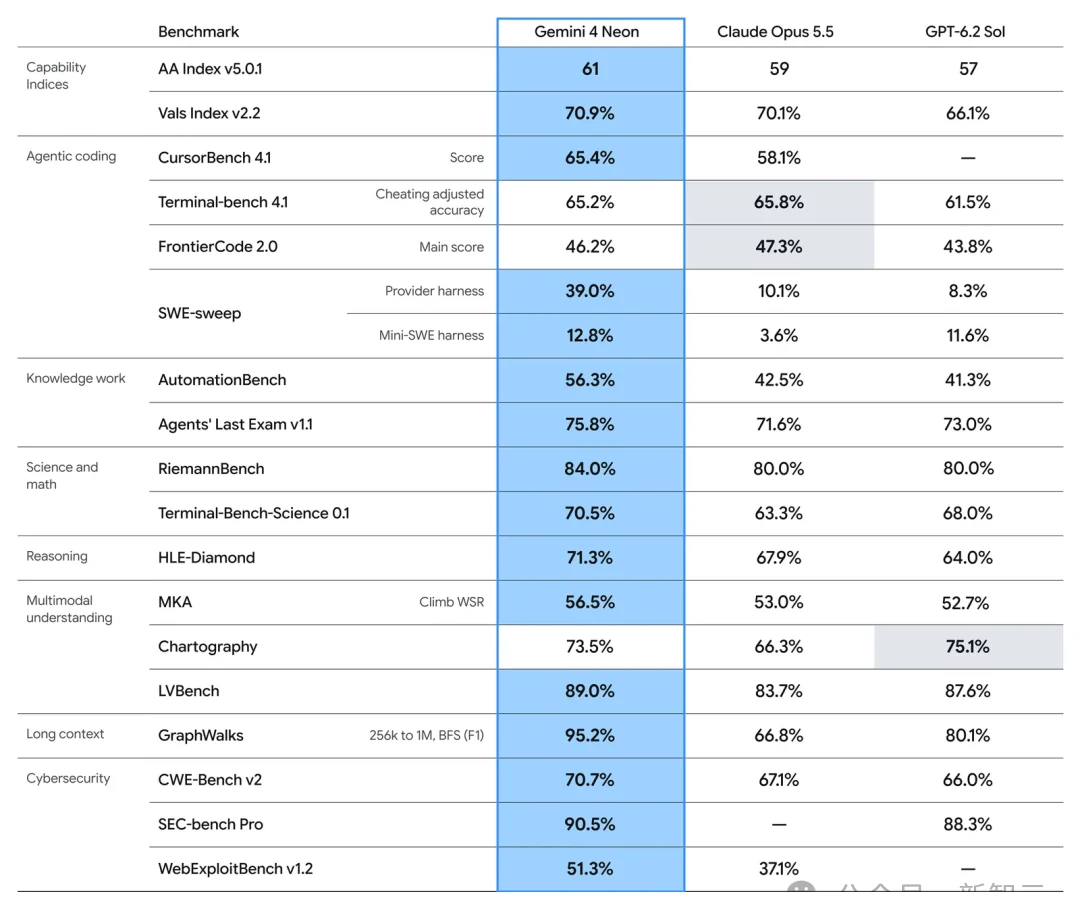
Other leaderboards land in the same place. Arena's new Agent leaderboard, built from more than 4,200 real sessions, put Neon second on its first appearance. Zapier's automation benchmark, which runs 657 real business workflows, gave it 56.3% and first place. On security, SEC-bench Pro came in at 90.5%, a new high, and CWE-bench v2 landed 3.4 points above Carbon.
Speed backs it up. Artificial Analysis measured about 110 output tokens per second against Carbon's 57, and the average task finished in 21 minutes against 36 for Carbon.
How much does it cost per task?
This is where the gap is widest. The coding agent scores are close: Neon at 58.6, with Claude Code's Fable 5.2 and Opus 5.5 both sitting around 58. The invoices are not close at all.
| Model | Coding agent score | Cost per task |
|---|---|---|
| Gemini 4 Neon | 58.6 | $6.86 |
| Claude Opus 5.5 | About 58 | $12.61 |
| Claude Fable 5.2 | About 58 | $15.47 |
Neon's first-place run used Google's own Antigravity CLI as the harness. That detail matters for any agent benchmark. The harness decides how tools get called, when context gets compacted, and how failures get retried. Swap it out and the same model can move several points.
Independent tests point the same way. Developer Pranav Reddy gave Neon, Opus 5.5, and Carbon the same Three.js riding animation to build. His read was that Neon beat Opus 5.5 and came close to Carbon.
What the three demos show
Google published three worked examples, each pointed at a different weakness.
Rebuilding Turing's study in 3D. Neon ran the /swarm team for 12 hours to recreate Alan Turing's room at King's College, Cambridge, where he wrote the 1936 paper that set up modern computing. It pulled archival photographs, modelled and rigged the room in Blender, and rendered period materials and lighting. The camera pushes in from the lawn outside the chapel, and the Turing machine on the desk is there too. What this tests is scheduling: dozens of subtasks, twelve hours, no drifting off target.

Half a million spreadsheet formulas. Neon spread 100,000 cells across sub-sheets and wrote more than 500,000 live formulas to do Sobel edge detection and 3D depth mapping with no image library. Six interaction modes switch the view, and changing the light angle relights the image in real time. This one tests whether reasoning survives being written as code that has to stay correct at scale.
A ski simulator written from scratch. 10,200 lines of custom WebGL2 shaders, a 120Hz physics engine, six mountain runs, dynamic snow tracks, slab avalanches, spatial audio, and real elevation data from Mont Blanc and Chamonix. No prefab 3D assets. Here the test is long-code engineering: shaders, physics, terrain, and audio all have to hold together in one project.

How Neon and Hydrogen split the work
Inside Antigravity, Neon can work alone or take the orchestrator role. A large task arrives, Neon splits it, and parallel Hydrogen sub-agents do the parts. Hydrogen is the light model in the family, the fastest one, at half of Neon's price.
The split is clean. Neon plans, judges, and signs off. Hydrogen writes code, edits files, and runs tests. If a sub-agent's work fails review, it goes back with instructions instead of being accepted.
DeepSeek's recent Super-agent proposal looks similar from a distance, but it solves a different problem. Swarm is about dividing one task among several agents. Super-agent is about one long-running system that tracks many tasks at once, with a router matching messages to workers. Both separate coordination from execution, and both keep a feedback loop. They differ in scope, in who does the hard reasoning, and in where the strong model sits. Google puts its strongest model at the top. DeepSeek's design leans on a lighter router with stronger workers.
Where Neon still loses
Two benchmarks keep Opus 5.5 in front: Terminal-bench 4.1 and FrontierCode 2.0. Both lean on terminal work and code repair, and the lead is described as slight rather than decisive. The coding agent margin is thin too, 58.6 against roughly 58, which means a new harness or a new benchmark can flip the order.
What holds up better is throughput and price. Finishing a task in 21 minutes for $6.86 changes how many times you can run an agent before cost becomes the limit.
Coding plans
If you are comparing model access for agent work, our coding plan page lists the plans we currently have in stock and what each one includes.
Check the plan details against your own workload before buying.
What this means for developers
- Cost per task deserves the same attention as the score. When an agent runs a few hundred times a day, 45% off the bill matters more than one or two points.
- Orchestration changes the budget. A strong planner plus cheap parallel workers can undercut one strong model doing everything, as long as the review step really rejects bad work.
- Check the harness before comparing numbers. Agent scores come attached to the CLI and scaffolding that produced them.
- Keep a second model around. Neon is not first on every test, and its coding lead is small enough to disappear with the next release.