Kimi K3.1 Pro Open Weights: What the Release Means for Developers
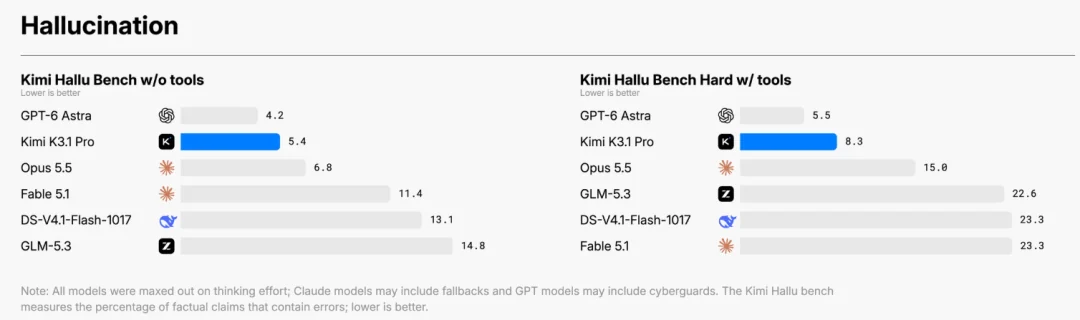
TL;DRMoonshot released the Kimi K3.1 Pro weights: a 2.8 trillion parameter mixture-of-experts model with a 1M token context window. It scores 65.7% on Terminal-Bench 4.0, behind Claude Opus 5.5 at 66.4% and ahead of GPT-6 Astra at 58.2%. BenchCAD comes in at 92.7 with tools (Opus 5.5: 96.2), OfficeQA Pro v2 at 64.4, and the claim-level hallucination rate drops from 23.4% on K3 to 8.3%. Open weights do not make inference cheap: at this size, most teams will still rent the model rather than run it.
By Cameron Voss
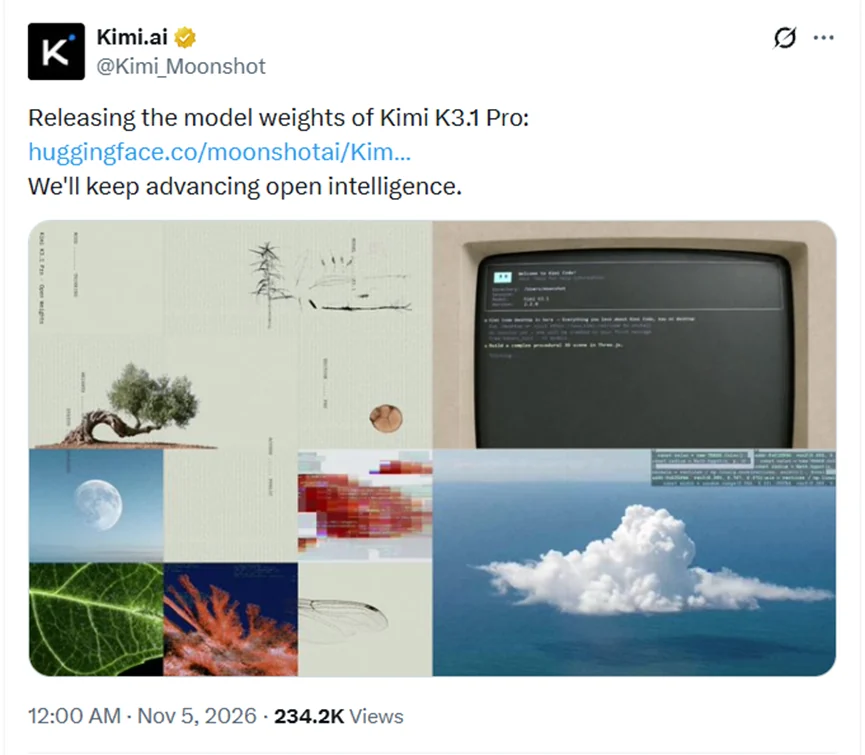
The weights are published on Hugging Face under the moonshotai/Kimi-K3.1-Pro path. NVIDIA AI's account congratulated the team the same morning, and replies included developers describing it as a Fable-class model they can now download.
If you write code or ship agent workflows for a living, the useful questions are narrower. Where do the numbers actually hold, and what breaks when you put this in a pipeline?
What did Moonshot actually release?
A 2.8 trillion parameter model built on a mixture-of-experts architecture, with a 1M token context window. Those numbers explain most of the reaction. Open weights at that scale put it among the largest open models released so far.
Moonshot also shipped a consumer-side feature in the same window: 3D Make is live in kimi.ai and the Kimi App. You can preview and edit a 3D model in the browser, download it for printing, or export a video and a Live Photo. That is a product feature, not a developer API, but it shows where the company thinks the model is strong enough to expose directly.

Kimi K3.1 Pro reaches developers through three different routes: an official membership, the Kimi API, and gateway plans that place Kimi, DeepSeek, and GLM behind one key. Each route has its own model IDs, point multipliers, and context limits, and they are not interchangeable. Our Kimi Subscription guide compares all three and shows the Claude Code setup for each, so you can pick the one that matches how you work.
How good is it at coding and agent work?
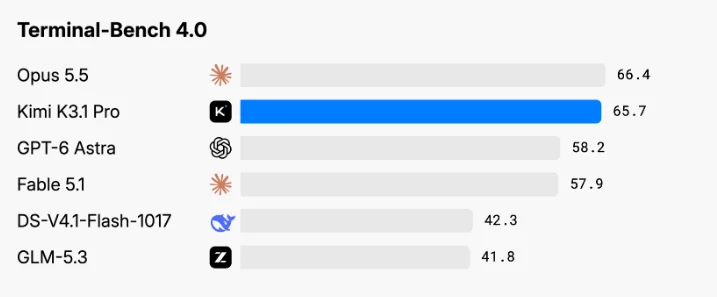
Terminal-Bench 4.0 is the number to look at, because it measures end-to-end work in a shell rather than single-file completions. Kimi K3.1 Pro reports 65.7%.
| Model | Terminal-Bench 4.0 |
|---|---|
| Claude Opus 5.5 | 66.4% |
| Kimi K3.1 Pro | 65.7% |
| GPT-6 Astra | 58.2% |
A 0.7-point gap to Opus 5.5 is small; differences in evaluation setup can affect comparisons. Being 7.5 points clear of GPT-6 Astra is the bigger claim, and it is the one that changes procurement conversations: the result is worth testing against your own coding tasks and deployment costs.
What does the walking robot demo prove?
Moonshot set the model a harder task than a coding benchmark: build a humanoid walking simulator from scratch. The scene has 296 skeletal components and 402 muscle components. The first version falls over after two steps.
Kimi K3.1 Pro then read its own results, found where the controller was wrong, changed it, and got the simulated body to alternate its feet and walk for 11.2 seconds. When arm movement would not improve, it did not keep tuning the reward function. It probed the simulator's dynamics, found 36 errors in the shoulder muscle moment arm calculation, fixed them, and retrained.
That is a different skill from writing a patch. The model debugged the environment it was being graded in, which is the behavior agent buyers actually want and rarely get to see in a chart.
Can it produce usable 3D models?
Give it a text description, a sketch, or a reference image and it infers shape, proportions, and spatial relationships, then emits a model you can open. One demo in the release is a robotic arm landing page written directly in code, running in a browser, with 2,300 parts and close to 300 pipes that animate.
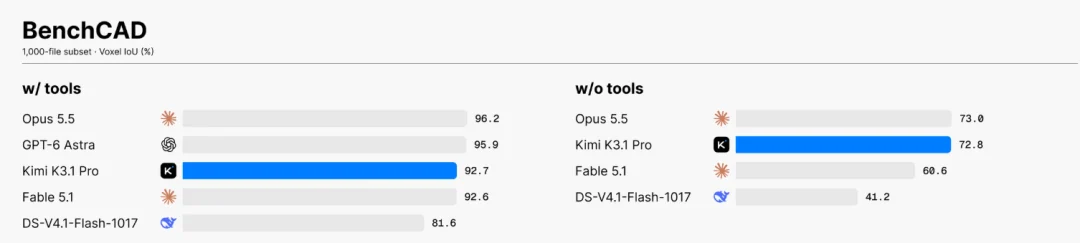
It also drives Blender and CAD tools by writing and running scripts, so parametric work such as mechanical parts, building components, and custom furniture is in scope. On BenchCAD it scores 92.7 with tool use, against 96.2 for Claude Opus 5.5 and 95.9 for GPT-6 Astra.
Read the 92.7 carefully. It is a with-tools number, and the published comparison also includes a no-tools column. The score reflects the model plus the workflow around it. A script runner alone does not guarantee a comparable result: the task, tools, prompts, and evaluation setup all matter.
Is the finance work trustworthy enough to use?
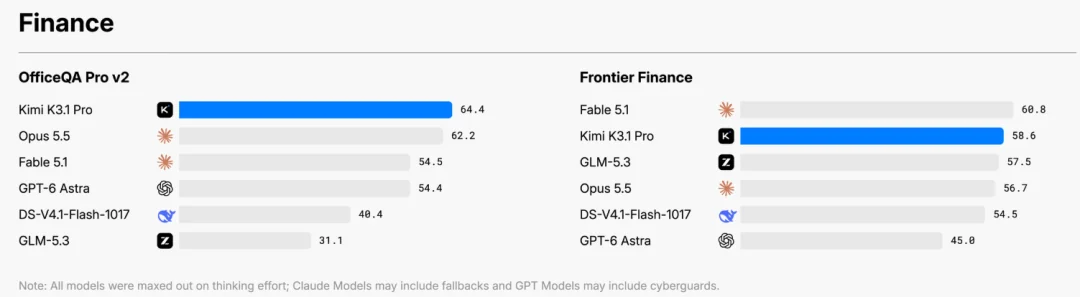
The finance claim is broader than a score. Moonshot describes a full workflow: document retrieval, cross-document data checks, model construction, and profitability analysis. OfficeQA Pro v2, which tests complex analysis over real financial documents, comes in at 64.4 and is reported as the best result on that benchmark at release.
The demo to watch is an NVIDIA financial model built end to end. Linked formulas across the file, written assumptions, adjustable operating drivers per scenario, and a sensitivity table showing what each change does to valuation.
The accuracy numbers matter more here than anywhere else. On Moonshot's internal Kimi Hallu Bench Hard, the claim-level hallucination rate falls from 23.4% on K3 to 8.3% on K3.1 Pro. The share of responses containing at least one factual error is 42.4% of the previous generation's figure.
8.3% is real progress and still too high to ship unchecked. Roughly one claim in twelve being wrong is fine for a first draft and not fine for anything a client signs.
What should you check before switching?
Four things, in the order they usually bite.
- Total size. 2.8 trillion parameters is a data-center deployment. Even with sparse activation, self-hosting means a serious GPU budget and a serving team. For most readers the practical path is a provider endpoint, not the weights.
- Context cost. A 1M token window is useful for repo-scale agents, but long sessions re-bill the input on every turn. An agent that keeps the whole repo in context gets expensive faster than one that retrieves.
- Benchmark source. Every score in this article comes from Moonshot's release material. None of these scores come from an independent harness, and vendor-run benchmarks tend to describe the best case.
- Tool dependency. BenchCAD and the finance workflows both assume the model can run code. Check that your environment gives it a sandbox before you compare its numbers to a competitor's.
One more thing the announcement does not answer: latency at scale. A model this large can be cheap per token and still be too slow for an interactive agent loop. That is a question for whoever serves it.
FAQ
Are the Kimi K3.1 Pro weights open?
Yes. Moonshot published the weights on Hugging Face under its Kimi K3.1 Pro License. The model card describes a 2.8 trillion parameter MoE model with a 1M token context window. Review the license before use; open weights do not necessarily mean an unrestricted open-source license.
How does it compare with Claude Opus 5.5?
On Terminal-Bench 4.0 it scores 65.7% against 66.4% for Opus 5.5. On BenchCAD with tool use it scores 92.7 against 96.2. Both are Moonshot-reported figures, so treat the ordering as directional rather than settled.
Can it run on a single server?
The full model requires substantial memory and compute. Quantization, offloading, and specialized hardware may change the requirements, but latency and throughput must be tested for your setup. Many teams may prefer a hosted endpoint.